

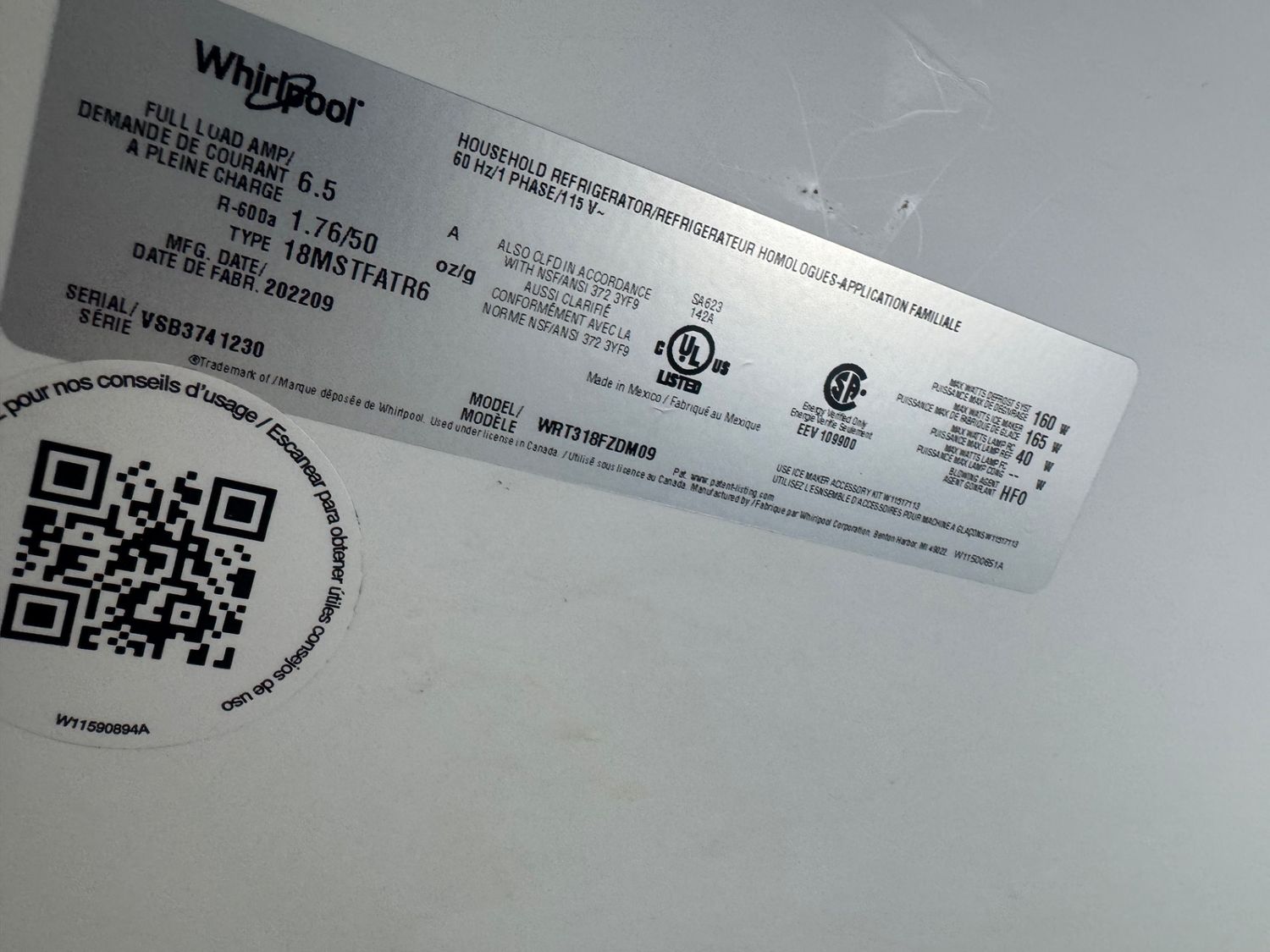
When a refrigerator stops cooling, the evaporator coil often tells you what is wrong before you open a single line — if you know how to read the frost on it. A Whirlpool top-freezer refrigerator (model WRT318FZDM09) in the Carrington community of NW Calgary is a clean example of a visual diagnosis that pointed straight at the sealed system.
The symptom, and the tell
The owner reported the fridge and freezer were both warm — a dual-compartment cooling failure. That symptom alone is ambiguous: it could be a defrost-system fault, a failed evaporator fan, or a problem inside the sealed refrigeration loop. What resolved the ambiguity was the frost itself.
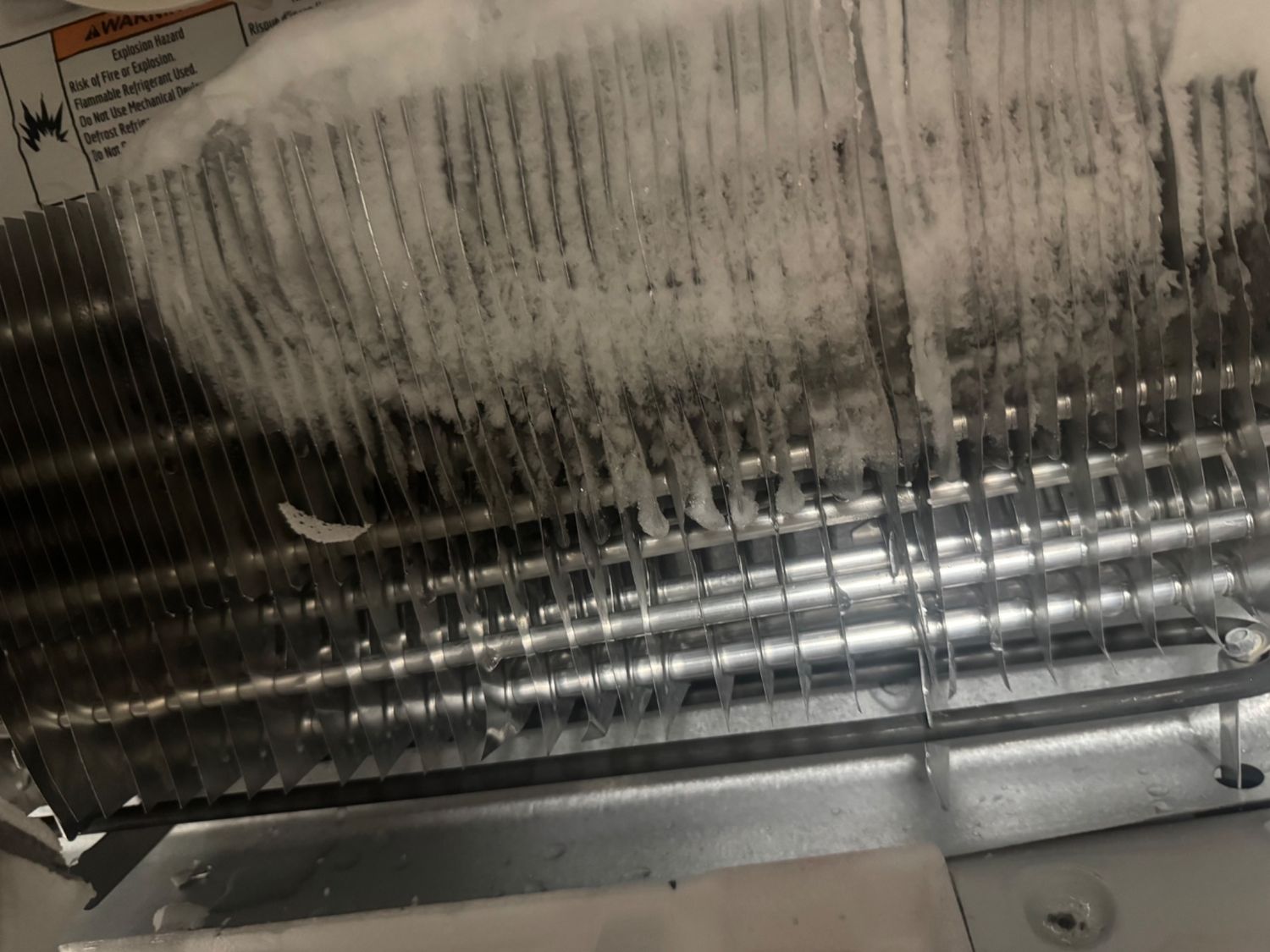
On this coil, ice had built up heavily in one corner while the rest of the coil sat bare and dry. That sharp asymmetry is the tell. In a healthy system, refrigerant boils off evenly along the whole evaporator, so frost — when it forms — spreads fairly uniformly across the coil. When refrigerant flow is restricted, only the first stretch of coil past the restriction gets cold enough to frost, and everything downstream is starved. Heavy ice in one corner with bare tubing beside it is the classic look of a restricted or failing sealed system, not a defrost problem.
That distinction is the diagnostic branch point. A failed defrost heater produces uniform heavy frost across the entire coil, because the system is cooling fine but nothing is melting the accumulation. A door-seal issue would not produce this localized pattern at all. The uneven frost let TechVill technician Randy read the fault category — a sealed-system restriction — from visual inspection, before committing to opening the refrigerant circuit.
The scope, and an honest number
Correcting a restricted sealed system is not a single-part swap. It means replacing the compressor and filter drier, addressing the restriction and any related fittings, then evacuating, recharging, and leak-testing the circuit. That is a substantial, multi-step repair.
Randy laid out the scope and the cost, and the owner made a reasonable economic call: on a mass-market top-freezer refrigerator, a full sealed-system rebuild can run close to the price of a new unit, and they chose to replace rather than repair. This is worth drawing a line under. On a premium built-in — a Sub-Zero, a Miele column — a sealed-system rebuild is routine, because the original investment and the cabinetry integration justify it. On a mass-market unit, replacement economics often win, and pretending otherwise to book the bigger job would not serve the customer.
The diagnostic visit was billed at the standard service call, $177.45 CAD ($169 + 5% GST), and nothing else. The owner paid for an accurate diagnosis that told them exactly where their money was best spent — which, in this case, was not with a repair.
The takeaway
An uneven frost pattern is one of the more reliable visual cues in refrigeration work: localized ice with adjacent bare coil means restricted flow, uniform frost means a defrost fault. Reading it correctly does two things at once — it lands the right diagnosis on the first visit, and it lets the conversation move straight to the honest question of whether this particular unit is worth rebuilding.
Book online to schedule a refrigerator diagnostic with our team.