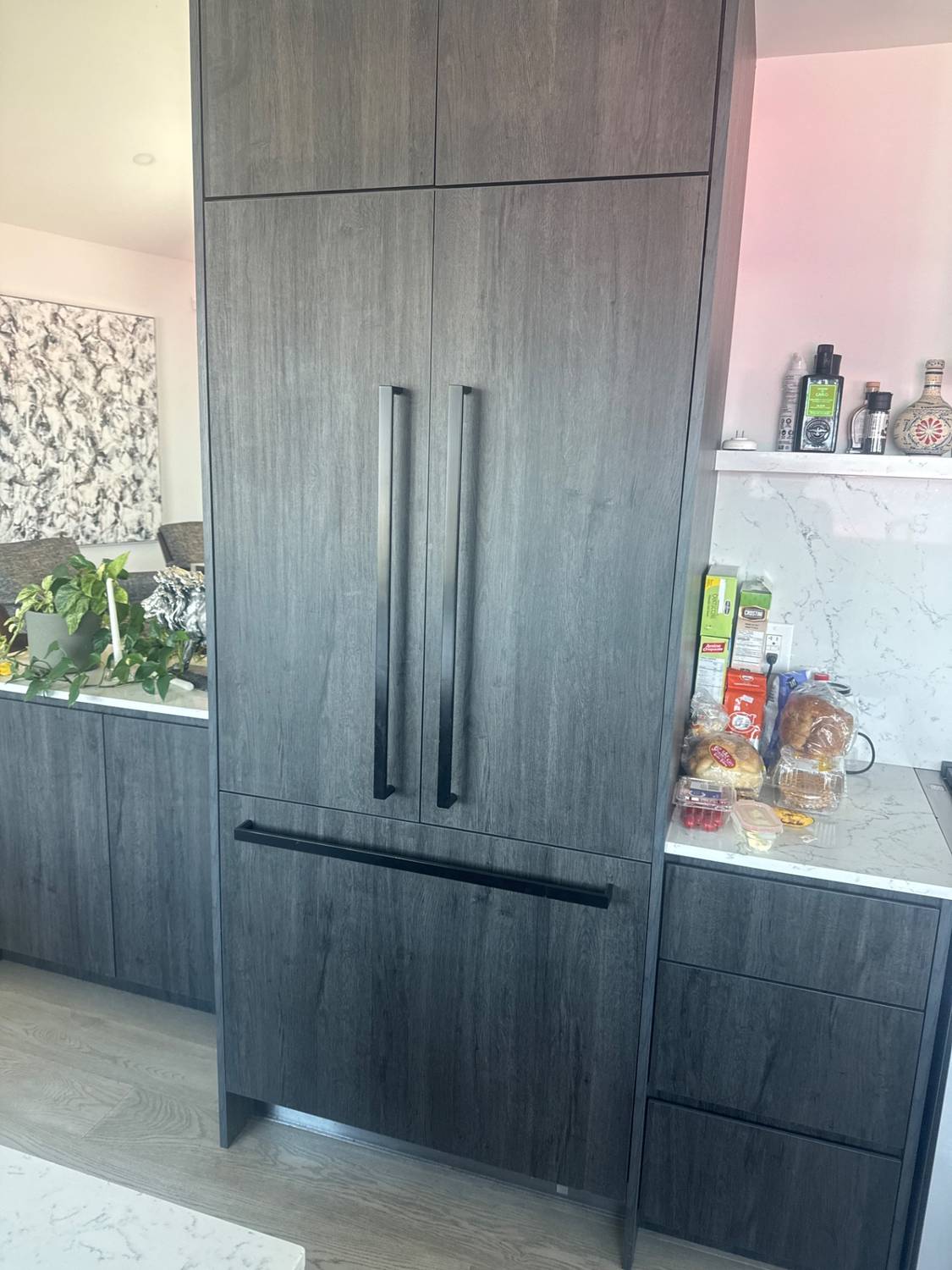


A Surrey homeowner’s Samsung French door refrigerator had stopped cooling in the fresh food compartment. TechVill technician Shahid returned to the property with the parts identified at the diagnostic visit, and rebuilt the unit’s defrost subsystem as a set rather than swapping the one component that had obviously failed.
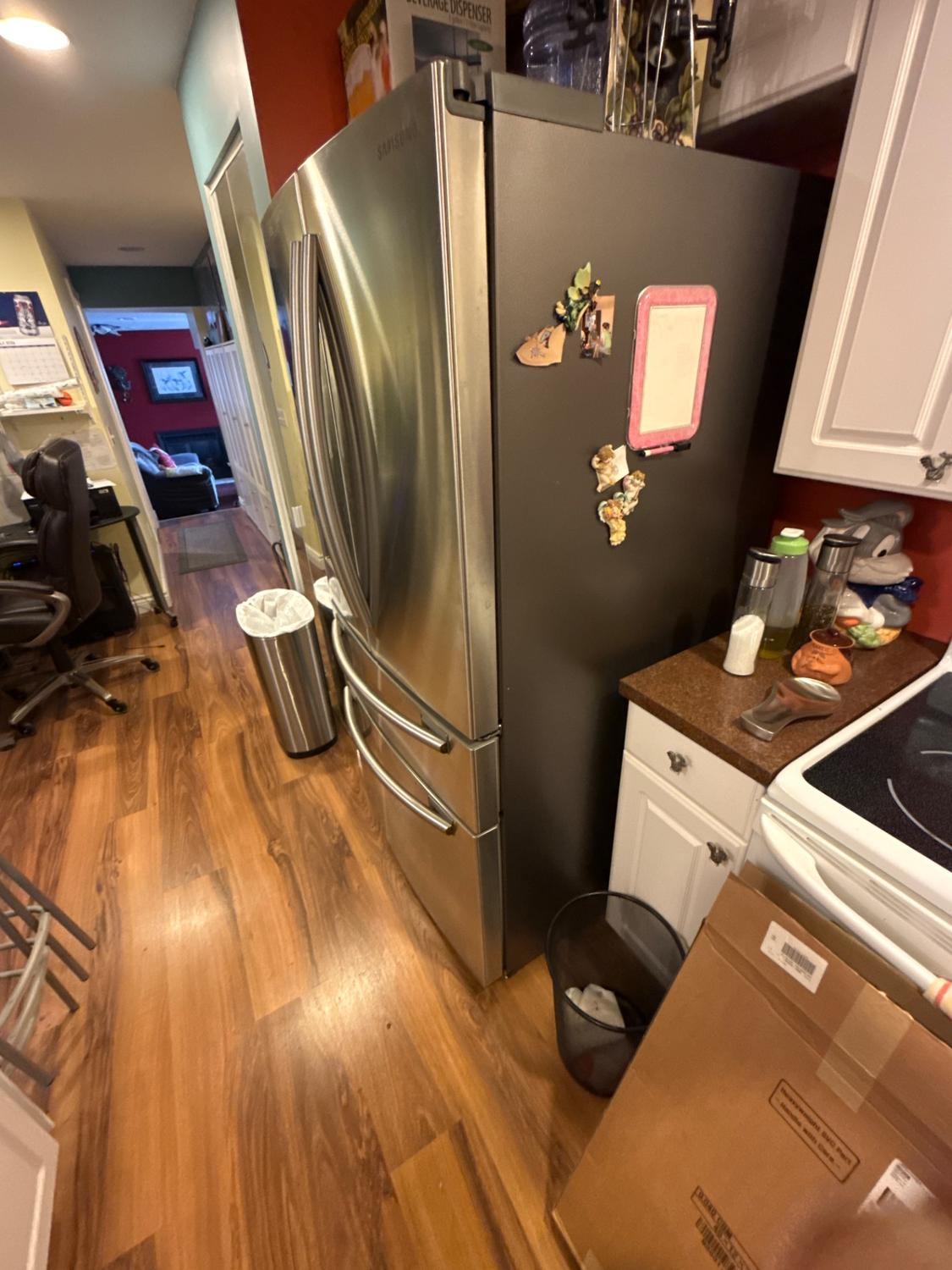
The Problem — A Fresh Food Compartment That Would Not Hold Temperature
“Not cooling” on a French door refrigerator is a symptom with a wide catchment. It can mean a sealed system that has lost charge, a compressor that will not start, a failed evaporator fan, a stuck damper — or a defrost system that has quietly stopped clearing the coil.
The distinction matters because those repairs are separated by an order of magnitude in cost. A sealed-system fault on a unit of this age is often the point where replacement becomes the sensible option. A defrost fault is a component repair with a long service life ahead of it.
The rating plate identifies the unit as an RF25HMEDBSR built in October 2014 — a Twin Cooling Plus French door model with independent airflow to the fresh food and freezer compartments.
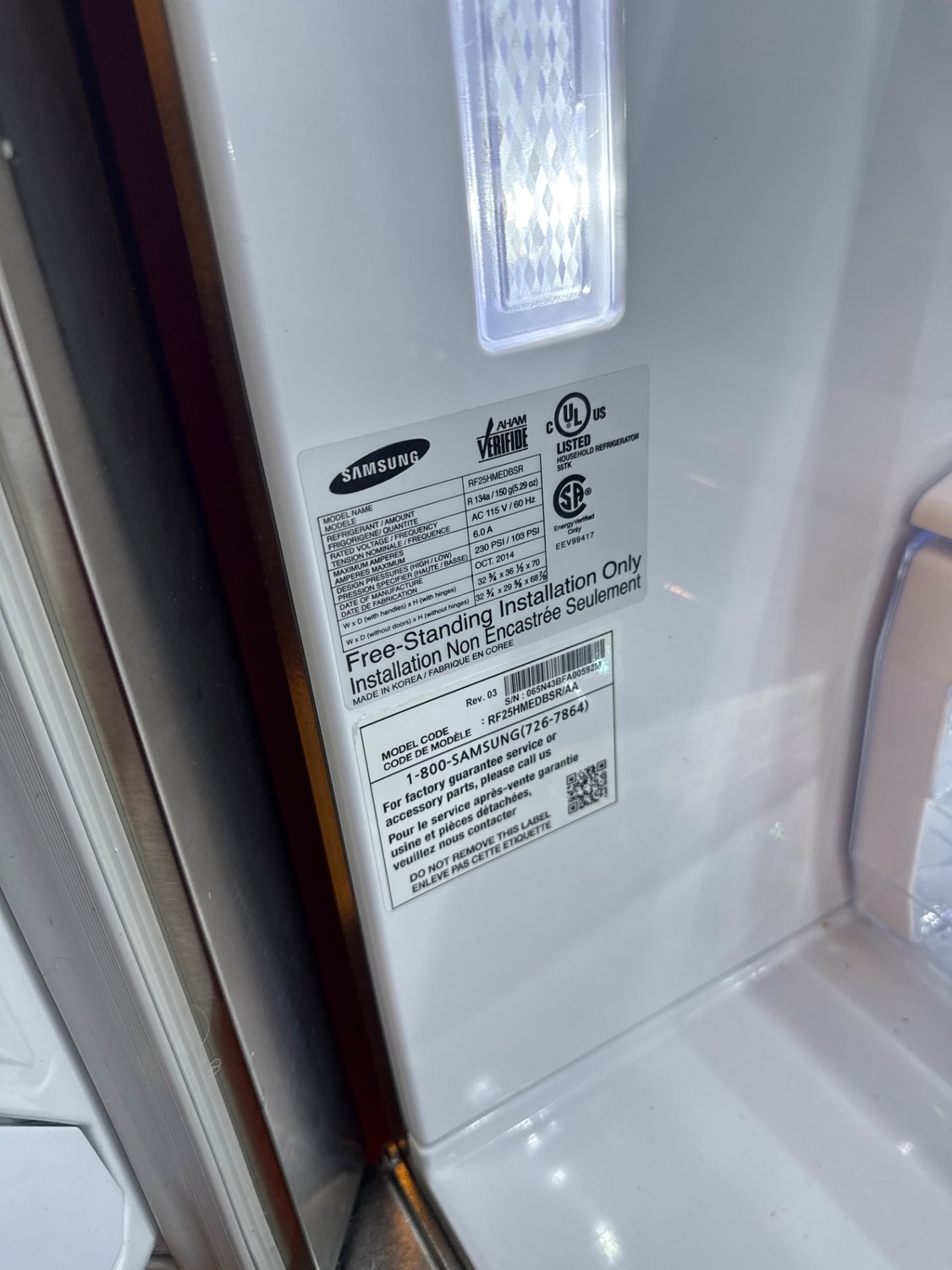
That architecture is worth knowing before opening the machine. On a Twin Cooling unit the two compartments are fed separately, so a fresh food side that fails while the freezer carries on is not an anomaly to explain away — it is the expected presentation when the problem sits in the airflow or defrost path of one compartment rather than in the refrigerant circuit shared beneath them.
Diagnosis — Tracing “Not Cooling” to the Defrost Path
The diagnostic visit established the cause and specified the parts; this article documents the return visit that carried the work out.
The mechanism behind a defrost failure is worth setting out, because it is the reason a refrigerator can be mechanically healthy and still warm.
Air circulating through a refrigerator carries moisture — from food, and from every door opening. That moisture condenses on the evaporator coil, which is the coldest surface in the machine, and freezes there. This is normal and unavoidable. To keep it from accumulating, the appliance runs a defrost cycle on a schedule: a heating element mounted along the coil warms it just enough to melt the accumulated frost, the meltwater drains away, and cooling resumes.
Interrupt that cycle and the frost never leaves. It builds layer on layer between the fins until it becomes a solid block that air cannot pass through. From the outside, nothing dramatic happens — the compressor still runs, the fan still turns, and the compartment simply drifts warm because no cold air can get out of the evaporator housing.
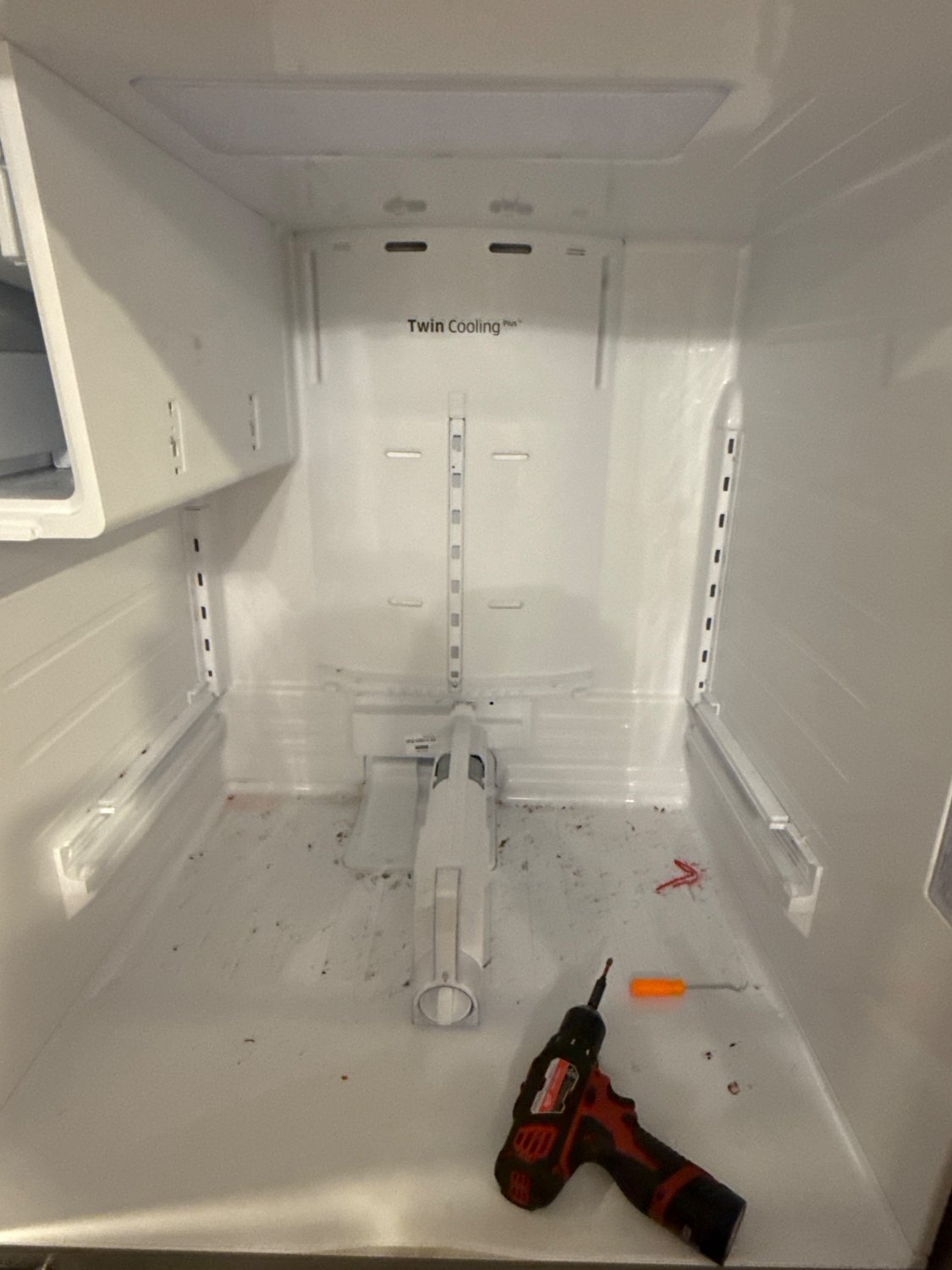
The Repair — Three Components, Replaced Together
Components replaced:
- Defrost bi-metal thermostat (part #DA47-00243K) — the temperature-sensing switch mounted on the evaporator that closes to permit the defrost cycle and opens to terminate it once the coil has cleared
- Heater, metal sheath, AC 120 V (part #DA47-00434A) — the sheathed defrost element that runs along the evaporator and melts accumulated frost off the coil
- Evaporator cover assembly (part #DA97-13757A) — the housing that encloses the evaporator and directs cold air into the compartment, including its ducting and insulation
Why all three rather than the failed one: these parts are not three independent components that happen to sit near each other. They are one subsystem. The thermostat decides when the heater runs and when it stops; the heater does the work; the cover assembly contains the coil, routes the air the coil cools, and channels the meltwater the defrost cycle produces toward the drain.
A failure in any one of them leaves evidence on the other two. Heavy frost accumulation loads and distorts the cover assembly and its ducting. A heater that has been cycling against a marginal thermostat has been thermally stressed. Repeated freeze–thaw at a compromised cover degrades the seals and insulation that make the compartment’s airflow work at all.
Replacing one part and returning the other two to service on a system that has already run out of specification is how a repair becomes a repeat visit. Replacing the subsystem returns the whole defrost path to a known state at once.
The Result — Verified on Site
With the components installed, Shahid ran the unit and tested it through operation. All functions checked out correctly and the job was completed on the visit.
As with any refrigeration repair, internal temperatures take time to stabilize fully after the cabinet has been open and the coil cleared — the compartment normalizes over the following hours rather than instantly.
The work carries a 90-day labour warranty.
What This Case Demonstrates
The economics of an eleven-year-old refrigerator. A unit built in 2014 is well inside a reasonable service life for a French door of this class, provided the repair is the right one. The whole calculation turns on the diagnosis: a defrost subsystem rebuild is a proportionate investment in a machine with years left, while an unnecessary sealed-system repair on the same appliance would spend a substantial share of replacement cost.
Factory authorization on the parts side. TechVill holds factory authorization from Samsung, which means access to manufacturer service data and to genuine Samsung service parts through authorized channels. On a defrost circuit that matters concretely: the bi-metal thermostat’s switching temperature and the heater’s wattage are matched to this evaporator, and both are specified in Samsung’s service documentation rather than guessed at from physical fit.
Why aftermarket substitution is a poor bet here. Defrost components are calibration parts, not generic hardware. A bi-metal thermostat that terminates at the wrong temperature either cuts the cycle short — leaving frost behind to accumulate again — or runs the heater long, wasting energy and warming the compartment on every cycle. A sheathed heater at the wrong wattage does the same thing from the other direction. Both parts will physically install. Neither failure mode announces itself for weeks.
Cost. The repair totalled $871.67 plus GST — $915.25 — covering $397.67 in parts, a $30 parts handling fee and $444 labour, split as a $445.91 prepayment against the parts at the diagnostic visit and $469.35 on completion.
Need Samsung Refrigerator Repair in Surrey?
TechVill is factory-authorized by Samsung for appliance repair across Surrey, Vancouver and the Lower Mainland. Whether a unit needs a diagnostic assessment or a full defrost subsystem rebuild, our technicians arrive with Samsung service data and access to genuine OEM parts.
Book online to schedule a Samsung refrigerator diagnostic with our team.