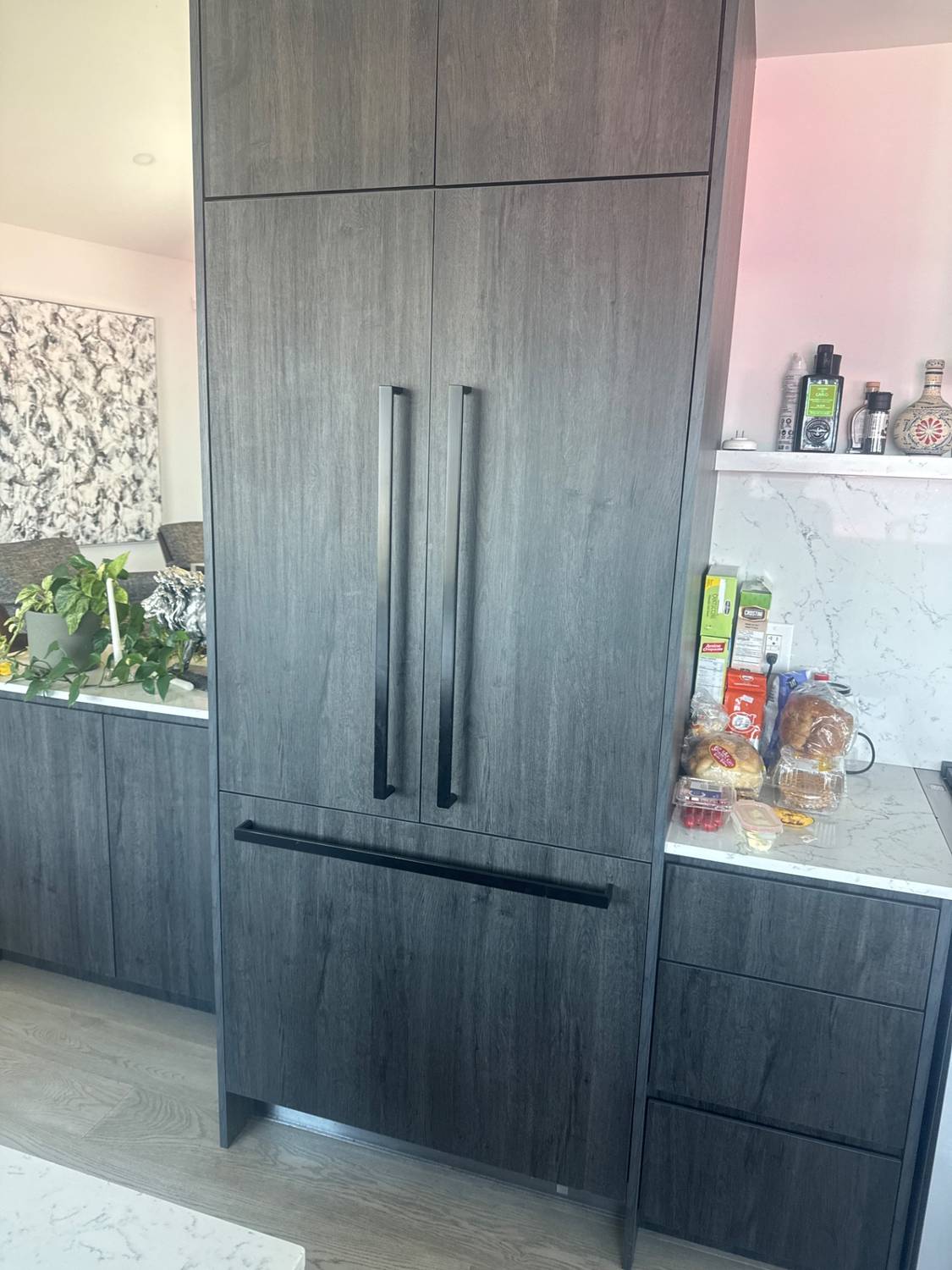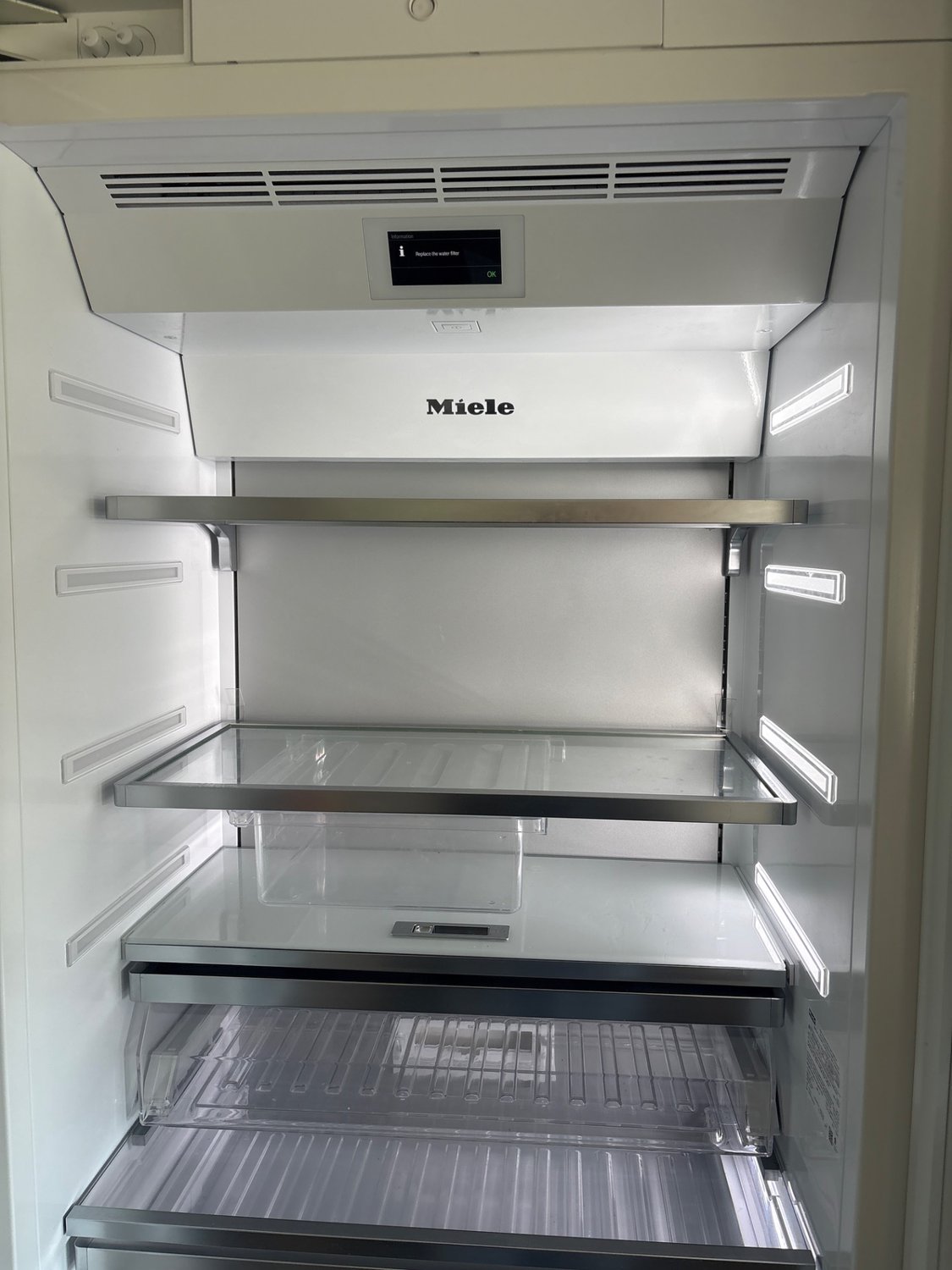


A homeowner in the Rocky Ridge area of far northwest Calgary described the fault with an unusually precise starting point: “After a 3hr power surge on Friday freezer is no longer working, it is not cold although fridge is still cold.”
A known trigger event, and an asymmetric result. TechVill technician Randy diagnosed the failure to the inverter board — and cleared the compressor of any part in it with a single measurement.
The Problem — Half a Premium Built-In Went Down
The unit is a Thermador T36BT820NS/11, a 36-inch built-in refrigerator freezer installed flush with the surrounding cabinetry. Appliances in this class are specified into a kitchen rather than delivered to one; the door panels, the trim and the cabinet opening are all built around the machine. Replacing one is not a matter of rolling in a new box.
The asymmetry in the symptom is the interesting part. When a refrigerator loses cooling in one compartment but holds it in the other, that pattern immediately narrows what can be wrong — provided you know how the machine is built.
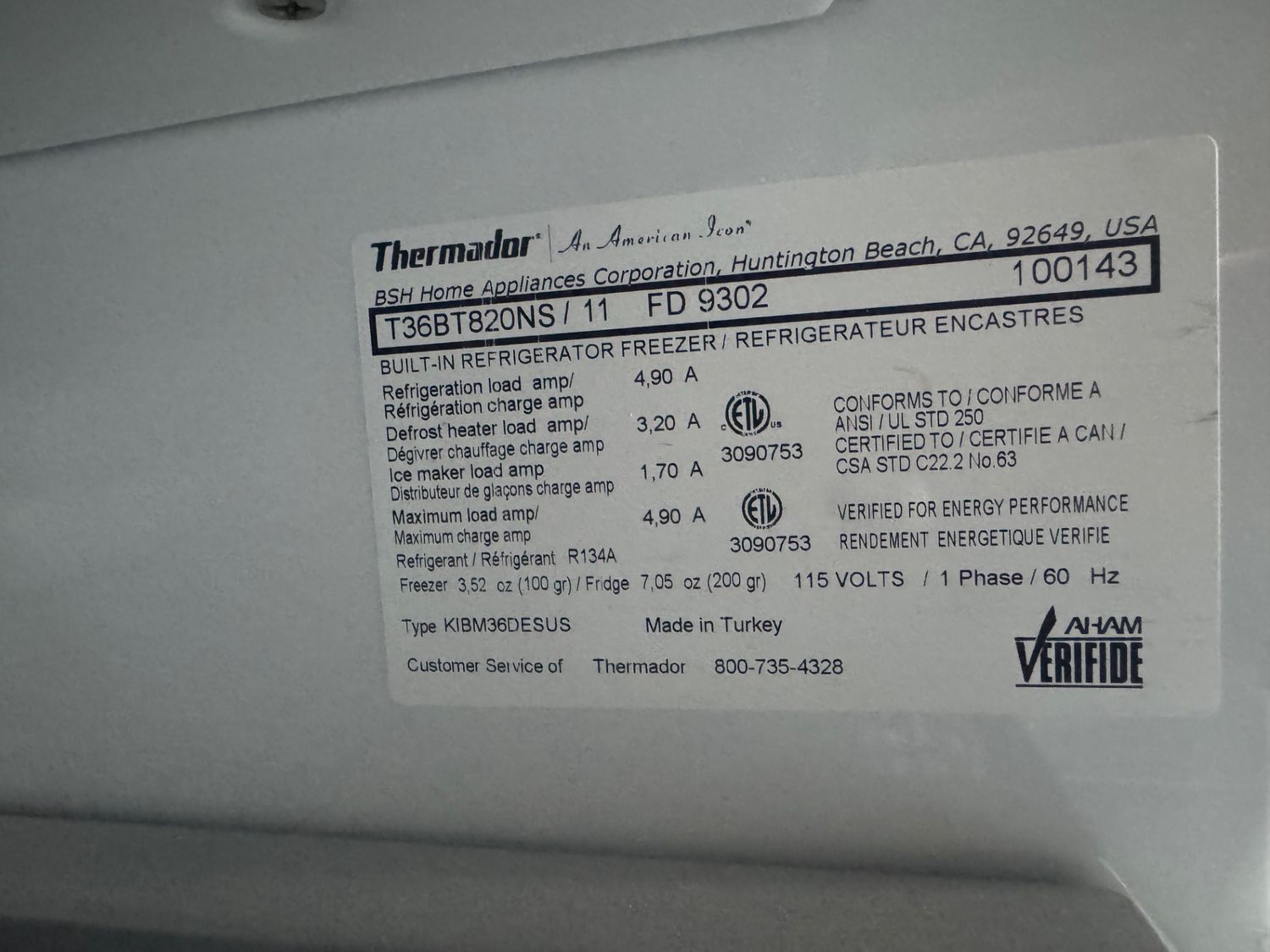
This model’s own rating plate settles that question. It lists two separate R134a charges — 100 g on the freezer side and 200 g on the fridge side. Those are not two labels for one circuit. They are two independent sealed systems, each with its own compressor, sharing one cabinet and one machine compartment.
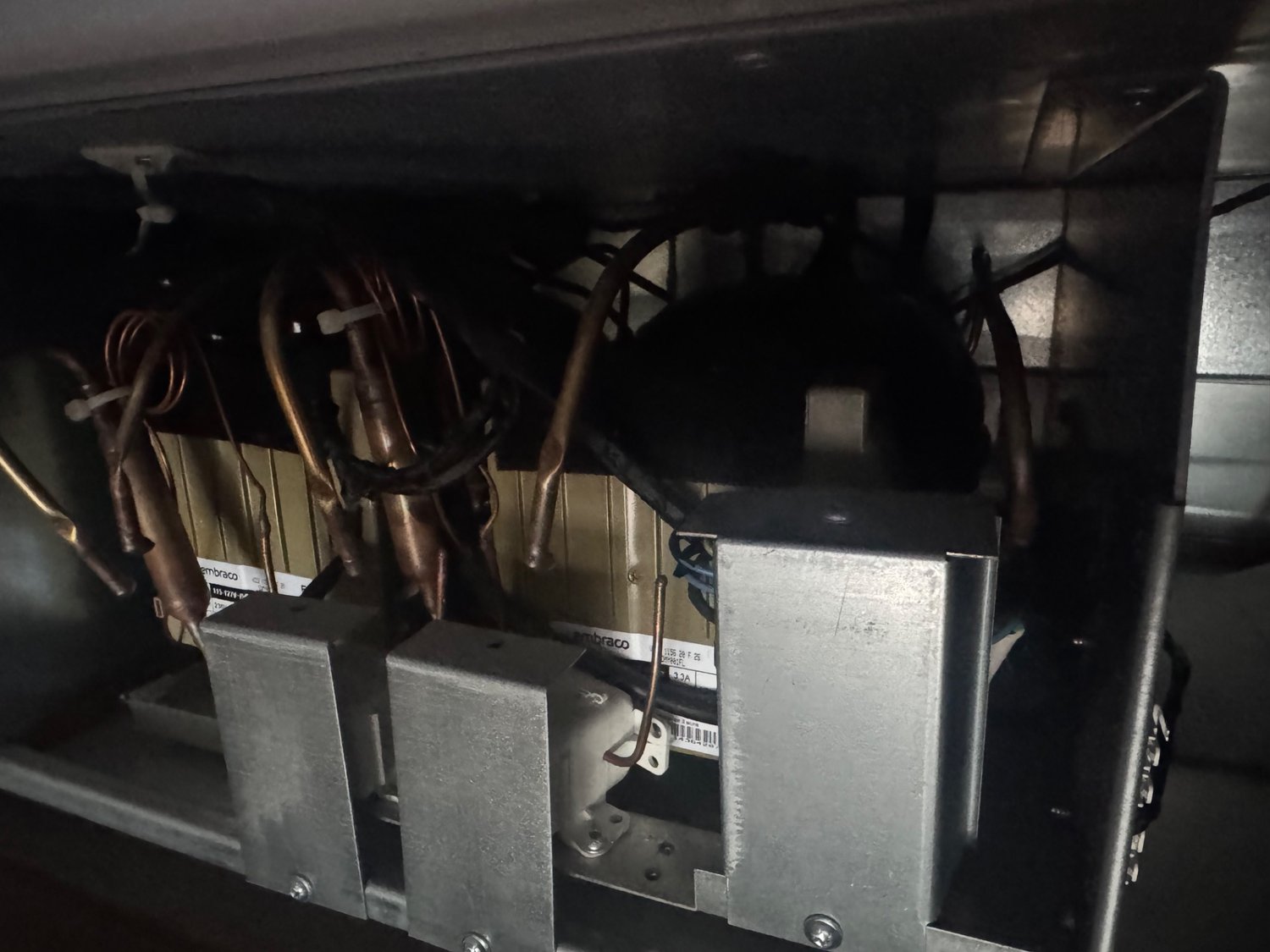
So a fridge side that is still holding temperature does not tell you the freezer side is nearly fine. It tells you one of two parallel systems has stopped, and the other has not — which is precisely the shape of a fault confined to one circuit’s compressor, or to whatever drives it.
Diagnosis — Confirm the Compressor Is Idle, Then Find Out Why
Randy’s first confirmation was straightforward: the freezer was warm because its compressor was not running.
That is where a great many diagnoses stop, and where the expensive mistake gets made. A compressor that will not run is very often assumed to be a failed compressor, and on a premium built-in that assumption writes a quote in the thousands — sealed system access, a new compressor, filter drier, evacuation and recharge, and most of a day on site.
Before going anywhere near that conclusion, Randy consulted Thermador’s technical support line for the model, then went back to the unit and measured the compressor windings directly.
The reading was 16.4 ohms.
That number is the entire case. A compressor motor is a wound electrical machine, and its windings have a characteristic resistance. Read open, and the winding is broken. Read near zero, and it is shorted. Read a normal value in the low tens of ohms, and the motor is electrically intact — it is capable of running and simply is not being told to, or is not being supplied with what it needs to.
16.4 ohms is a healthy reading. The compressor was not the failure.
What was left was the component between the control logic and the motor: the inverter board. On a variable-speed compressor the inverter board takes incoming power and synthesizes the drive waveform that spins the motor at a commanded speed. It is a power-electronics assembly — transistors, switching circuitry, control logic. With it dead, a perfectly healthy compressor sits still, because nothing is driving it.
Why a Surge Produces Exactly This Failure
The homeowner’s timeline fits the diagnosis without any strain.
Power disturbances do not damage every component equally. A motor winding is a heavy coil of magnet wire with substantial thermal mass and considerable tolerance for a transient. The switching semiconductors on an inverter board are neither of those things — they are voltage-rated devices with narrow margins, and they are the parts that fail first when the supply misbehaves for three hours.
That the surge killed the board and left the motor untouched is not a coincidence. It is the expected outcome, and it is the reason the resistance check was worth doing before quoting anything.
It also carries a caution worth passing on. A surge event does not always announce itself with an appliance that stops immediately. Damage to control electronics can present as an intermittent fault, a delayed failure, or — as here — one half of a dual-system appliance quietly giving up while the other half carries on normally.
The Repair — One Board, on Order
Component required:
- Inverter board (part #00650436) — the power-electronics assembly that converts incoming supply into the drive waveform for the freezer-side compressor motor
The part is sourced through BSH Group’s OEM service channel. The 00-prefix numbering is the shared service-parts convention across the BSH brands, which is a useful signal in itself: it confirms the part is a genuine Thermador service component rather than a look-alike.
At the install visit the board goes in, the freezer-side compressor is tested for restored operation, and the compartment is confirmed back to normal temperature. There is no sealed-system work in the scope, no refrigerant handling, and no reason for either — the refrigerant circuit was never opened and never failed.
The diagnostic visit ran an hour, covering the manufacturer consultation and the electrical testing.
The Result — What the Measurement Saved
The quoted repair is $837 plus GST, or $878.85: $417 for the board, a $30 parts handling fee, and $390 labour. The diagnostic visit was billed at the premium service call rate, $271.95 including GST, paid on the day.
Set that against the repair that a compressor assumption would have produced on a built-in of this class, and the value of one meter reading becomes concrete. The gap between the two quotes is not a rounding difference — it is the difference between replacing a $417 electronic assembly and opening a sealed system to replace a compressor that measured perfectly healthy.
What This Case Demonstrates
A built-in refrigerator is bought once and lived with for a long time. The cabinetry is cut for it, the panels are matched to it, and swapping the unit means work far beyond the appliance itself. That economics only holds up if the diagnosis is accurate — an unnecessary sealed-system repair on a healthy circuit spends a large fraction of replacement cost and fixes nothing.
Consulting the manufacturer’s technical support on a premium unit is part of that accuracy, not an admission of uncertainty. Model-specific service data is where the expected values, the known failure modes and the correct test procedures live, and the boards inside a machine like this are not interchangeable with anything.
The same applies to the part itself. An inverter board is matched to a specific compressor and a specific control strategy; the drive waveform it produces is not generic. A substitute that physically fits and electrically approximates is a compressor failure waiting to happen on a system whose compressor has just been measured healthy.
Need Thermador Refrigerator Repair in Calgary?
TechVill repairs built-in and premium refrigeration across Calgary and surrounding areas, from a single control board to full sealed-system work. Our technicians arrive with the test equipment to measure a circuit rather than guess at it, and with access to genuine OEM parts through authorized supplier networks.
Book online to schedule a Thermador refrigerator diagnostic with our team.