

When a gas burner starts behaving strangely shortly after the cooktop was last cleaned, the cause is often not a failed component at all. It is a burner cap sitting in the wrong position. Here is a Calgary example where one cap swap explained two symptoms that sounded completely unrelated — and one of which sounded dangerous.
Two symptoms, one call
A homeowner in far-west Calgary described the problem this way: “When you light the back burner, the front is releasing gas.” Alongside that, the left front burner was running with a flame that could not be turned down, burning orange rather than blue.
Those read as two separate faults. Gas escaping from an unlit burner suggests a valve or a line. An uncontrollable orange flame suggests an air-shutter or orifice problem. Neither is something to leave alone — orange on a natural gas burner means incomplete combustion, and a properly tuned flame burns blue.
Step one: rule out the leak, directly
TechVill technician Randy started with the safety question rather than the convenience one. He tested the burner nozzle for leakage and found none. The gas delivery system was intact.
That is the negative result the whole diagnosis turns on. It means the sensation the customer described as “releasing gas” was not gas escaping from a defective valve — it was unburnt fuel and disturbed combustion at a burner that was not mixing air and gas correctly.
Step two: the caps were in each other’s places
The burner caps for the right front and left front positions had been exchanged.
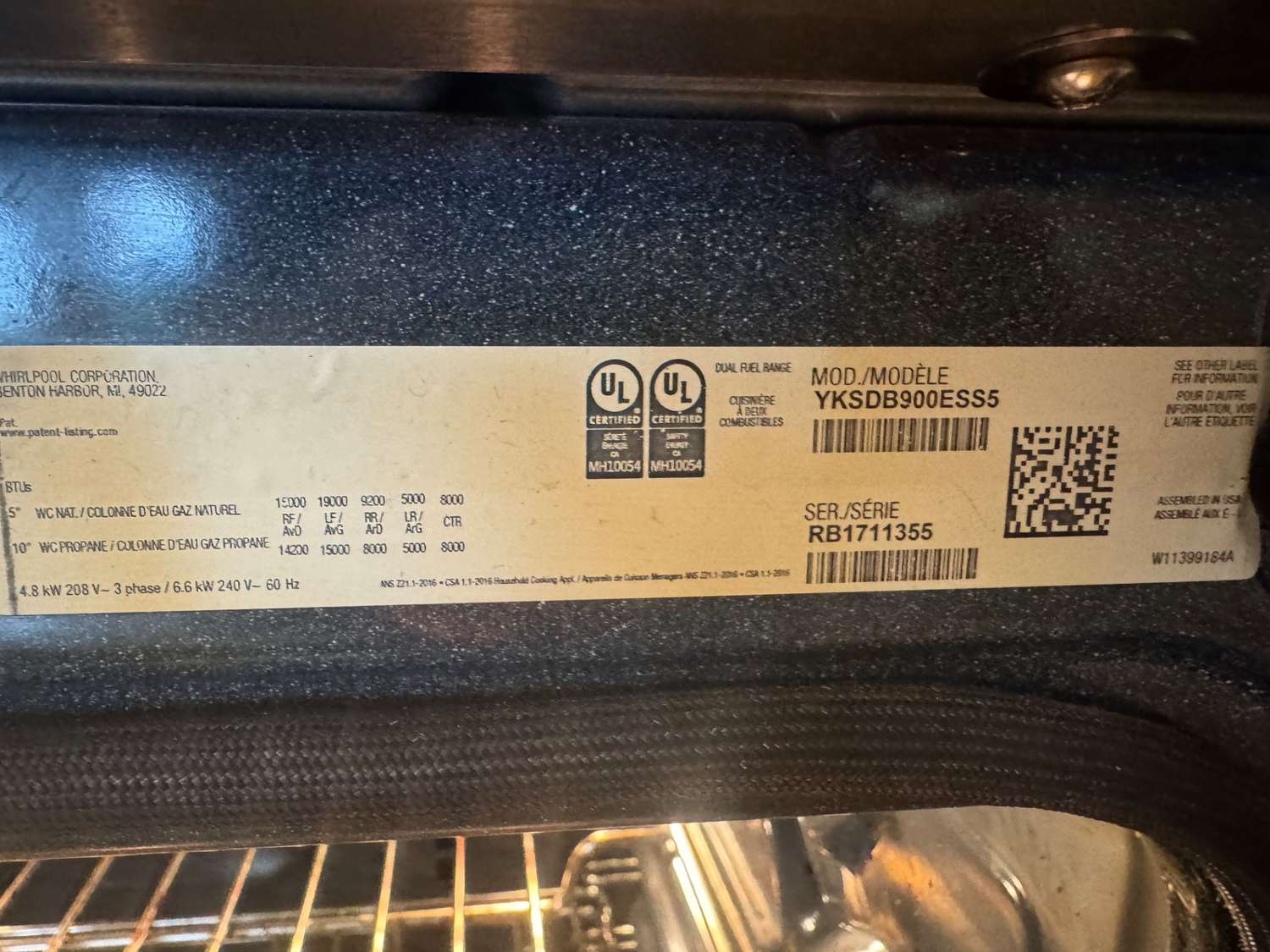
This matters because burner caps are not generic lids. On this KitchenAid YKSDB900ESS5 dual-fuel range, the rating plate lists a different natural-gas output for every position on the cooktop — 15,000 BTU at the right front, 19,000 at the left front, 9,200 at the right rear, 5,000 at the left rear and 8,000 at the centre. Each cap is machined with port sizing matched to the burner head underneath it.
Put a cap sized for a 15,000 BTU head onto a 19,000 BTU head and the geometry that controls the air-to-gas ratio no longer matches the burner it sits on. The flame runs rich and yellow-orange, does not respond properly to the valve, and pushes fuel through the port pattern in a way that a cook standing at the range reads as gas escaping. Both of the homeowner’s symptoms come out of that single mismatch.
The fix: no parts at all
Randy returned each cap to its correct position and ran all the burners. Every one lit and held a clean blue flame across its range, and the valve control on the left front behaved normally again.
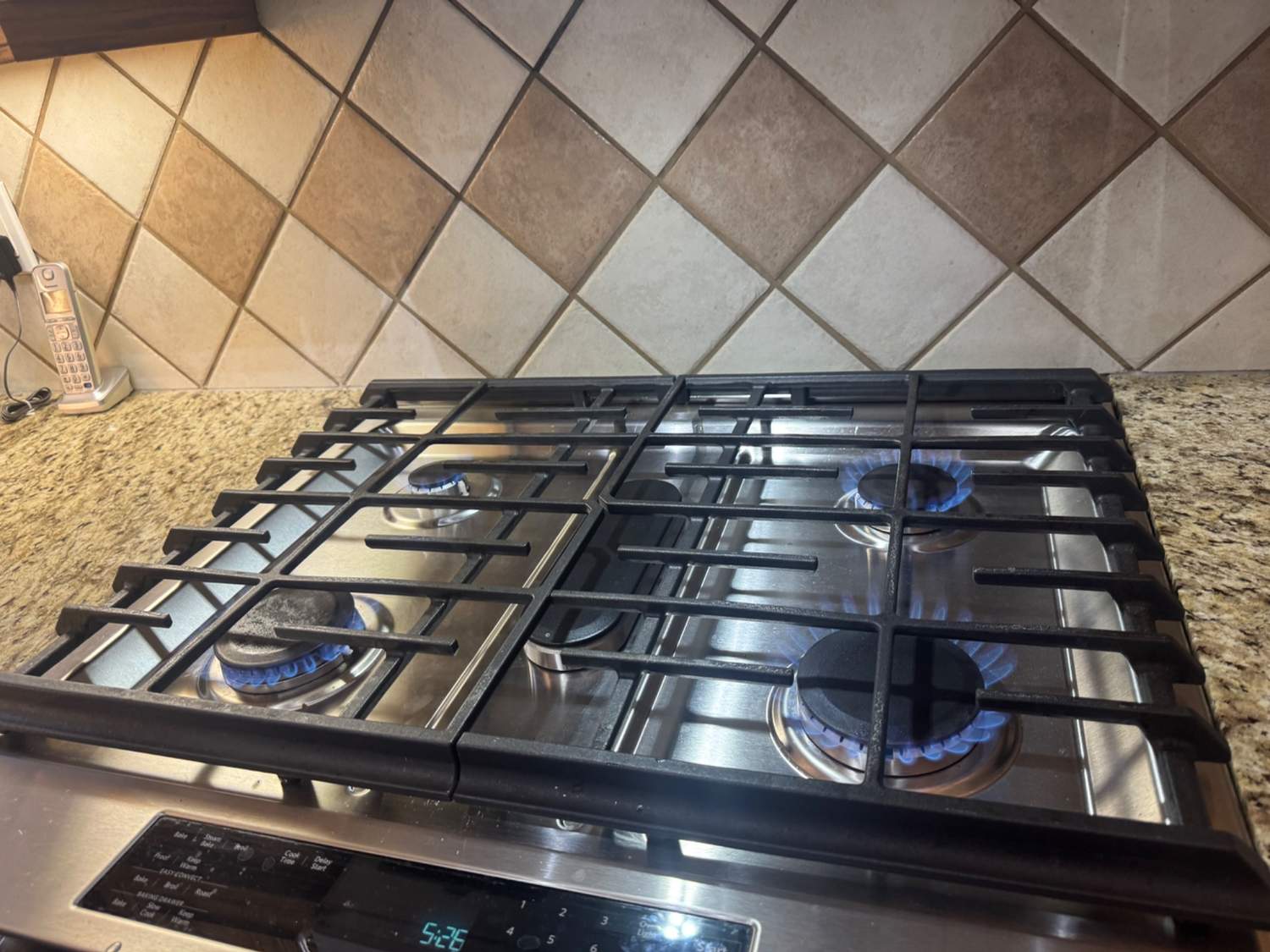
No parts were replaced. Nothing on the range was defective. The visit ran 25 minutes and was billed as the standard service call — $177.45 including GST, with no parts and no additional labour charged, because none was warranted.
Since this was a corrective adjustment rather than a component replacement, no parts or labour warranty attaches to the work. There was no failure to warranty.
The takeaway for anyone with a gas cooktop
Burner caps come off for cleaning and they all look broadly similar sitting on a counter. On a range where the burners run anywhere from 5,000 to 19,000 BTU, “broadly similar” is not close enough. If a burner starts flaring orange, refuses to simmer, or smells wrong after a deep clean, check the caps before assuming a failure:
- Caps and heads are matched per position; most manufacturers mark them or size them visibly differently.
- An orange flame is a combustion symptom, not automatically a gas-supply symptom.
- A genuine gas smell still warrants a proper leak test — which is exactly why that test came first here, before anything else was concluded.
That said, anything that presents as a gas leak deserves a technician with a leak-test procedure rather than a guess. The value of this visit was not the cap swap, which took seconds. It was confirming, by direct test, that there was no leak to worry about — and then finding the real reason the burner was misbehaving.
Book online to schedule a KitchenAid range diagnostic with our team.