(855) 397-7233
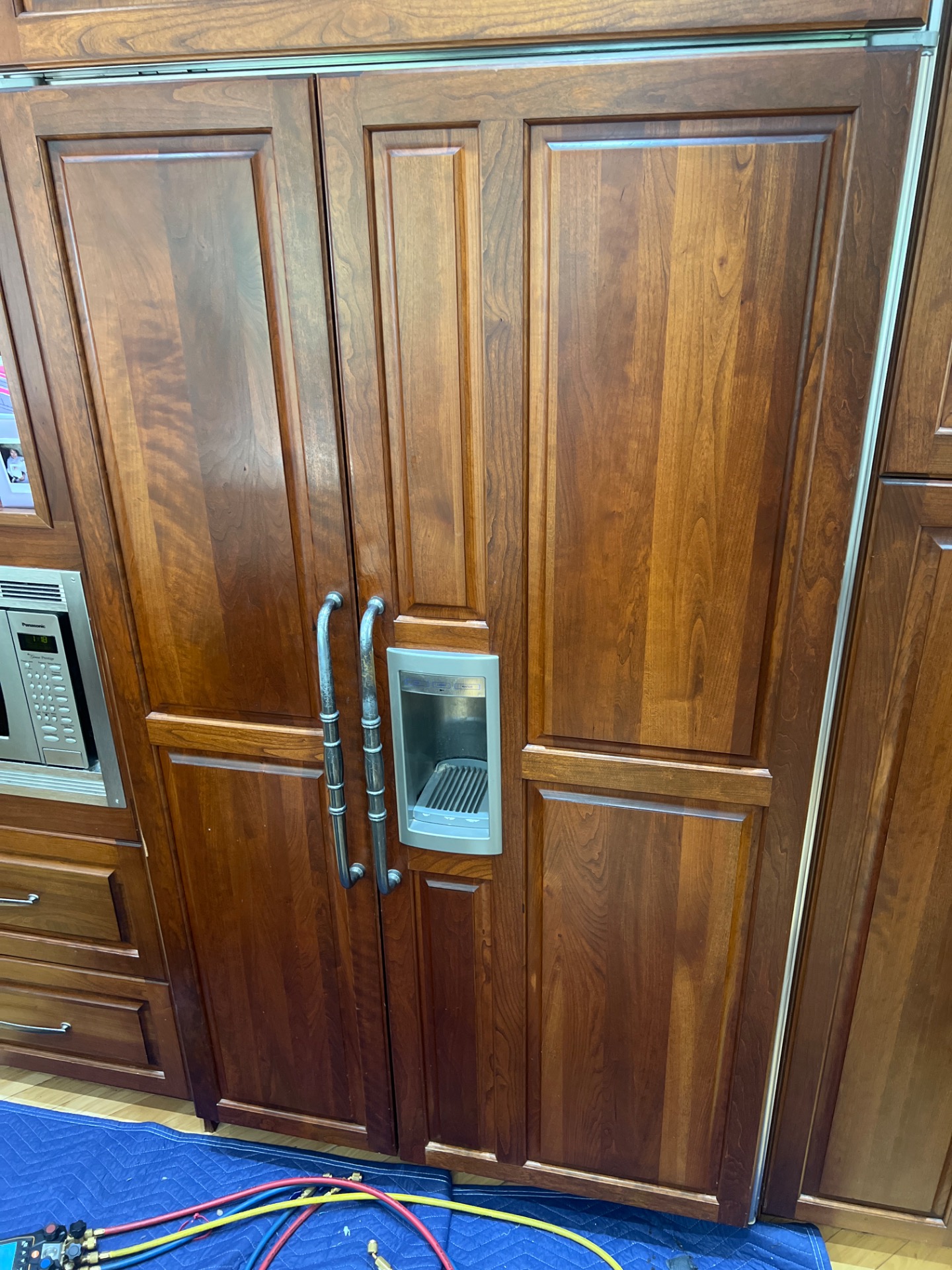
Two Sub-Zero 600-series classic built-in side-by-side refrigerators, two different model numbers, two different SW Calgary homes, two service visits months apart — and the same two parts on the order list for both rebuilds. The defrost terminator and the temperature thermistors. Same OEM service part numbers, both times. That is not coincidence, and it is worth being explicit about why.
This case is one of those two repairs. A homeowner in the Coach Hill community contacted TechVill for fridge repair in Calgary because their Sub-Zero 685/02 was running continuously and only shutting off when the freezer door was opened. The diagnosis ran into a multi-component cascade failure across the sealed system and the control electronics — and once again, the OEM parts list included the same defrost terminator and the same thermistors that had appeared on a different 600-series rebuild in Evergreen earlier in the portfolio. That pattern is the part of this case worth explaining.
What the symptom said
The customer reported it precisely: the fridge runs continuously, and only shuts off when the freezer door is opened. Two diagnostic clues hide in that one sentence, and reading them together is what told TechVill technician Leonid where to look.
The continuous-run portion tells you the unit is not reaching its temperature setpoint. Either it is losing cold faster than it can produce it — which usually means a sealed-system fault — or it is mis-reading its own temperature feedback, in which case the control logic is calling for cold the unit does not actually need.
The “stops when freezer door is open” portion is the unit’s built-in safety interlock kicking in. Most Sub-Zero side-by-side designs of this generation include door-open logic that interrupts compressor operation when a door is held open for an extended period, to prevent the compressor from running indefinitely in a “lost cooling” state. On a healthy unit you never notice that interlock, because the compressor would never be commanded to run continuously in the first place.
Read together, the two clues describe a unit whose control board is commanding the compressor to run continuously, and whose only safety net against that runaway behaviour is a door-open interlock that the homeowner happened to trigger while putting groceries away. The control board is calling for cold it should not be calling for. The thermistors are reporting temperature data the board is acting on. And somewhere downstream, a compressor is being asked to deliver cooling capacity that the rest of the sealed system cannot actually sustain.
What the diagnostic found
Leonid worked through the failure systematically and identified five components requiring replacement together. The chain mattered as much as the individual parts:
- Thermistors — the temperature sensors that feed the control board the cabinet temperature data it uses to make every cooling decision. Failed thermistors do not report the unit’s actual temperature; they report what they have degraded to read. The board acts on the false reading and calls for cooling that may or may not actually be needed.
- Control board — the unit’s brain, commanding compressor cycle, defrost cycle, and door interlocks. With bad thermistor input feeding it, the board’s logic itself can run correctly while still producing the wrong outputs. On this unit, the board had also developed faults of its own.
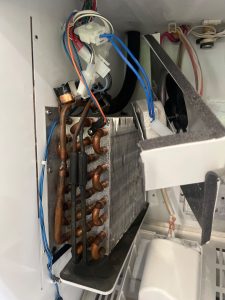
- Defrost terminator — the thermal control that ends the defrost cycle correctly when the evaporator coil has warmed enough. A failed defrost terminator means the defrost cycle does not terminate on schedule, throwing the entire cooling rhythm of the unit out of sync.
- Freezer-side compressor — at the end of its mechanical life under the accumulated load stress of running on bad thermistor data and an incomplete defrost cycle.
- Switch — a door-related switch component, part of the interlock chain that was the only thing breaking the runaway-cooling logic in the customer’s symptom.
Replacing only the compressor would have left a new compressor running continuously, because the thermistor data feeding the board was still bad. Replacing only the thermistors would have left the unit unable to cool at all, because the compressor and the defrost terminator were on borrowed time. The system-wide failure called for the system-wide rebuild, and that is what got scoped.
The two parts that keep coming up
The Sub-Zero parts list on this rebuild included a defrost terminator (part #7006594) and thermistors (part #4204150). Both of those exact OEM service parts also appeared on an earlier portfolio case — a Sub-Zero 695/S3 in the Evergreen neighbourhood across SW Calgary. Different model number, different home, different street, different service visit. Same two parts.
That is the pattern worth being explicit about. The Sub-Zero 600-series classic built-in side-by-side line spans several model numbers — the 685 and 695 are two of them, both from the same engineering generation. The units share core sealed-system architecture and control-electronics topology, and they share where their stress points sit. The defrost terminator on this generation operates in a thermal cycle that wears it predictably; the thermistors sit in temperature environments that degrade their accuracy gradually over years of use. When a 600-series unit reaches the age where one of these starts to fail, the other tends to be next in the same population.
For TechVill, that turns into a specific inventory positioning decision. The defrost terminator 7006594 and the thermistor 4204150 are not parts that get ordered fresh each time a 600-series Sub-Zero call comes in. They are parts that get kept on hand — same operational pattern as the Viking inverter board the team stocks for VCSB and VCBB refrigeration, the Wolf relay boards stocked for NW Calgary oven service, and the Wolf oven thermostat stocked for fast-turnaround gas-range safety calls. Recurring failure points get recurring inventory positioning, and the result is a faster install visit when the next 600-series Sub-Zero customer calls.
That stocking decision is not visible from the outside. From the customer’s side, it just looks like the parts were available, the install happened sooner than the manufacturer’s service-channel lead time would have predicted, and the repair held. From TechVill’s side, it is a specific inventory practice anchored in documented recurring failure patterns across the portfolio.
The rebuild itself
Components replaced:
- Sub-Zero freezer-side compressor (part #4202280, EMI60HER) — drives the cooling cycle on the freezer side of the side-by-side architecture; the failed unit had reached end-of-life under accumulated load stress
- Sub-Zero defrost terminator (part #7006594) — ends the defrost cycle on the evaporator when correct temperature is reached; recurring stress point on this generation, also documented in Evergreen
- Sub-Zero thermistors (part #4204150) — feed cabinet temperature data to the control board; recurring stress point on this generation, also documented in Evergreen
- Sub-Zero control board (part #4204280) — receives sensor input and commands the compressor, defrost cycle, and door interlocks; the failed unit was producing incorrect command outputs
- Sub-Zero switch (part #7014646) — door-related switch component, part of the interlock chain that was the only thing breaking the runaway-cooling logic during the customer’s symptom
Sealed-system procedure performed:
After component installation, the sealed system was pressure-tested to confirm no leaks at the new connections. A deep vacuum was performed to remove air, moisture, and non-condensables from the refrigerant loop. The system was charged with the correct refrigerant to Sub-Zero specifications. Post-repair testing confirmed the unit started cooling on schedule, all subsystems were operating as expected, and the symptom was absent on cycle verification.
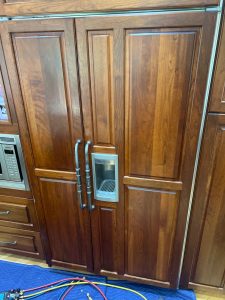
The visit ran 240 minutes on site, consistent with the scope of multi-component installation plus the pressure test, vacuum, and recharge verification.
What the customer paid, and one honest cost adjustment
The total quoted: $2,759.40 CAD ($2,628 + 5% GST). Itemized:
- Parts (compressor + defrost terminator + thermistors + control board + switch): $1,368
- Parts handling: $30
- Refrigerant (Freon): $250
- Labour: $980 (reflecting the 4-hour scope)
One detail in the work order is worth being explicit about: the OEM compressor came in $176 more expensive than the original quote had anticipated, and the customer was informed of the increase and authorized it before the part was ordered. That is the right way to handle quote-vs-actual cost variation: transparent disclosure, customer approval, paper trail in the work order. The note reads “compressor more expensive by $176, Cm agreed.”
The service call was collected on the diagnostic visit ($259, billed separately). Parts prepayment of $1,368 was collected after the customer approved the quote, before the order went to the Sub-Zero service channel. Payment recorded at completion was $1,507.80 CAD, covering the remaining labour, refrigerant, and tax balance.
What this case demonstrates
Reading a symptom carefully is the first piece of the diagnostic work. “Runs continuously, stops when the door is open” is not a vague complaint — it is two specific clues that together tell you the control logic is calling for cold the unit cannot deliver, and the only safety net is the interlock. Anchoring the diagnosis in that read avoids the cheap mistake of replacing the compressor and discovering the symptom is still there.
System-wide diagnosis on cascade failures is the right scope on this generation of premium built-in refrigeration. The Sub-Zero 600-series classic line was engineered for a service life well past 20 years, and the rebuilds it needs along the way address the system as a system. Replacing one part at a time on a unit with five failed or failing components means five service visits, not one — and the customer pays for the labour on every one of them.
Recurring brand-pattern part documentation is a piece of operational expertise that pays off on response time. When TechVill knows from prior cases that the 7006594 defrost terminator and the 4204150 thermistors are stress points on Sub-Zero 600-series rebuilds, the parts get stocked. When they are stocked, the next 600-series customer does not wait for a multi-week manufacturer’s service-channel shipment. The Coach Hill repair benefited directly from that documented pattern.
Honest cost adjustment in writing is the right discipline on quote variations. The compressor surcharge of $176 was disclosed, authorized, and recorded — not absorbed silently into the labour line or sprung on the customer at completion. Same proactive-communication standard documented across the portfolio’s other Leonid-led cases.
Coach Hill sits in the T3H postal corridor — the most documented postal code zone in TechVill’s portfolio now, with four distinct SW Calgary communities represented across both premium-built-in and mass-market repair work. The case extends an inner-SW corridor that already includes Mayfair, Upper Mount Royal, and Britannia on the premium side and Signal Hill on the mass-market side. Sub-Zero 600-series rebuild capability across multiple T3H homes is now anchored capability rather than a one-off claim.
Need Sub-Zero Service in Calgary?
TechVill services Sub-Zero refrigeration across Calgary and surrounding areas, with documented experience on the 600-series classic built-in, the current BI-line built-in, and dual-compressor 700-series architectures. Our technicians arrive with the Sub-Zero parts-catalogue access, the recurring-pattern parts stocked for fast install on common 600-series rebuilds, and the sealed-system service equipment for full system overhauls.