

When an electronic range stops responding to its own buttons, the appliance has usually already told the technician what is wrong. The story is in the stored error codes — and on a range with two interacting electronic faults, the lesson is that reading the codes is only half the work. Interpreting them together, and recognizing what each code does to the other, is what turns a hopeful single-part swap into a repair that actually holds.
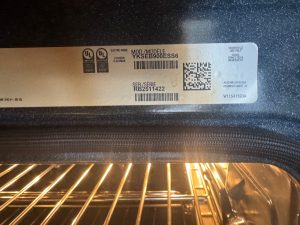
A homeowner in the Beddington Heights community of north Calgary contacted TechVill because the buttons on their KitchenAid YKSEB900 electric slide-in double-oven range had stopped responding. The control interface was no longer accepting input, which on a fully electronic range means the appliance is effectively unusable — no temperature setting, no mode selection, no way to start a cycle.
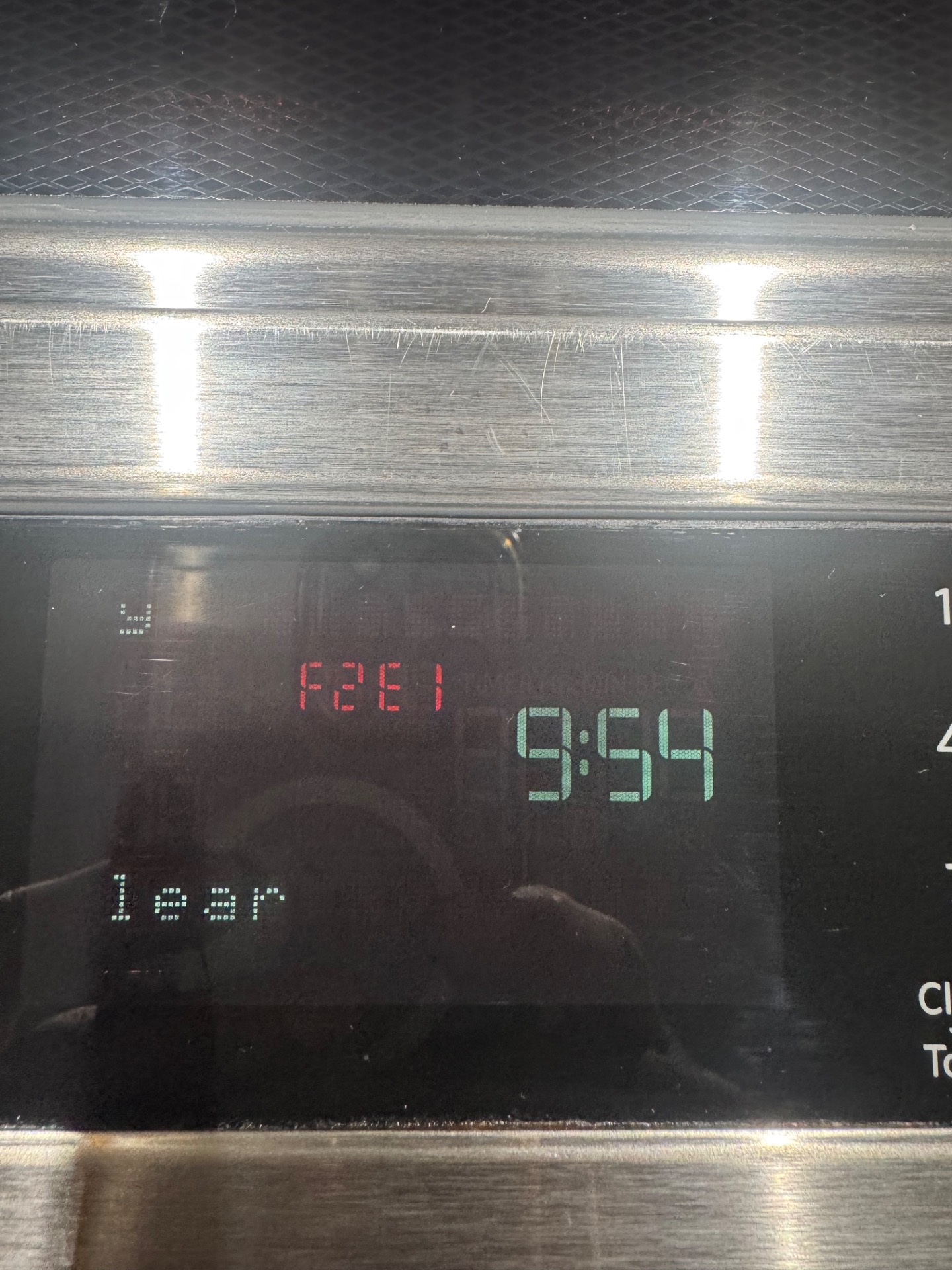
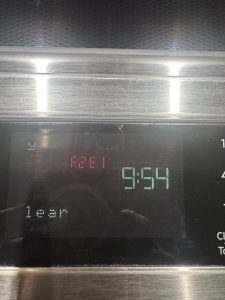
TechVill technician Randy pulled the stored error codes first. The range had two of them.
The two codes, and why both matter
F1 E1 indicates an internal control failure on the main control board. Typically that points to an EEPROM or processor-level fault — something on the board itself has stopped working correctly, independent of any user input or any signal coming in from the front panel. The board is producing an internal error and reporting it.
F2 E1 indicates a shorted or stuck key on the user interface — the control panel touchpad has a key registering as permanently pressed or shorted. The panel is sending the board a continuous false signal, as if a button were being held down indefinitely.
Either code on its own would explain unresponsive behaviour. F1 E1 alone would mean the board could not process inputs cleanly because the board itself was malfunctioning. F2 E1 alone would mean the board was being flooded with a false input from the panel that drowned out the legitimate user inputs. Both together is a guarantee: the board has an internal fault and is also receiving a constant false signal from the panel that would corrupt any legitimate command the user tried to send.
That dual-fault read is what justifies the scope. The work order is honest about the framing: replacing both the main control board and the control panel is “necessary to run further testing.” That phrase is doing real work. With two interacting electronic faults, neither replacement can be properly validated without the other one also being in place. A new board installed under a stuck-key panel would just go on receiving the false input — the symptom would not change, and the new board would test “broken” on cycle attempts even though it was perfectly functional. A new panel wired into the original faulty board would not resolve the symptom either, because the board’s internal fault would still be there to corrupt any clean input the new panel sent.
Why a less careful approach gets this wrong
The diagnostic temptation on this kind of fault is to take the most “obvious” failure first and hope. F1 E1 sounds more serious than F2 E1, so a less-careful approach would replace the control board, see whether the symptom resolves, and only return to the panel if it did not. That logic is wrong here in a specific way: the new board, installed under a stuck-key panel that is feeding it a continuous false input, would produce the same unresponsive symptom the customer originally called about. The technician would report back “the new board is also broken” — when in fact the new board is perfectly fine and the panel beneath it has been sabotaging every input cycle.
Same pattern in reverse: a panel replacement under an internally-faulted board would not resolve the symptom either. The board’s EEPROM or processor would still be producing errors regardless of what the new panel sent in.
The honest scope on a dual-fault system is to replace both interacting components together and verify after. If additional faults surface after the two known ones are resolved, the customer gets contacted before scope expands. That is the framing on this work order, and it is the correct one for repairs where the components interact rather than failing independently.
The KitchenAid–Whirlpool parts catalogue note
Both parts on this repair carry the W-prefix Whirlpool Corporation service numbering — W11084243 for the main control board, W10920246 for the control panel. That places KitchenAid squarely in the Whirlpool service ecosystem. KitchenAid, Whirlpool, JennAir, Maytag, and Amana all route through the same parts catalogue infrastructure. For TechVill’s parts sourcing, knowing the corporate family means the order goes through the correct channel and the correctly-matched components arrive without back-and-forth on cross-references.
That brand-family knowledge is its own piece of expertise. It is the difference between a same-week parts delivery on a confidently-routed order and an extended back-and-forth with a distributor over what fits a KitchenAid range from 2017.
Components ordered for the install visit:
- Main control board (part #W11084243) — processes user input from the control panel and switches the heating elements, oven cycles, and display functions; the failed unit on this range had an internal fault (F1 E1) preventing reliable processing of input commands
- Control panel (part #W10920246) — touchpad surface the user interacts with; the failed unit had a stuck or shorted key (F2 E1) feeding the main board a constant false input that overrode legitimate user commands
What the customer paid and what is left
The total quoted: $1,396.26 ($1,153.76 parts, $30 handling, $212.50 labour) plus 5% GST = $1,466.07. Payment received on the diagnostic visit: $1,388.90 CAD, parts prepaid against the install scope. A small balance remains against the full quoted total — final reconciliation runs on the invoice when the install visit completes.
The diagnostic ran 25 minutes on site. The stored error codes pointed directly to the two failed components rather than requiring extensive component-by-component testing — that is one of the operational efficiencies the appliance’s own fault-code system offers when the technician knows what each code means in the context of the others.
What this case demonstrates
Letting the appliance tell you what is wrong is a starting point, not a finishing point. Modern ranges store fault codes precisely so a technician can read them rather than guess. The diagnostic skill is in interpreting the codes correctly — recognizing that two codes together describe a single coupled fault, not two independent ones, and understanding why a sequential repair (replace one, see if it works, then maybe replace the other) is the wrong order on coupled faults.
“Necessary to run further testing” is the honest scope framing on coupled-fault systems. The work order does not over-promise that these two parts will resolve everything — it states that both are necessary to validate the repair. If additional faults emerge after the dual replacement, scope conversation happens before any further work, not after a surprise charge.
Brand-family parts catalogue knowledge is a quiet expertise that pays off on parts ordering reliability. KitchenAid, Whirlpool, JennAir, and Maytag all share the W and WPW prefix infrastructure — and TechVill’s portfolio of past repairs on the Whirlpool Corporation family includes refrigerators, ranges, dishwashers, and washers across multiple Calgary and BC neighbourhoods. That accumulated context means a KitchenAid YKSEB900 order routes correctly the first time.
Beddington Heights is established 1980s north Calgary residential — single-family homes and townhomes in the T3K postal corridor, north of McKnight Boulevard. This is the first documented case in Beddington Heights for the portfolio and the second case in the broader north Calgary corridor for technician Randy, who also handled a Whirlpool drain repair in Brentwood. Both cases are Whirlpool Corporation family — the through-line is starting to show.
Need KitchenAid or Whirlpool Range Repair in Calgary?
TechVill services KitchenAid, Whirlpool, JennAir, Maytag, and the broader Whirlpool Corporation family of appliances across Calgary and surrounding areas. Our technicians arrive with the W-prefix parts-catalogue knowledge, the error-code interpretation framework for stored fault codes, and access to OEM-spec replacement components.
Book online to schedule a KitchenAid range diagnostic with our team.