

A gas cooktop that clicks when you turn the knob is doing its job. A gas cooktop that keeps clicking after the burner has lit, and keeps clicking while you cook, is telling you something specific — and it is not “the knob is failing.” The failure has a precise location, a precise cause, and a precise fix that has nothing to do with the ignition switch. This case ran that diagnosis through, and the underlying mechanism is worth explaining on its own.
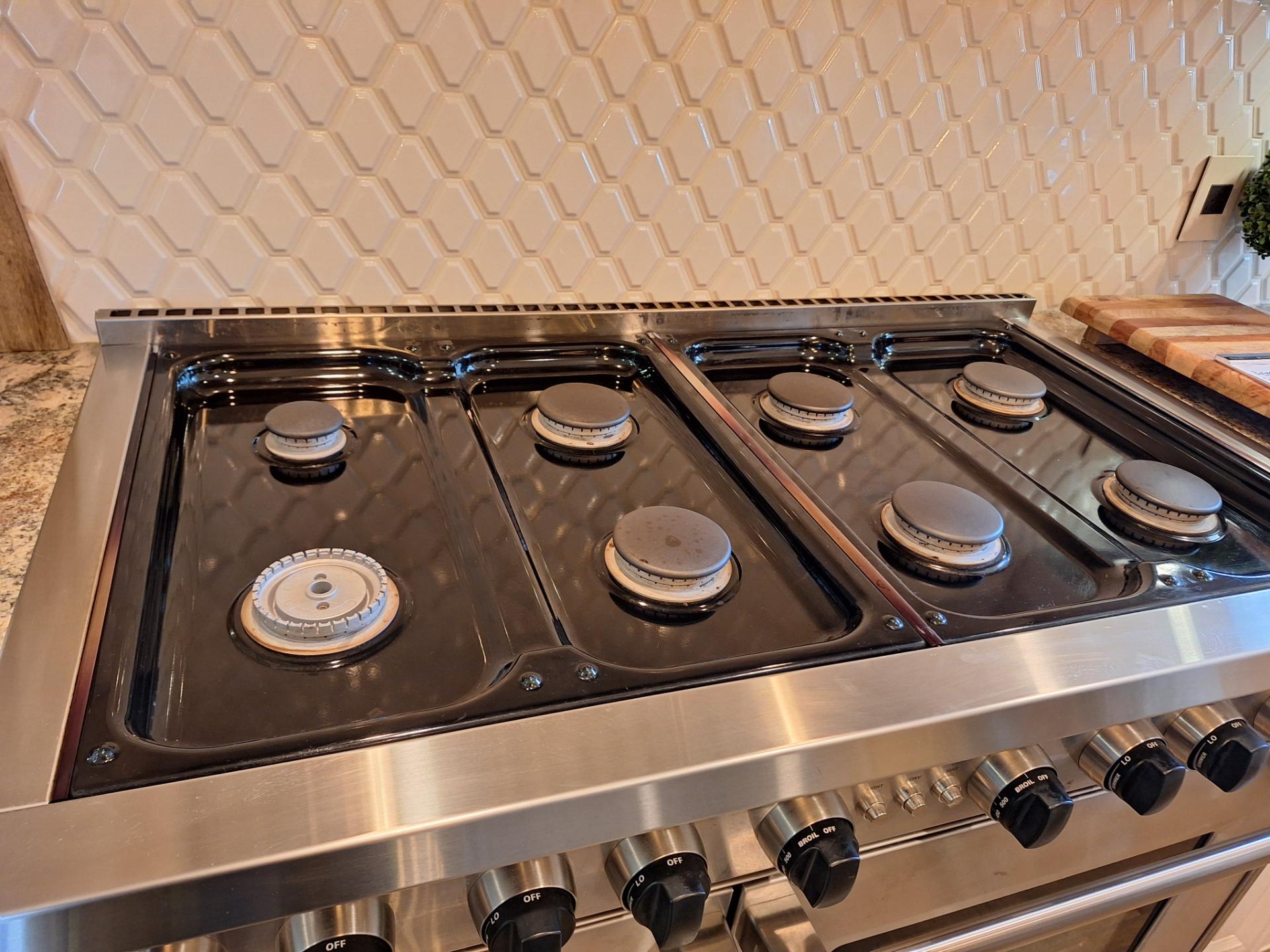
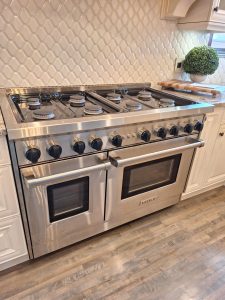
A homeowner on a multi-acre property in Priddis — the rural Foothills County hamlet southwest of Calgary — contacted TechVill because their Wolf GR488 48-inch pro-style gas range would not stop clicking. Even when the burner was lit and the flame was visibly cooking, the ignition system kept firing as if it were still trying to light something. TechVill technician Oleksandr arrived, duplicated the symptom, and walked the diagnosis through to the actual cause.
What “constant clicking” means on a gas range with electronic ignition
A working gas range with electronic ignition runs through a specific four-step cycle when you turn a burner knob.
- The spark module starts firing — that is the clicking sound, an audible signal of high-voltage pulses being driven across an air gap to the burner.
- Gas flows to the burner.
- The spark ignites the gas-air mixture and a flame appears.
- The flame sensor circuit detects the presence of flame and signals back to the spark module: “stop sparking — combustion is established.” The clicking stops.
When the system is working, step 4 cuts off the clicking the moment the flame appears. When the flame-detection part of the spark module fails, step 4 never happens. The module does not know the burner is lit, so it keeps issuing spark pulses indefinitely. The clicking does not stop because the module is still trying to ignite something that is already burning.
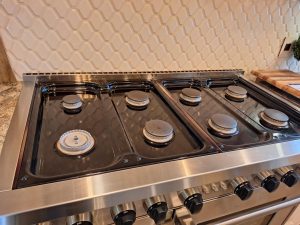
That is the failure mode in this case. Oleksandr observed the right-front burner clicking continuously even while it was actively cooking. That signature — clicking with the flame already on — points to one specific component, and only that component: the spark module’s flame-detection circuit on the affected burner. Not the knob. Not the gas valve. Not the wiring. The flame sensor inside the spark module is the part that has lost the ability to confirm what the eye can see.
Why all four modules, not just the failed one
The right-front spark module is the failed part, and replacing only that module would resolve the symptom on the right-front burner. The customer, when given the full picture, approved replacement of all four spark modules instead. The technical reasoning behind that decision is worth being explicit about — it is not an upsell, it is a same-age components calculation.
All four spark modules on a single Wolf GR488 cooktop share an operating history. Same age. Same usage hours. Same heat exposure. Same voltage environment from the same supply. When one module’s flame-detection circuit has failed from cumulative wear, the other three are statistically the next candidates in the same population — not because they fail in lockstep, but because they have all been running in the same conditions for the same number of years.
Replacing one module now means another labour visit when the second module fails, and another when the third, and so on. Replacing all four during one labour visit collapses what could be four scheduled repairs over the next year or two into a single rebuild of the ignition system to factory-new condition. The math is the same as every other “replace adjacent same-age components together” decision in premium appliance service: paying for the second, third, and fourth modules now is cheaper than the future labour for return visits when each fails on its own.
Components ordered (install scheduled for parts arrival):
- Wolf spark module (part #18191030 / 829016) × 4 — drives the high-voltage spark to the burner and reads back from the flame sensor circuit to confirm ignition; the failed unit on the right front had lost flame-detection function
- Wolf oven lamp assembly (part #822269) — secondary finding; pre-staged from inventory to be brought on the return install visit so an oven lamp check can be completed in the same trip
The oven lamp is a small detail with a real operational consequence. Only one assembly was available in inventory at the time of the diagnostic visit. Discovering that fact at the return install — and finding the lamp was needed — would have meant a third trip to actually replace it. Securing the part now, before the install visit, collapses three potential trips into two. The kind of operational discipline that separates premium-brand service from generic appliance work is often this kind of detail: not the technical repair itself, but the staging that makes the technical repair flow smoothly.
Cost and what the customer paid on the diagnostic visit
The total quoted: $1,118.25 ($1,065 + 5% GST), broken into $680 for the four spark modules, $30 parts handling, $325 install labour for the return visit, and $30 mileage out to the rural Priddis address.
Payment collected on the diagnostic visit: $1,048.95 — the four modules and handling fully prepaid ($745.50 with GST) plus the service call and mileage for this visit ($303.45 with GST). Remaining due on completion: the install labour line, around $69.30 with GST, with a small allowance for the oven lamp inspection.
What this case demonstrates
A symptom mapped to its actual cause is worth more than a symptom mapped to whichever part the customer guessed. “The cooktop keeps clicking” sounds vague — but on a gas range with electronic ignition, it has a specific failure-mode mapping, and getting that mapping right is the difference between a one-visit repair and an open-ended series of visits replacing wiring, valves, and knobs that were never the problem.
Same-age component replacement is a customer-aligned scope decision when it is offered with the technical rationale and accepted. The customer in this case had a clear choice — replace one module now and likely replace the others over the next two years, or replace all four now and rebuild the ignition system in one visit. Either choice is defensible. The honest version of the conversation is the one that lets the customer make it.
Rural Foothills County service is its own capability. Priddis is a thirty-to-forty-minute drive southwest of Calgary, on Alberta’s rural road grid rather than a typical urban street layout. The estate-home customer base in the area routinely runs premium kitchens with Wolf, Sub-Zero, Thermador, and Miele equipment — and being able to drive out and service those installations correctly is the difference between rural Foothills customers being covered and not. This is the second documented case in Priddis in TechVill’s portfolio, after a GE Monogram range repair on a different acreage property.
Need Wolf Range Repair in Calgary or Foothills County?
TechVill services Wolf and Sub-Zero appliances across Calgary, Foothills County, and the surrounding rural service area. Our technicians arrive with brand-specific test equipment, access to the Wolf service parts catalogue, and the inventory awareness to pre-stage scarce parts before return visits.