(855) 397-7233
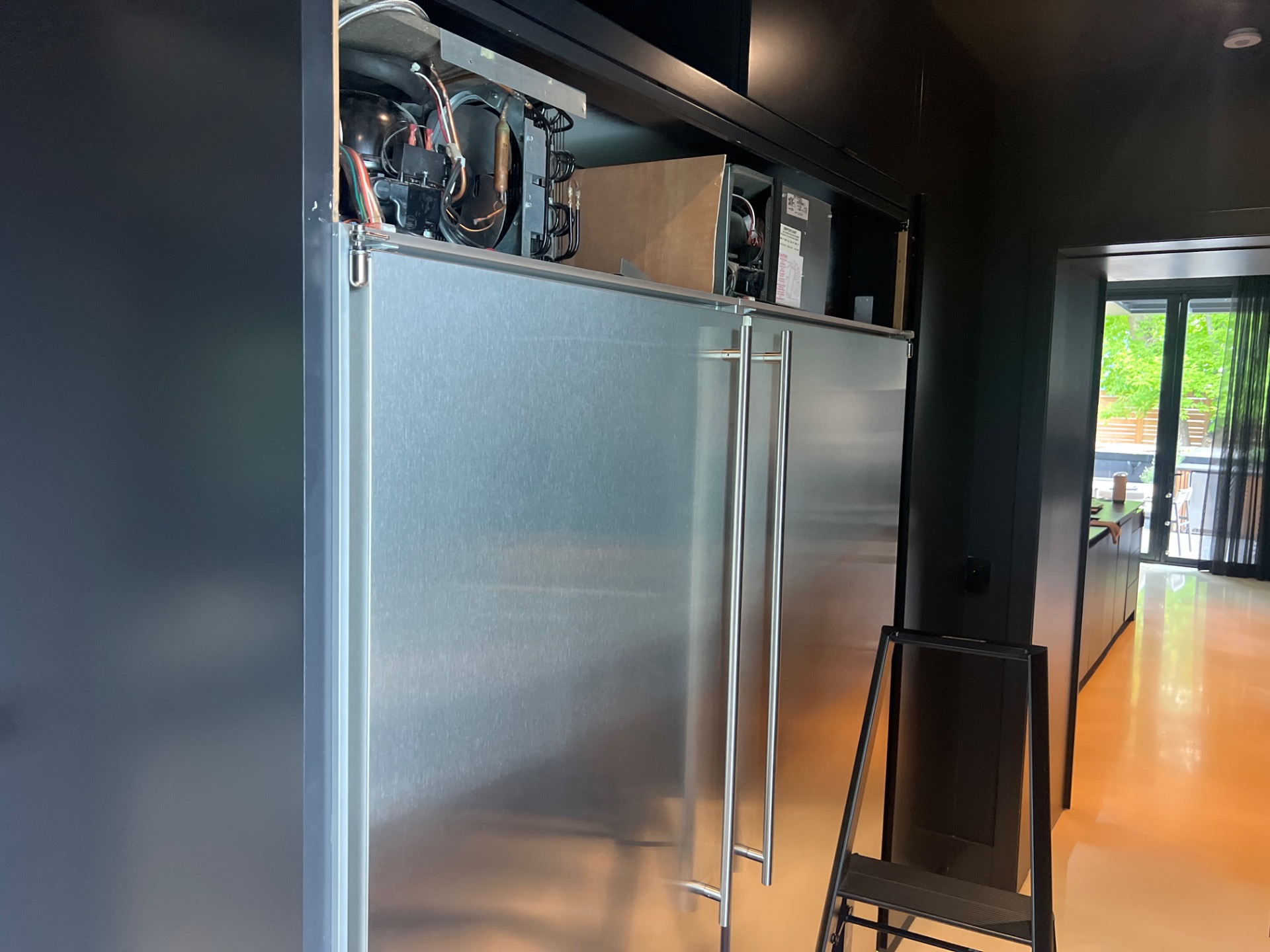
A homeowner in the Britannia community of SW Calgary contacted TechVill about a Marvel M72CSS-WS specialty built-in freezer column that had started making a loud noise. The customer’s read was that the cause was the compressor or the fan — both reasonable suspects on a freezer with audible mechanical complaint. TechVill technician Leonid arrived with a multimeter, pressure gauges, and the diagnostic discipline that comes from five previous sealed-system rebuilds across premium refrigeration brands in the Calgary area.
The diagnosis honoured the customer’s intuition without stopping at it. The compressor was indeed at the heart of the failure — and the failure had cascaded across the sealed system as a whole. This is the story of why the repair scope ran wider than the symptom suggested, why the visit took five hours on site, and why all of that was the right answer on this specific unit.
The Problem — A Specialty Freezer in a Premium Built-In Installation
Marvel sits in a specialized corner of the premium refrigeration market. The brand focuses on built-in freezer columns, wine coolers, beverage centers, undercounter refrigeration, and outdoor cold storage — equipment that is often installed as the secondary cold storage in a luxury kitchen, alongside a primary Sub-Zero, Thermador, or Miele refrigerator. The M72-series is Marvel’s premium dedicated freezer column, with a new replacement cost in the $5,000–$8,000+ range, plus the cabinetry rework that any built-in replacement requires.
Most appliance shops never service Marvel. The brand’s specialization, parts channel, and installation conventions are different enough from mass-market refrigeration that the diagnostic discipline does not transfer cleanly. Adding Marvel to a documented service capability is a meaningful step into a corner of the premium market that homeowners genuinely struggle to find service for.
The customer’s complaint was specific: loud noise from the compressor area. That symptom on a built-in freezer of this tier deserves a stop-everything diagnostic call, not a routine slot a week out. The cost gap between a $200 fan repair and a $3,000+ sealed-system rebuild is wide, and getting the diagnosis right matters in both directions.
Diagnosis — Why Customer Intuition Was Half the Answer
The compressor was indeed failed, and the customer’s intuition was the right starting point. But the diagnostic work past the compressor revealed three additional sealed-system faults that explain the broader picture.
The temperature thermostat had failed. On this generation of Marvel, the thermostat is the primary cycle-control element for the sealed system — it tells the compressor when to run and when to stop based on the freezer’s internal temperature feedback. A compromised thermostat keeps the compressor cycling incorrectly under load, accelerating wear on the compressor and stressing every other component in the loop.
The defrost timer had failed. The defrost cycle on a freezer column is the periodic short cycle in which a small heater clears frost from the evaporator coil so the system can keep transferring heat efficiently. The defrost timer is what cycles that heater on and off correctly. A failed timer means the defrost cycle does not run on schedule, frost builds up on the evaporator, heat transfer drops, and the compressor runs longer and harder to compensate.
The filter drier was due for replacement on the same scope. Any time the sealed system is opened to replace a compressor or other refrigerant-carrying component, standard service practice replaces the filter drier as well. The drier traps moisture and contaminants in the refrigerant loop; reusing the old drier after exposing the system to atmosphere would introduce moisture into the new sealed loop and shorten its life.
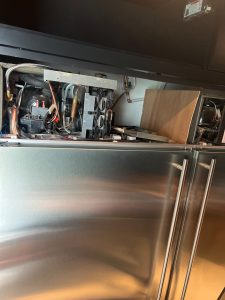
Reading the four faults together explains the picture. The thermostat had been cycling the compressor incorrectly for some period; the failing compressor had been losing efficiency, requiring longer run times and harder duty cycles; the defrost timer fault had been compounding the load by allowing frost buildup on the evaporator; and at some point the compressor itself crossed from mechanically stressed to mechanically failed. Replacing only the compressor — the customer’s first guess — would have produced a unit that ran for a few months and then failed again on the un-addressed adjacent components. The durable repair called for a full sealed-system overhaul, addressing the loop as a whole.
The Repair — One Visit, Five Hours On Site
The repair completed in a single visit. On a built-in installation, that is the right operational outcome — the customer is not without the unit for multiple appointments, and the work runs end-to-end while the system is open and accessible.
Components replaced:
- Marvel compressor — the core of the refrigerant circuit, responsible for pressurizing and circulating refrigerant through the freezer’s cold loop; the failed unit had reached the end of mechanical life under accumulated load stress
- Temperature thermostat — primary cycle-control element for this Marvel generation; the failed unit had been commanding incorrect compressor cycling, contributing to the upstream load that finished the compressor
- Defrost timer — cycles the defrost heater on and off on schedule; the failed unit had been allowing frost buildup on the evaporator, reducing heat transfer and increasing compressor duty cycles
- Filter drier — replaced any time the sealed system is opened; traps moisture and contaminants in the refrigerant loop and is standard service practice on every sealed-system service
- Refrigerant (Freon) — recharged to manufacturer specifications after the system was rebuilt
Sealed-system procedure performed:
After component installation, the system was pressure-tested to confirm no leaks at any of the new braze joints, fittings, or component seals. A deep vacuum was then performed to remove air, moisture, and any non-condensables from the loop — Marvel’s manufacturer specification calls for vacuum down to a specific pressure before charging. The system was charged with refrigerant to the correct quantity for this Marvel model, and the unit was started for post-repair verification. The freezer began cooling down on schedule, all functions tested correctly, and the original noise complaint was absent.
Why the Visit Took Five Hours
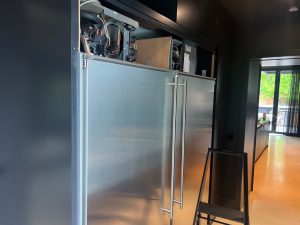
This was the longest single visit TechVill has documented across its case portfolio — 300 minutes on site. The work order is direct about the reason: “due to the installation design and limited access, removal and replacement of the compressor was particularly challenging and required additional labor.”
That is honest scope disclosure. Built-in Marvel freezer installations often have machine-compartment access tightly constrained by surrounding cabinetry. The compressor sits in a compartment that was designed for the original install — when the unit gets dropped into the cabinetry once at the manufacturer or installer — not for in-place service replacement years later. Removing and replacing the compressor in that constrained access often takes multiple times the bench-work equivalent.
The labour line on the invoice reflects what the work actually took. Not a generic flat rate, not a padded hourly multiplier — five hours of constrained-access compressor work plus the sealed-system rebuild verification cycle. That accounting matters for two reasons. First, it gives the customer an honest read on why a built-in service visit on a difficult installation is more expensive than the same scope on a free-standing unit. Second, it preserves the diagnostic relationship: the customer sees the work explained, not just billed.
What the Customer Paid
The total quoted: $3,063.90 CAD ($2,918 + 5% GST). Itemized cleanly:
- Parts (compressor + thermostat + defrost timer + filter drier): $1,188
- Parts fee: $30
- Refrigerant (Freon): $350
- Labour: $1,350 (reflecting the 5-hour scope and difficult-access compressor work)
- Subtotal $2,918 + 5% GST = $3,063.90
Parts and the parts fee were prepaid prior to the install visit ($1,278.90 with GST). Balance settled at completion covered refrigerant and labour ($1,785 with GST). The math reconciles cleanly to the quoted total.
What This Case Demonstrates
Customer intuition is the right starting point on a diagnostic conversation, and the right approach is to honour it without stopping at it. The customer suggested compressor or fan. The technician confirmed the compressor was at the heart of the failure — and went past it where the evidence warranted. That is the difference between deferring entirely to a customer’s first read (which gets a short repair that fails again) and ignoring it (which damages trust). Honouring the intuition, then doing the full diagnostic, gets both correct outcomes at once.
System-wide diagnosis on cascade failures is what separates a durable rebuild from a sequential series of repairs. Four sealed-system components had reached or were approaching failure on this unit, and the underlying causes were interconnected — the thermostat’s incorrect cycling stressed the compressor, the defrost timer’s failure compounded the load, and the filter drier was due as standard practice on any system opening. Addressing the loop as a whole means the unit comes out of the visit operating on a fully-rebuilt sealed system, not on three good components and one borrowed-time component waiting to fail next.
Honest labour-line explanation is the right accounting on constrained-access installs. The five-hour visit was not five hours of arbitrary billing — it was the actual time the constrained access required. Saying so in the work order, and showing the rationale to the customer, preserves the integrity of the invoice on a premium-tier ticket.
OEM-only parts are categorically the right choice on premium specialty refrigeration. Sealed-system components have to match the design pressures, capacities, and operating temperatures of the original Marvel engineering. Generic substitution at the compressor or thermostat level would introduce tolerance mismatches that would shorten the life of the rebuild — and the rebuild cost makes that a poor trade in any direction.
Britannia anchors one of TechVill’s strongest documented coverage clusters in the city. The community sits along the Elbow River corridor in SW Calgary, surrounded by Mayfair, Bel-Aire, and Upper Mount Royal. Median home values in the $1.8M to $2.4M range, household incomes at the $200K+ median level, kitchens routinely specced with Sub-Zero, Wolf, Miele, Thermador, and now Marvel specialty refrigeration. The portfolio’s documented inner-SW Calgary premium corridor now covers Britannia, Mayfair, Upper Mount Royal, Roxboro, and Altadore — five communities anchored by sealed-system rebuild capability.
Need Marvel or Sub-Zero Specialty Refrigeration Service in Calgary?
TechVill services Marvel specialty refrigeration, Sub-Zero, Wolf, Viking, Miele, and the broader premium built-in segment across Calgary and the surrounding areas. Our technicians arrive with the sealed-system service equipment, the OEM parts-catalogue access, and the documented experience to handle full system rebuilds on premium freezer columns, wine coolers, and built-in refrigeration.
Book online to schedule a Marvel specialty freezer service appointment with our team.