(855) 397-7233
A homeowner in Canmore called TechVill about a Sub-Zero built-in wine refrigerator that had gone warm. On a kitchen appliance, “warm instead of cold” is an inconvenience. On a wine storage unit, it is a countdown — a collection held at cellar temperature can start to lose character within days once the cooling stops. Our technician Hardeep drove out to the Bow Valley to find out why, and what he traced the fault to turned a suspected recharge into a full sealed-system rebuild. Here is how the visit unfolded, and where the repair stands right now.
The arrival — a wine fridge that had stopped cooling
Canmore sits roughly 110 km west of Calgary along the Trans-Canada, and premium built-in kitchens are common in the Bow Valley’s mountain properties — Sub-Zero, Wolf, Miele and Viking all show up regularly out here. This unit was a Sub-Zero built-in wine refrigerator, model 424 (identified from the control panel on the unit itself; the model was not recorded on the original work order). It is a dual-zone design, meaning it holds two independent temperature zones — one for reds, one for whites or sparkling — each with its own cooling circuit.
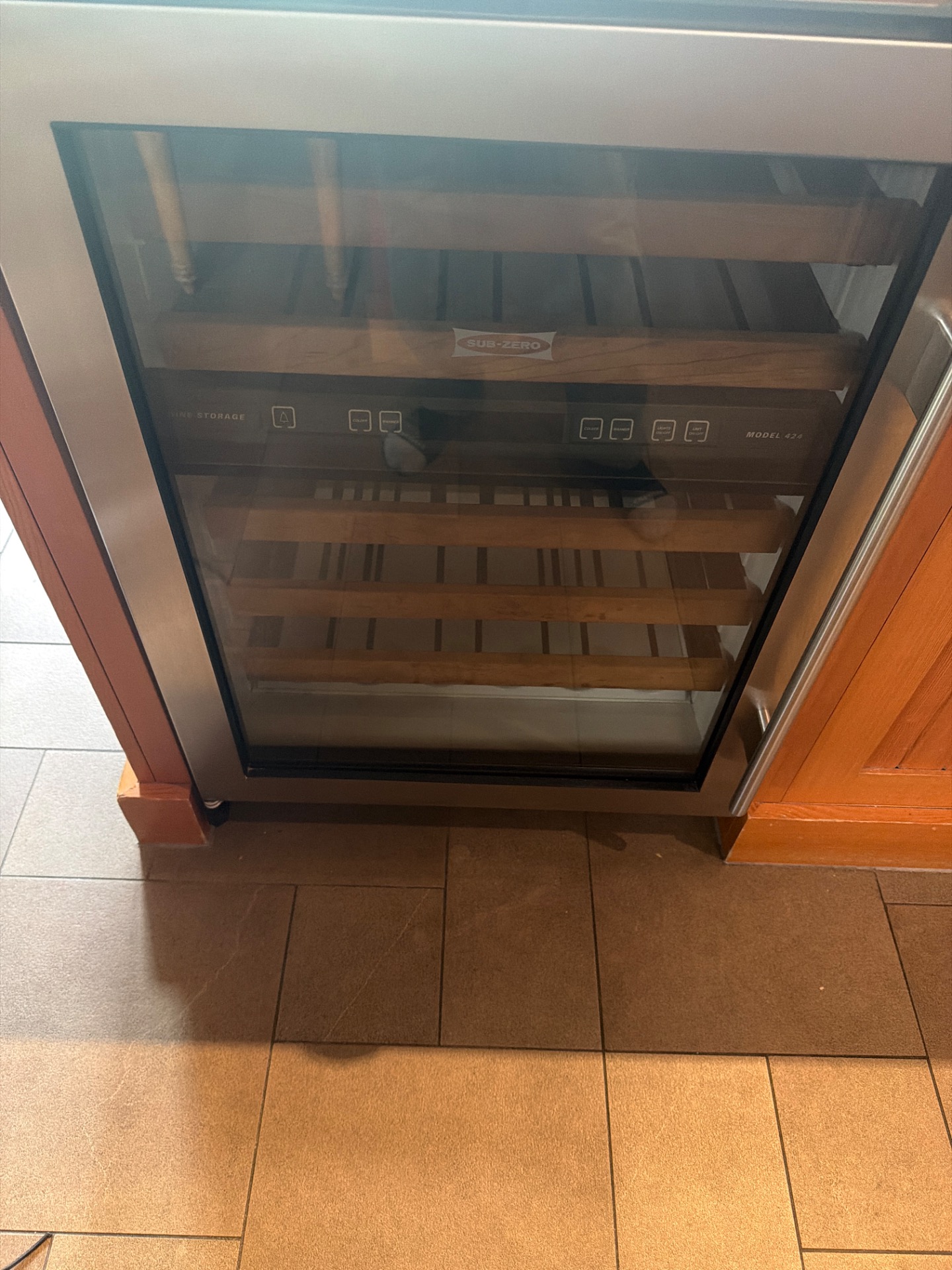
The customer’s report was simple: the cooling system was not working, and the cabinet was sitting at room temperature instead of holding its set points. The real question was why. A wine fridge can go warm for several reasons that look identical from the front — a compressor that will not start, a compressor that runs but produces no cooling, a control board that never commands the compressor at all, or a sealed-system problem where the refrigerant that carries the heat away has been lost. Each points to a very different repair, so Hardeep worked the system component by component rather than guessing.
Working the diagnosis — voltage was fine, the sealed system was not
The visit took 41 minutes on site, and the symptom-to-cause chain came through cleanly. Hardeep verified the control side first: all major components were receiving proper voltage, which told him the electronics were doing their job and commanding the system correctly. The condenser fan — the outdoor-side fan that sheds heat — was running normally. The evaporator fan — the indoor-side fan that circulates cold air through the cabinet — was also running normally. So the problem was not a dead board or a failed fan.
That narrowed it to the refrigeration circuit itself, and there the picture changed. The compressor was receiving voltage — the command was reaching it — but it was not running properly. It was not doing the mechanical work of pressurizing and circulating refrigerant. And when Hardeep checked the sealed system, it had little to no refrigerant remaining. The charge that carries heat out of the cabinet was gone.
That combination matters. A unit cannot pull heat out of the wine cabinet if there is no refrigerant to circulate, so the lost charge alone explains the warm cabinet. But it also explains the compressor: running a compressor with insufficient refrigerant can damage its internal components, because the refrigerant that normally cools and lubricates the mechanism is not there. So the two failures are linked — refrigerant loss, and a compressor that is no longer running as it should.
Importantly, no leaks or physical damage were visible on the appliance or the surrounding cabinetry during the visit. When refrigerant is gone but there is no external leak point, the leak is usually internal to the sealed system — a coil or an internal joint. That single fact is what rules out the cheap fix. Simply recharging the refrigerant would send the new charge straight back out the same hidden leak within weeks. The correct repair is to replace the sealed-system components where internal leaks originate, not just top up the gas.
The scope — a full sealed-system rebuild, approved on site
Based on the diagnosis, Hardeep quoted a comprehensive sealed-system rebuild rather than a recharge. Because this is a dual-zone unit, several of the components come in pairs — one set per cooling loop. The parts scoped are genuine Sub-Zero OEM service parts:
Components to be replaced:
- Compressor assembly (part #7011059) — the heart of the sealed system; it pressurizes and circulates the refrigerant that carries heat out of the cabinet. It ships with its integrated valve and electricals as one package, so the compressor and its control hardware are matched on reassembly.
- Filter driers, 2x (part #7014682) — one per refrigerant loop; each removes moisture and contaminants from the line so they cannot circulate and damage the new compressor.
- Evaporators, 2x (part #4211541) — one per zone; these are the coils inside the cabinet that absorb heat from the stored wine. Replacing both addresses the likely internal leak point and keeps the two zones matched.
- Thermistors, 2x (part #4204150) — the temperature sensors that report each zone’s temperature back to the control board; replaced together so both zones read on a calibrated, matched basis.
All parts are sourced through Sub-Zero’s OEM service-parts channel. On premium wine storage equipment, this is not a preference — it is a requirement. The sealed-system tolerances, the evaporator coil geometry, the thermistor calibration curves and the compressor specifications are engineered specifically for Sub-Zero’s temperature-control targets. An aftermarket thermistor with a different resistance-to-temperature curve, or a coil with different geometry, would not hold the tight, stable temperatures a wine collection needs — which defeats the entire purpose of the repair.
When the parts arrive, the install visit will follow the standard sealed-system discipline: access and replace the compressor, driers, evaporators and thermistors; pressure-test the system to confirm no leaks remain; pull a deep vacuum to remove residual moisture and non-condensable gases that would otherwise degrade performance; recharge the refrigerant to manufacturer specifications; then run the unit through multiple cycles to verify both zones cool and hold their set points. Hardeep also disclosed up front that if the rebuild surfaces any additional related sealed-system components, the customer will be re-quoted before further work — no surprise charges added after the fact.
Where it stands now
As of the diagnostic visit, the customer has approved the full rebuild scope and prepaid for the required parts on site so they can be ordered, with an estimated arrival of five to seven days. The install is scheduled to follow once the parts are in hand. We are documenting this case while the repair is still in progress — the diagnosis is complete and the scope is set, but the sealed-system rebuild itself is pending parts arrival, and we will not claim a finished result before the unit is verified cooling across both zones.
What this case shows
This is the kind of repair where the diagnostic discipline is the whole story. A less thorough approach might have recharged the refrigerant, handed back a briefly-cold unit, and left the customer to discover the internal leak all over again a few weeks later. Verifying the fans, the voltages and the compressor before touching the refrigerant is what separated a genuine sealed-system rebuild from a temporary patch.
It also reflects why sealed-system work on premium equipment is specialized. Refrigerant handling, deep-vacuum evacuation, precise charging and matched-component replacement are not general repair tasks — they require the equipment and the technical capability to execute correctly, especially on a wine fridge where the target is not just “cold” but a narrow, stable band that protects a collection. TechVill has serviced Sub-Zero built-in refrigeration and wine storage across Calgary and the Bow Valley, and our technicians arrive with the test equipment to walk the sealed system end-to-end and access to genuine Sub-Zero OEM parts.
Need Sub-Zero wine fridge repair in Canmore?
TechVill services Sub-Zero wine refrigerators and built-in refrigeration across Canmore and the Bow Valley mountain corridor. Whether your unit needs a diagnostic assessment or a full sealed-system rebuild, our technicians arrive with the test equipment to trace the fault end-to-end and access to genuine Sub-Zero OEM parts.
Book online to schedule a Sub-Zero wine fridge diagnostic with our team.