
When a food court operator calls in smoke coming out of a refrigerator every time the unit powers on, the differential is narrower than it sounds. On a commercial reach-in, “smoke at startup” almost always points to one component — and catching it in the right window is the difference between a same-day replacement and an electrical fire.
This is a write-up of that call – a commercial fridge repair in Calgary on a Delfield reach-in at the Market Mall food court (Varsity, NW Calgary), serving Potato Corner. Smoke from the cabinet, food at risk, lost sales by the hour. The fix was a single OEM part. The diagnostic discipline — and the response window — is the story.
The Differential on “Smoke from a Commercial Reach-In”
On a commercial reach-in refrigerator, almost every motor in the cabinet runs continuously whenever the unit is energised. The compressor cycles. The condenser fan cycles. But the evaporator fan motor inside the cabinet runs the entire time the unit has power — that is how cold air is moved past the evaporator coil and into the food zone.
When motor windings degrade, the failure path is predictable: insulation breakdown → localised overheating → resistive losses that produce heat the motor can’t shed → visible smoke as the surrounding lacquer and insulation off-gas. The first motor to show this on a commercial reach-in is almost always the evaporator fan, for the simple reason that it is the one running continuously.
What separates a small fix from a large one is timing. A motor that is smoking but the cabinet is still cooling is a motor that is failing — windings degrading, smoke produced, but the rotor still turning and the system still moving air. A motor that has been left to run another shift or two is a motor that seizes, draws locked-rotor current until the wiring harness melts, and pulls the compressor down with it on the way. That is when “smoke from the fridge” becomes a four-figure or five-figure event.
On Site at Market Mall
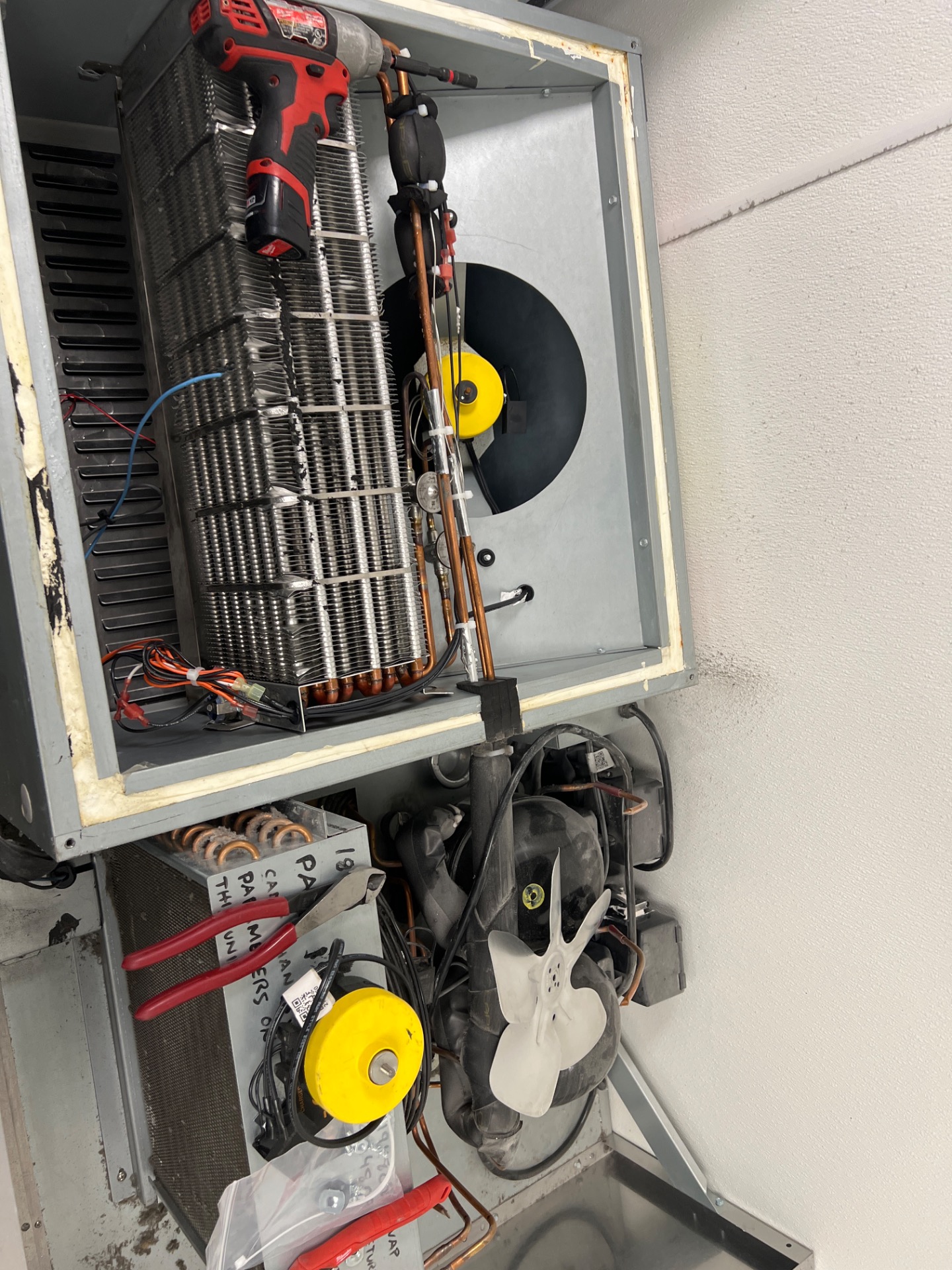
Technician Leonid arrived on the same-day call. The Delfield reach-in was still cooling but smoke was visible at the cabinet at startup. With the evaporator section opened, the fan motor was confirmed as the source — windings degraded, smoke at energise, but the cooling circuit downstream still intact. No fault had spread to the control circuit, the wiring harness, or the compressor.
That is the window the call was made in. A shift or two later and the diagnosis would have read very differently.
The Repair
Components replaced:
- Evaporator fan motor (part #2162750) — the continuously running motor that draws air across the evaporator coil and circulates cold air through the cabinet on a commercial reach-in
After the motor swap, the unit was powered on, the new motor was verified running cleanly, and the cooling pulldown was monitored. No additional faults were found at the time of service. The reach-in was returned to operation the same day, back in the operator’s revenue stream before the lunch rush moved into dinner.
Why This Reads as a Different Kind of Repair
A residential refrigerator that smokes is a “we’ll book you in next week” job. A commercial reach-in at an active food court that smokes is a stop-everything call: every hour offline is lost sales for the operator, plus food-safety risk if product can’t be transferred to a working unit fast enough. Treating the call with that urgency is part of the actual product on commercial service — not just the parts swap.
Two more things worth naming about this repair:
Proportionate scope. A less disciplined response to “smoke from a commercial fridge” gets the operator a quote for a full electrical-system inspection or a unit-replacement recommendation. On a Delfield reach-in, that is the wrong scope — the fault isolates cleanly to one continuously running motor, and the repair stays at the size of the actual problem. Total: $585 CAD, parts and labour, instead of a four-figure inspection or a $4,000+ replacement quote.
OEM Delfield service part, not a generic 115V motor. Commercial foodservice refrigeration has different duty-cycle requirements than residential equipment — the motors run continuously for years, not in short cycles. A generic aftermarket 115V fan motor will physically fit a Delfield housing, but it is not rated for the continuous-run profile and its winding spec is not matched to the original control circuit. Substituting the OEM Delfield part keeps the unit on the manufacturer service profile — which matters when health-inspection records, warranty paperwork, and franchise compliance documents are in play for a food-court operator.
The Diagnostic Pattern Worth Carrying
If you operate a commercial reach-in, a chest freezer, or a walk-in, the practical rule is: smoke at startup is a same-day call, not a Monday call. The motor at fault is recoverable as a single-part swap if it is caught while the system is still cooling. The same fault, left in service, takes out the wiring harness and the compressor with it.
The diagnostic question for the technician is the same one: when did the smoke start, and is the cabinet still holding temperature? The answer determines whether this is a $585 service call or a major rebuild.