

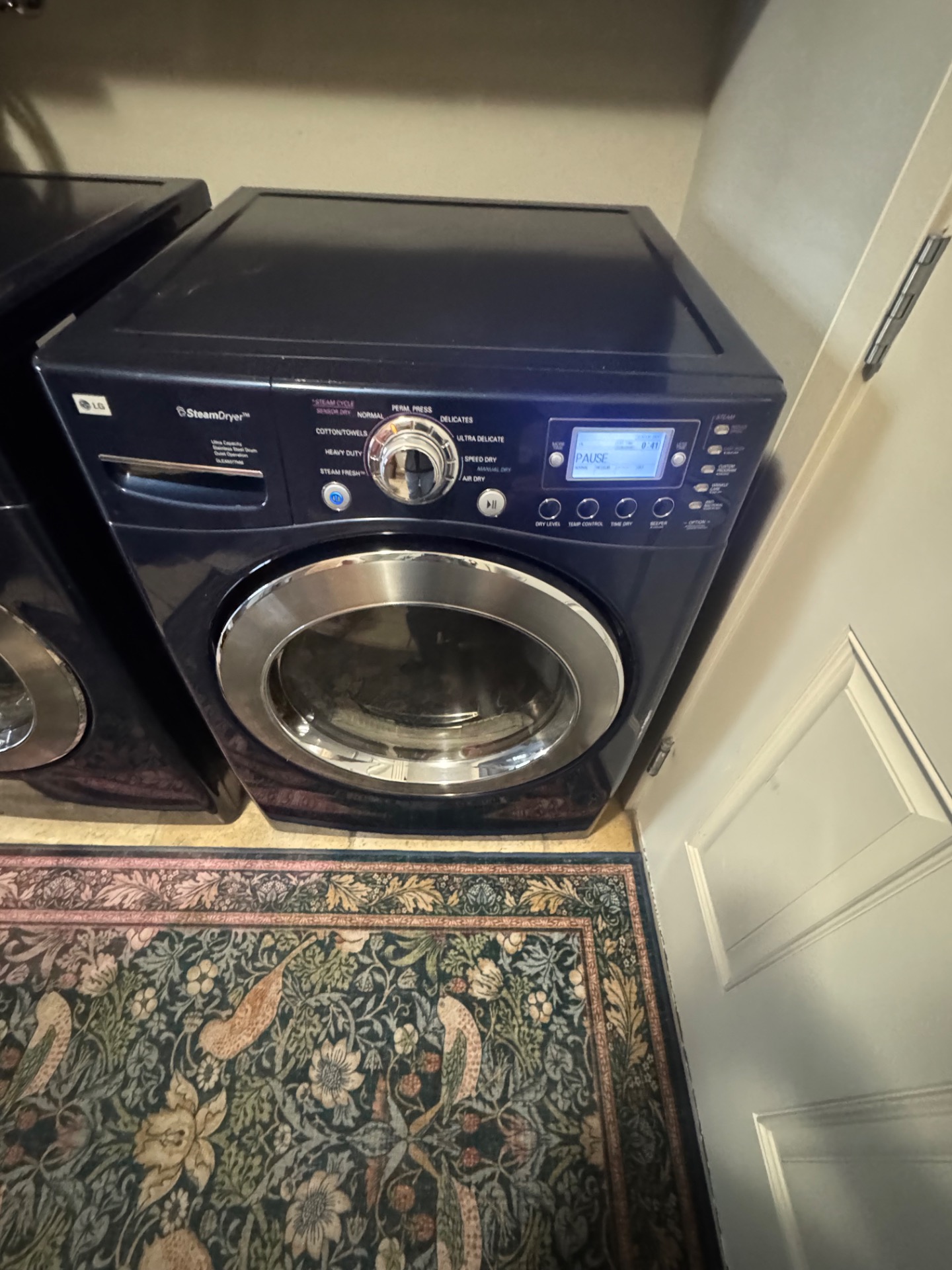
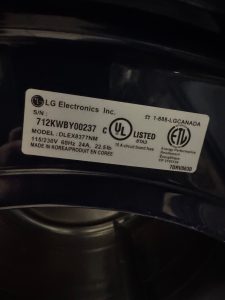
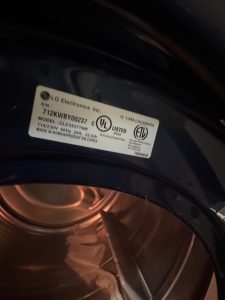
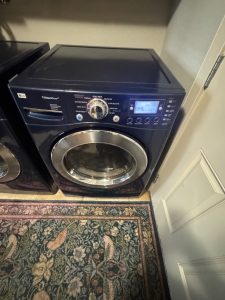
A homeowner in the Cranston community of deep SE Calgary contacted TechVill with a precise measurement of their dryer’s problem: it was taking five cycles to fully dry a single load. TechVill technician Yevhen walked the diagnosis on an LG DLEX8377 electric dryer, identified the cause, and ordered the OEM part. The customer’s quantified symptom description carried most of the diagnostic weight before the technician arrived.
What the measurement told us
“Took five cycles to dry one load” is a quantified observation, not a vague complaint. It carries three pieces of diagnostic information at once. First, the unit is running and tumbling — a non-tumbling dryer would not dry at all, so the motor and the tumbler chain are working. Second, the symptom is consistent across multiple cycles rather than intermittent, which points away from a thermal-cutoff or sensor issue that would produce a different complaint pattern. Third, the dryer is producing some heat but not enough — a vent blockage typically causes overheating shutdowns or scorching, not weak heat over extended runs.
That signature maps cleanly to one component: a weak heating element, degrading but not failed entirely.
How the heating element works
The heating element on an electric dryer is a coiled resistive element that converts electrical current into heat as air passes over it. Hot air gets pulled through the tumbler, picks up moisture from the laundry, and exhausts out the vent. The drying time the manufacturer specifies — usually 40 to 60 minutes for a standard load — depends on the element delivering its full design heat output across each cycle.
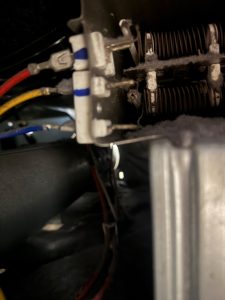
Over years of use, the element can degrade in a few ways. Partial breaks in the coil reduce the active resistance carrying current. Insulation around the coil degrades and changes the heat transfer pattern. Electrical conductivity at the connection terminals decreases. Any of those reduce heat output without producing complete failure — and the result is exactly what the customer described: the dryer still runs, still tumbles, still gets warm, and takes far longer than design to bring a load to dry.
What gets replaced and what the install will look like
The OEM LG heating element assembly (part #5301EL1001A) replaces the failed unit on the return install visit. After installation, post-install testing verifies heat output to specification — running a complete cycle on a standard load and confirming the dry time is back to the manufacturer’s spec window rather than the five-cycle marathon the customer had been seeing.
The diagnostic visit ran 50 minutes — efficient given the clean symptom-to-cause mapping. Parts ordered through the LG service channel.
Components ordered for the install visit:
- LG dryer heating element assembly (part #5301EL1001A) — resistive coil element that converts electrical current to the heat used to dry laundry; the failed unit had degraded enough to produce significantly reduced heat output without complete failure
What the customer paid on the diagnostic visit
The total quoted for the install scope: $538.65 CAD ($513 + 5% GST), broken into $263 for the heating element assembly, $30 parts handling, and $220 install labour. The diagnostic service call is a separate line at $177.45 ($169 + 5% GST).
Payment collected on the diagnostic visit: $485.10 CAD, covering the service call and the prepayment for parts and handling ($307.65 = $293 + GST). Balance due on completion of the install visit: $231 for the labour line with GST.
The two-stage workflow keeps the customer’s exposure transparent. The diagnostic and the part are settled before the install; the labour is settled at completion. End-to-end cost across both visits comes to $716.10.
What this case demonstrates
Customers who describe symptoms in measurable terms get faster, more accurate diagnoses. “Five cycles to dry a load” is the kind of detail that does diagnostic work before the technician arrives. A vague “it’s not drying well” leaves the full differential open — bad element, bad airflow, bad sensor, bad cycle logic. A specific cycle count narrows that immediately. The same principle shows up across the portfolio: customers who name the location of a leak, count the frequency of a glitch, or measure the time a cycle takes hand the technician a starting point that saves diagnostic billable time and lands on the right cause sooner.
OEM-only parts are the correct standard on dryer heating elements specifically. Aftermarket heating elements at lower price points exist for most major brand dryers, and they fit physically. What they often do not match is the specific resistance value the manufacturer’s controller is expecting to see — which means the cycle timing the controller calculates based on element draw can drift, and the dry time can come out wrong even with a “working” new element installed. Using the OEM 5301EL1001A means the unit’s controller and the new element are operating on the same engineering assumptions the LG design was built around.
Cranston is the first documented case in TechVill’s portfolio in the master-planned SE Calgary corridor — the Auburn Bay, Mahogany, Cranston, and Seton communities that share the deep-SE postal codes. Most of these communities were built in the 2000s and 2010s, with mid-tier mainstream-brand appliances that fall comfortably in the repair-worthy age window. Adding documented service capability in this corridor opens the portfolio’s coverage to a sizable family-suburban customer base that the established older SE Calgary cases (Dover, for instance) did not represent.