(855) 397-7233
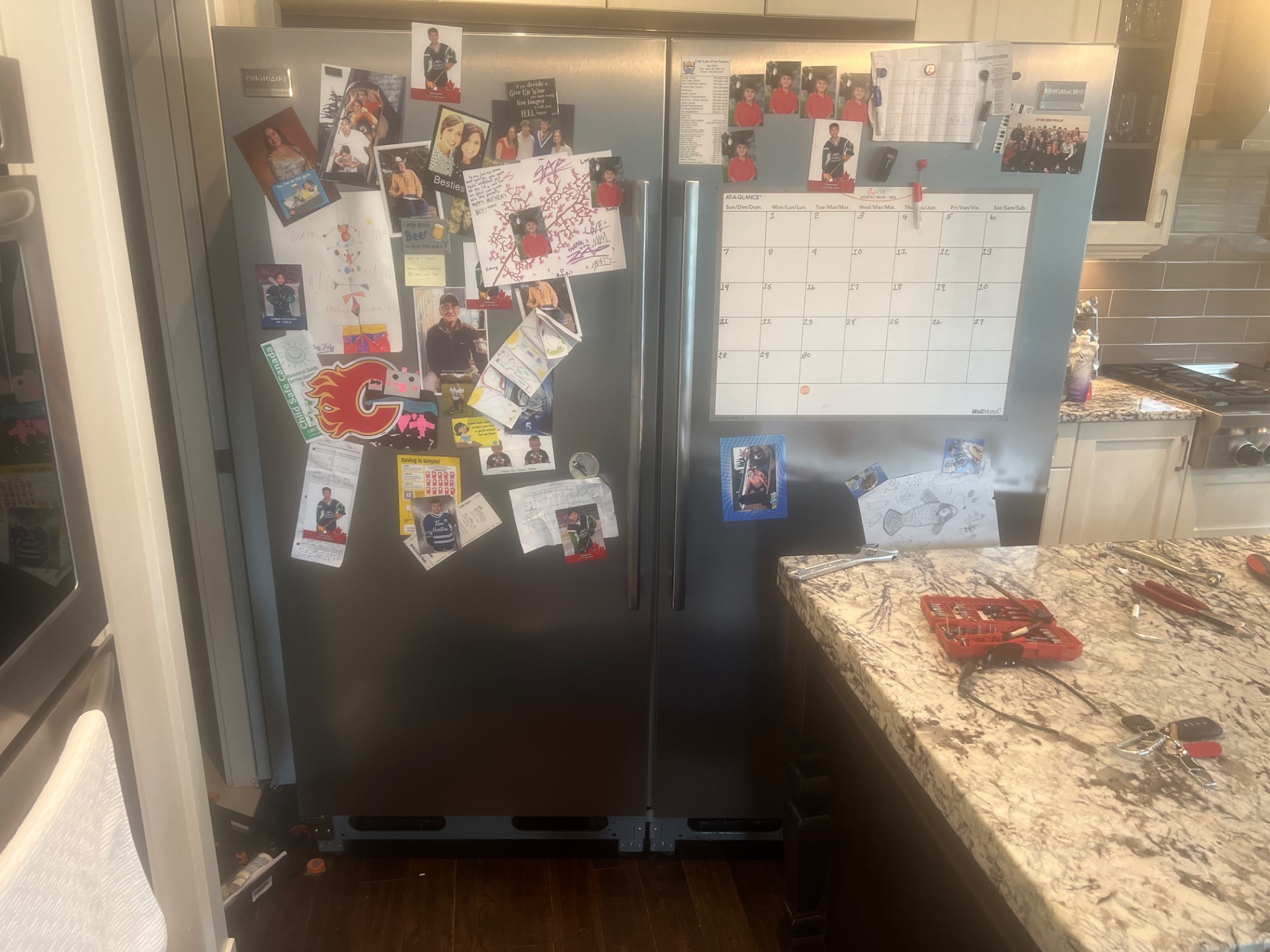
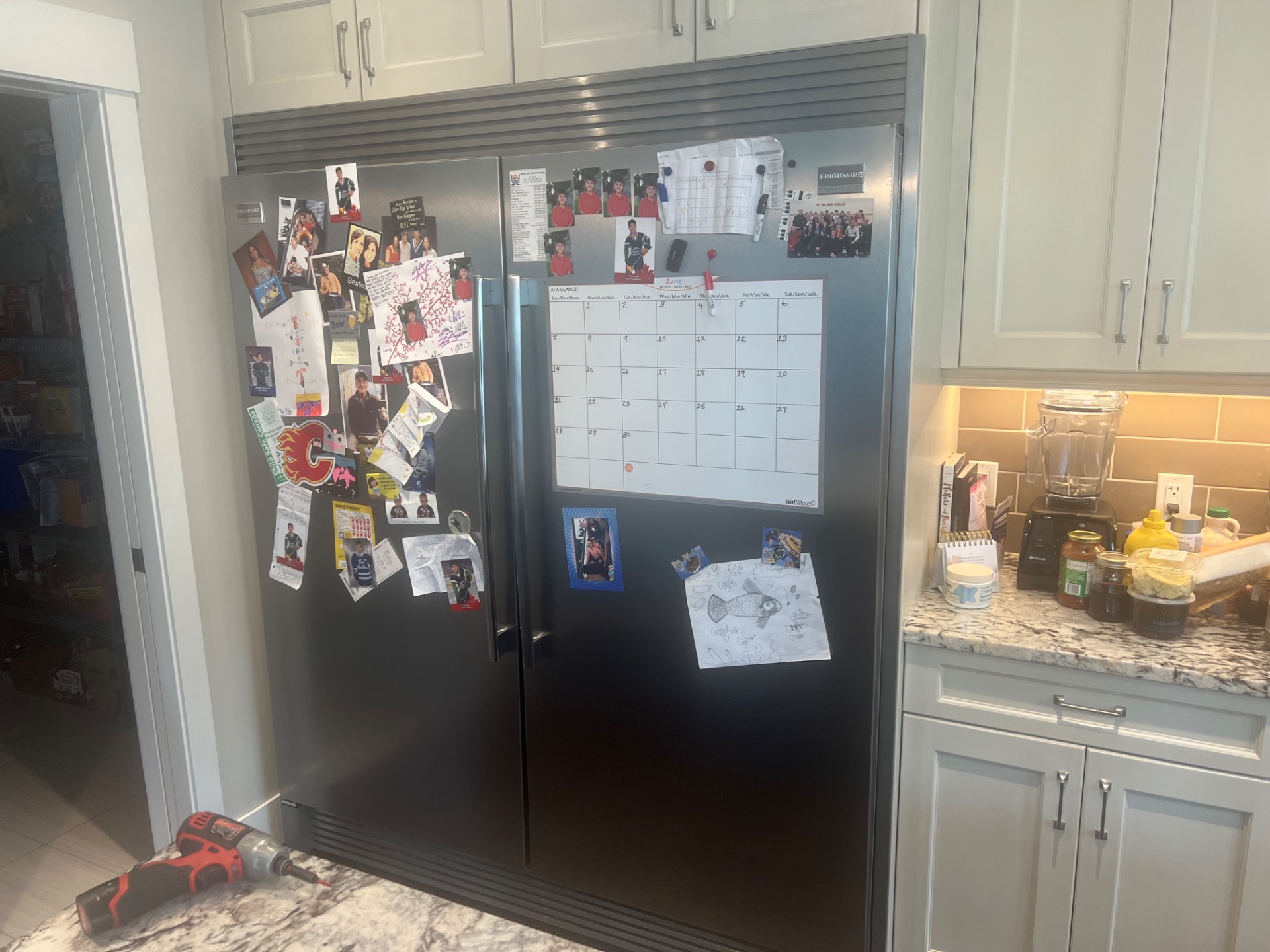
A homeowner in the Aspen Woods community of southwest Calgary contacted TechVill after their Frigidaire refrigerator (model FTRH19D7LF1) stopped cooling and started sounding a persistent temperature alarm. The fridge compartment had drifted all the way up to roughly 14°C — essentially room temperature. TechVill technician Leonid traced the failure to the sealed refrigeration system and rebuilt the refrigerant circuit end-to-end rather than recommending a replacement. The work took 5.5 hours on site.
The Problem – A Mid-Tier Fridge Holding at Room Temperature
The customer reported three things: the refrigerator was not cooling properly, it was running at about 14°C when it should hold between 0°C and 4°C, and the built-in temperature alarm would not stop sounding. That alarm is a useful signal — it means the electronic control had already detected an out-of-spec compartment temperature and was flagging it, so this was not a case of a mildly warm fridge that someone happened to notice.
A refrigerator sitting at 14°C is not suffering an airflow quirk or a control glitch. It has stopped removing heat from the cabinet altogether. When a fridge is that far out of range, the problem lives in the sealed system — the closed refrigerant loop made up of the compressor, condenser, evaporator, filter drier and refrigerant charge. Chasing a thermistor or a fan on a unit that warm would have wasted the customer’s time and, more importantly, misdirected the repair away from the actual fault.
The FTRH19D7LF1 is a standard-height unit from Frigidaire’s mid-tier residential line. On a mid-tier fridge, a full sealed-system rebuild is a real decision point: the labour, parts and refrigerant add up, and plenty of shops will simply tell the homeowner to buy a new appliance. Getting the diagnosis right first — confirming that the sealed system genuinely needed rebuilding, not guessing — is what makes a repair like this defensible rather than a gamble.
Diagnosis – Tracing the Failure to the Sealed System
Leonid confirmed the unit at the address as a Frigidaire FTRH19D7LF1 and worked the refrigerant circuit as a system rather than swapping parts on a hunch. With the compartment holding near room temperature and the compressor unable to pull the cabinet down, the evidence pointed to a sealed-system-level failure across more than one component — the reason a single-part swap would not have held.
This matters because the sealed system is a closed loop under pressure. If one part of that loop is compromised, opening the system to replace it means the refrigerant has to be recovered, the circuit reconditioned, and the charge rebuilt from scratch. There is no partial fix. So the diagnostic question was not only “which part failed” but “what does the whole circuit need to run reliably again once it is opened” — which is why the job was scoped as a full rebuild with a leak test and a fresh charge, not a quick component change.
The Repair – Full Sealed-System Rebuild
Based on the diagnosis, Leonid performed a complete sealed-system rebuild in a single extended visit. Multiple refrigerant-circuit components were replaced, and the circuit was then reconditioned and recharged.
Components replaced:
- Sealed-system component (part #297414901) — Frigidaire OEM refrigerant-circuit part. The service record documents this by part number; its specific in-circuit function was not written up on the work order, so we are not naming it here rather than guessing.
- Sealed-system component (part #5304507765) — Frigidaire OEM refrigerant-circuit part, likewise documented by number only, with its specific function not recorded on the work order.
- Filter drier — absorbs moisture and traps contaminants circulating in the refrigerant line; it is replaced as a matter of course any time the sealed system is opened, because a saturated drier can no longer protect the new components. The specific OEM part number for the drier was not recorded in the service documentation.
All parts were sourced through Frigidaire’s OEM service-parts catalogue (Frigidaire sits within the Electrolux family, so its 2974-series and 5304-series part numbers follow that group’s service-parts convention).
Sealed-system procedure performed:
Once the components were installed, Leonid worked the circuit in the correct order. First the system was pressure tested to check for leaks — it passed, with no leaks detected. This step is not optional: a rebuilt sealed system that leaks will lose its charge and fail again within days or weeks, so confirming that every brazed joint and connection is tight before charging is what separates a lasting repair from a callback. Next, a deep vacuum was pulled on the circuit to evacuate all air, moisture and non-condensable gases. Moisture is the quiet killer here — trapped water can freeze at the metering point, choke off refrigerant flow, and damage a fresh compressor — so a proper deep vacuum is essential, not a formality. Finally, the system was charged with R134a refrigerant to Frigidaire’s specification for this model — the correct weight of charge, measured rather than estimated.
The Result – Cooling Restored and Verified
With the circuit sealed, evacuated and charged, the compressor started and ran normally, and the cabinet began pulling down as expected. Leonid verified the repair through extended testing across multiple cycles — cooling performance was restored, compartment temperatures were dropping properly, and no additional issues surfaced during the post-repair check. Because a sealed-system rebuild reconditions the entire loop, a fridge typically needs a number of hours to settle into a stable, normalized temperature across all compartments after service, and the unit was confirmed to be trending the right way before Leonid left. The completed repair carries TechVill’s 90-day labour warranty, plus up to one year of manufacturer parts warranty.
The full sealed-system rebuild — multi-component replacement, pressure test, deep vacuum, precise R134a charge and multi-cycle verification — is why this visit ran 330 minutes, or 5.5 hours, on site. That is one of the longer single-visit repairs on record, and the time reflects the work being done properly rather than rushed.
What This Case Demonstrates – Rebuild Versus Replace on a Mid-Tier Unit
The total for this repair was $2,546 CAD plus 5% GST, or $2,673.30 CAD, covering parts, refrigerant, a handling and disposal fee for the old sealed-system components, and 5.5 hours of labour. On a mid-tier residential fridge, that is a substantial figure, and it is worth being transparent about why a repair at this level can still be the right call. Replacing a working, well-installed refrigerator carries its own costs and disruption, and many homeowners have sound reasons — the specific unit, its fit in the kitchen, or simply a preference to repair rather than discard — to keep the appliance they have. When the sealed system can be rebuilt to specification and verified leak-free, that repair restores full cooling and extends the unit’s service life. The job is only worth doing, though, if it is done thoroughly end-to-end, which is exactly what a pressure test, deep vacuum and measured charge deliver.
Sealed-system work is a genuine capability question, not a parts question. It calls for recovering and handling refrigerant correctly, pulling a proper deep vacuum, leak-testing under pressure, and charging R134a to a documented specification. TechVill’s technicians carry the equipment and the training to walk a refrigerant circuit end-to-end, and that is what let Leonid rebuild this circuit in one visit instead of condemning the appliance. It is also worth noting that this same protocol applies whether the fridge is a flagship built-in or a mid-tier unit like this Frigidaire — the physics of the sealed system do not change with the price tag.
Identifying the full scope of the failure on the first visit is what protected the customer from a repeat breakdown. Replacing a single suspected component and hoping the rest of the circuit was fine would have risked a fresh compressor failing within weeks once contaminated or leaking. Rebuilding the whole loop and verifying it under pressure eliminated that risk.
Finally, this is a case where genuine OEM parts matter for reasons beyond brand loyalty. A sealed system runs on precise pressures and a precise refrigerant charge; components with the wrong internal tolerances or displacement can leave the circuit running out of balance, which shortens compressor life and undermines the cooling performance the rebuild is meant to restore. Frigidaire OEM refrigerant-circuit parts are specified to the values this model was engineered around, which is why they were used here.
Need Frigidaire Refrigerator Repair in Calgary?
TechVill repairs Frigidaire refrigerators across Calgary and surrounding areas, including the Aspen Woods and Springbank Hill communities of the southwest. Whether your fridge needs a straightforward diagnostic or a complex sealed-system rebuild with refrigerant recovery, deep vacuum and recharge, our technicians arrive with the test equipment to walk the refrigerant circuit end-to-end and with access to genuine Frigidaire OEM parts.
Book online to schedule a Frigidaire refrigerator diagnostic with our team.