

What the ticket said
“Occasional water pooling underneath the refrigerator.” Maytag, Lincoln Park area condo in Calgary’s inner SW. The customer was describing a symptom, not a diagnosis – water under a refrigerator can trace back to several sources, and the right repair scope depends entirely on which one, which is why our Calgary fridge repair diagnosis starts at the source.
What the diagnostic showed
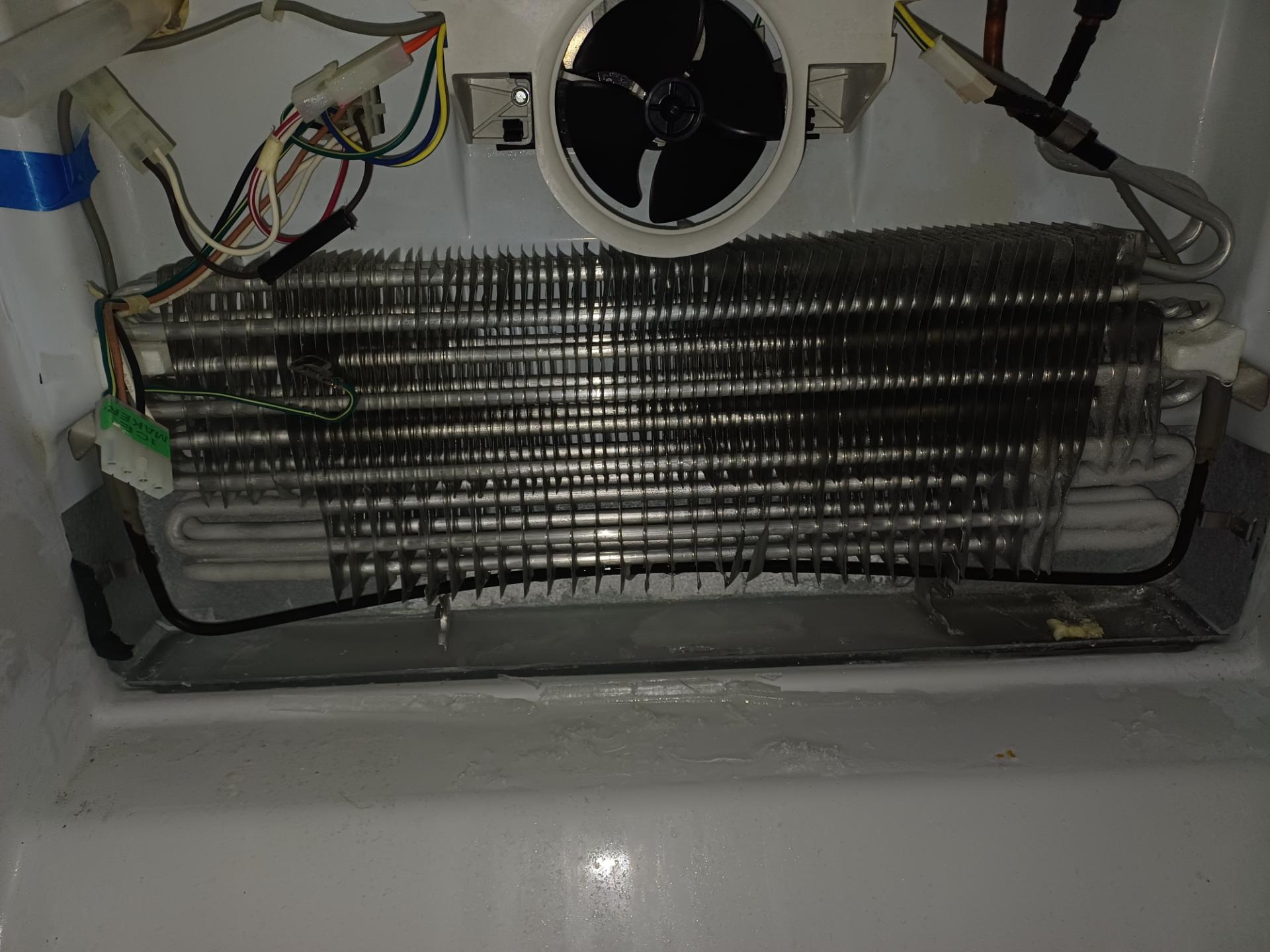
Technician Amin opened the freezer compartment and read the actual condition on the inside. Two findings, both pointing at the same root cause:
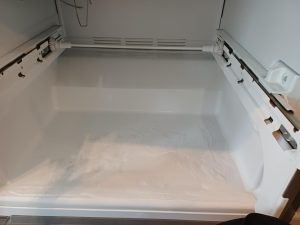
- Heavy ice accumulation on the freezer floor — defrost-cycle water that should have drained out to the evaporator pan was instead refreezing in place, building up over time.
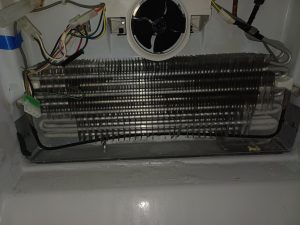
- The evaporator drain hole was clogged — the small drain opening at the bottom of the evaporator compartment, which routes melted defrost water down to the pan, was blocked.
And then a second contributor on the same drainage path:
- The rear drain hose duckbill valve was obstructed — the one-way check valve in the drain line (the small flexible flap that prevents air infiltration back up the line) wasn’t operating cleanly.
This wasn’t a parts-failure problem. The defrost cycle was working — the heater was generating heat at the right time, the cycle was initiating, the frost was melting. The water it produced just had nowhere to go. It pooled on the freezer floor, froze in place, and excess eventually found its way out underneath the unit. Clearing the blockage was the actual repair.
What the repair was
No parts needed. Drain system cleared end-to-end:
- Evaporator drain hole unclogged
- Duckbill valve cleared on the rear drain hose
- Freezer floor defrosted manually to clear accumulated ice
- Drainage flow verified — water now reaching the evaporator pan as designed
- Normal defrost cycle restored to functioning correctly
The labour-only repair is itself the value here. No parts means no parts markup and no parts-handling fee. The customer paid for the diagnostic skill (correctly identifying that the failure was downstream blockage, not upstream component failure) and the labour to clear and verify the system.
What else surfaced on the same visit
This is the part of the call that wasn’t in the original complaint, and it’s the part that mattered most for the customer’s home risk profile.
While accessing the rear of the refrigerator to inspect the drain hose, the technician noted two things about the household supply lines that didn’t belong:
- The refrigerator’s own water supply line was severely twisted and kinked at a tight bend behind the unit. Kinked supply lines develop stress fractures at the bend points over time; when those fail, the result is a continuous water leak under household supply pressure, which can flood a kitchen in hours.
- The dishwasher’s water supply line was outdated copper. Old copper supply lines harden, corrode at the fittings, and develop pinhole leaks. They’re past their service life for residential dishwasher feeds, and the failure mode is similar — slow leak that becomes a fast one with no warning.
The customer was advised — explicitly, not as an upsell — to replace both supply lines with braided stainless steel hoses. This is the modern industry standard for appliance water supply: flexible (so they don’t kink), pressure-rated (rated well above household supply), and resistant to the failure modes that take down both kinked rubber/PEX lines and aged copper. Naming the right replacement, rather than vaguely saying “have someone look at this,” is what makes the advice actionable.
The supply-line work wasn’t quoted or installed on this visit. The advice was given, the customer left with information and choice, and the conversation didn’t end with a same-day upsell. That’s the disclosure pattern — show what you noticed, recommend the right fix, let the customer schedule the work separately if they want.
Why this kind of visit matters beyond the parts
Two things worth pulling out of this kind of repair.
Diagnosing a drain failure correctly from “water under the unit” is real diagnostic work — even when the repair is parts-free. The symptom doesn’t say “drain system.” It says “water somewhere it shouldn’t be.” Tracing it back through ice accumulation on the freezer floor → evaporator drain blockage → duckbill valve obstruction is what gets to the actual fault. A less rigorous approach quotes a parts replacement on the assumption that the defrost heater or thermostat failed (also possible failure causes for the same symptom), and the customer pays for parts that weren’t needed.
Burst supply lines are among the most common and most damaging home-insurance claims in Canada. Water at household supply pressure can flood a kitchen in hours and a basement below in not much longer — and the typical claim runs into five figures by the time drying, refinishing, and damaged-content replacement are accounted for. Catching a kinked supply line or an aged copper feed proactively, while on-site for an unrelated repair, is exactly the kind of risk-catching that an aligned service technician does and an indifferent one doesn’t.
What the customer paid
$355.95 CAD total. Clean math: $339 + 5% GST. Flat labour-only fee for the drain system diagnostic, the unclog work, the post-repair verification, and the safety inspection that surfaced the supply-line concerns. No parts charges, no shipping, no separate diagnostic fee on top.
Need Maytag or Other Mass-Market Refrigerator Repair in Calgary?
TechVill services Maytag and the broader Whirlpool group of brands across Calgary and surrounding areas. Our technicians work the actual diagnostic chain instead of defaulting to parts-replacement assumptions, and they flag adjacent risks they notice on-site even when those aren’t in the original work order.
Book online to schedule a Maytag refrigerator diagnostic with our team.