(855) 397-7233
The service ticket read like a minor annoyance: the fridge “has a little noise.” A homeowner in inner SW Calgary — the Rideau Park and Elbow Park area — had a Sub-Zero 736TCI built-in refrigerator making a sound they could not quite place. TechVill technician Amin arrived expecting to chase a small rattle. What he found behind the interior panel was a defrost system that had quietly failed weeks earlier, and an evaporator frozen into a solid block of ice.
What the “little noise” actually was
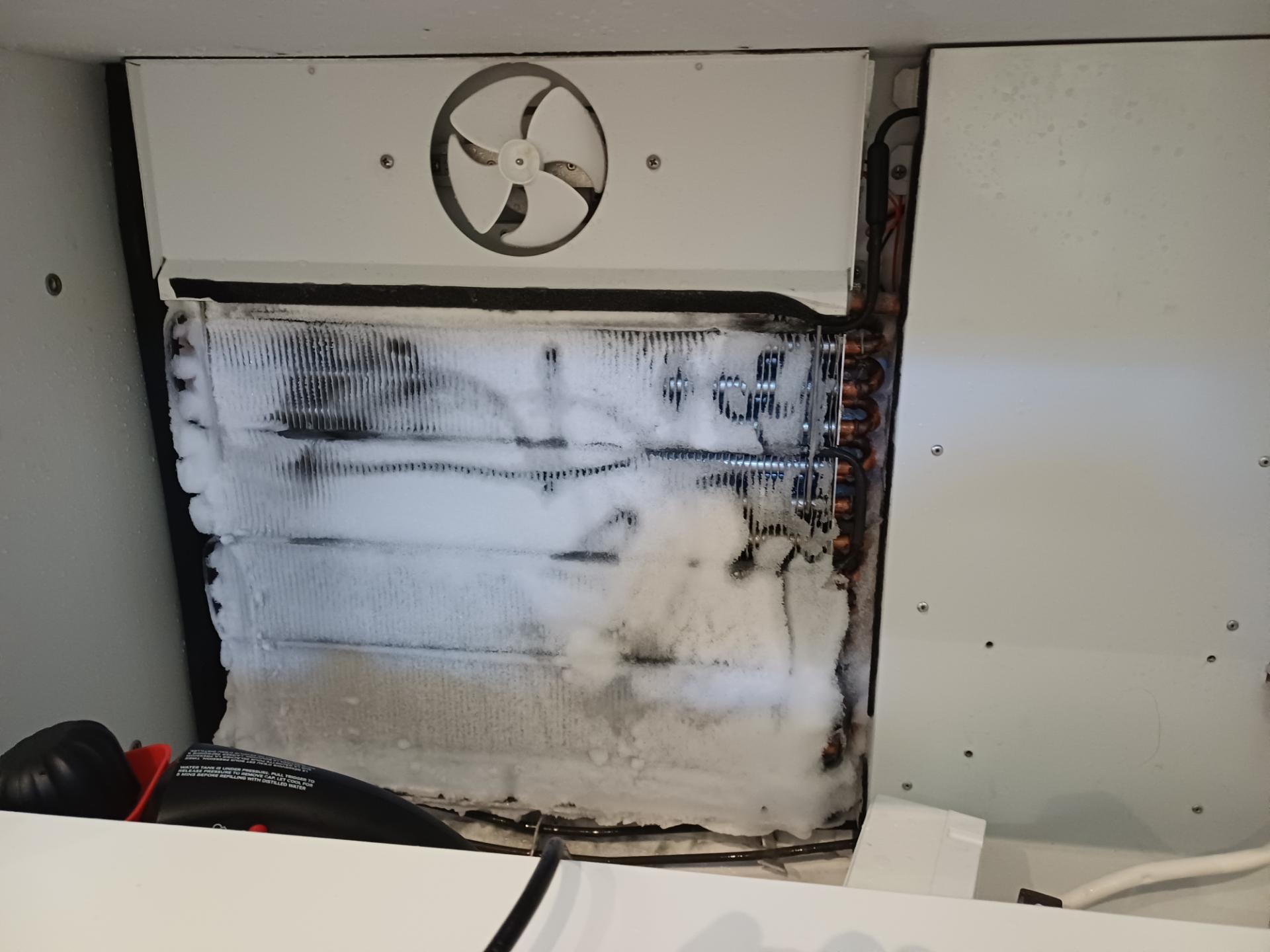
The first job on site was to trace the sound. It was a rhythmic scraping, and it tracked with the evaporator fan. When Amin removed the interior air panel, the cause was obvious: frost had built up so heavily that a wall of ice was physically touching the fan blades. Every rotation dragged the blades across the ice, and that contact was the “little noise.”
That is not a cosmetic problem. A fan motor forced to spin against ice resistance draws harder and runs hotter than it was designed to, and on a premium built-in that motor is not a five-minute swap. The noise the homeowner had learned to live with was a symptom of a much larger failure sitting behind it.
Tracing it to the defrost circuit
A Sub-Zero 736TCI, like any modern built-in, runs a timed defrost cycle: several times a day, heating elements warm the evaporator just enough to melt accumulated frost before it can bury the coil. When that cycle stops heating, frost never clears. It compounds. Given enough cycles, the coil disappears under a solid block — exactly what Amin was looking at.
The question was why the heat had stopped. He tested the two defrost heaters for continuity. The evaporator defrost heating element read open — no continuity, meaning the element had failed electrically and could not produce heat. He then tested the drain heating element, which keeps the defrost drain line from re-freezing. It also read open.
Both heaters had failed. That is unusual — two elements rarely die at the same moment — but the result was unambiguous: for some time, the defrost cycle had been running on schedule while heating nothing at all. The control board was calling for defrost; the coil never got warm. Frost had simply accumulated, cycle after cycle, until it reached the fan.
The repair
With the diagnosis settled, the work fell into a clear sequence.
First came a full manual defrost. New heating elements cannot be installed on an iced-over coil, so Amin melted the entire block by hand, cleared the meltwater, and dried the evaporator section. On a complete ice-out this is the most time-consuming part of the visit — there is no shortcut for it.
Components replaced (Sub-Zero OEM):
- Evaporator defrost heating element — warms the evaporator coil during each defrost cycle to melt accumulated frost; the failed original had gone open-circuit and produced no heat.
- Drain heating element — keeps the defrost drain line clear so meltwater can escape instead of re-freezing at the drain; also replaced after testing open-circuit.
- Defrost thermostat — senses coil temperature and terminates the defrost cycle at the right point; replaced preventatively so the entire defrost circuit was renewed as one unit rather than piece by piece.
Specific Sub-Zero part numbers were not recorded on this work order; the components are identified here by function. All three were sourced as Sub-Zero OEM defrost parts.
The defrost thermostat had not tested as failed. It was replaced deliberately anyway. When a defrost circuit has degraded far enough to freeze a coil solid, renewing every related component at once removes the guesswork about which aged part gives out next. It is the difference between fixing the fault and rebuilding the system around it.
The result — and the honest next step
With the new parts in, Amin verified continuity across all three components, then powered the unit up. The refrigerator ran normally and began pulling its compartments down toward food-safe temperatures. Because the cabinet had been fully frozen and then fully thawed, the homeowner was told to expect a recovery period before the fridge settled at its set point — normal after a complete defrost.
Then came the part that matters most on this case. Amin documented, for the homeowner, what happens if the problem ever comes back:
If a solid ice block or defrost failure occurs again despite these new parts, the most likely root cause is an intermittent relay on the main control board, which would call for a board replacement. No further action is required at this time.
Two failed heaters can be a coincidence, or they can be a symptom — a control board relay that intermittently fails to deliver power to the defrost circuit can, over time, look exactly like this. Amin could not confirm that on this visit, and the new parts fully resolved the fault in front of him. So the board stayed in place, and the customer paid for nothing they did not need. But the possibility is now on the record. If the fridge ever ices up again, the homeowner already knows where to look and does not start the diagnosis from zero.
That is the standard TechVill works to: fix what is proven, replace what is genuinely at risk, and tell the customer plainly about what is not yet certain — rather than sell a board today on a maybe.
The total for the visit was $962.85 CAD ($917 plus 5% GST), covering the three OEM defrost parts, parts handling, and roughly two hours of labour — most of it the manual defrost of a fully frozen evaporator.
TechVill repairs Sub-Zero built-in refrigerators across Calgary and surrounding areas, arriving with the test equipment to walk the defrost circuit end-to-end and access to genuine OEM parts. Book online to schedule a Sub-Zero refrigerator diagnostic with our team.