

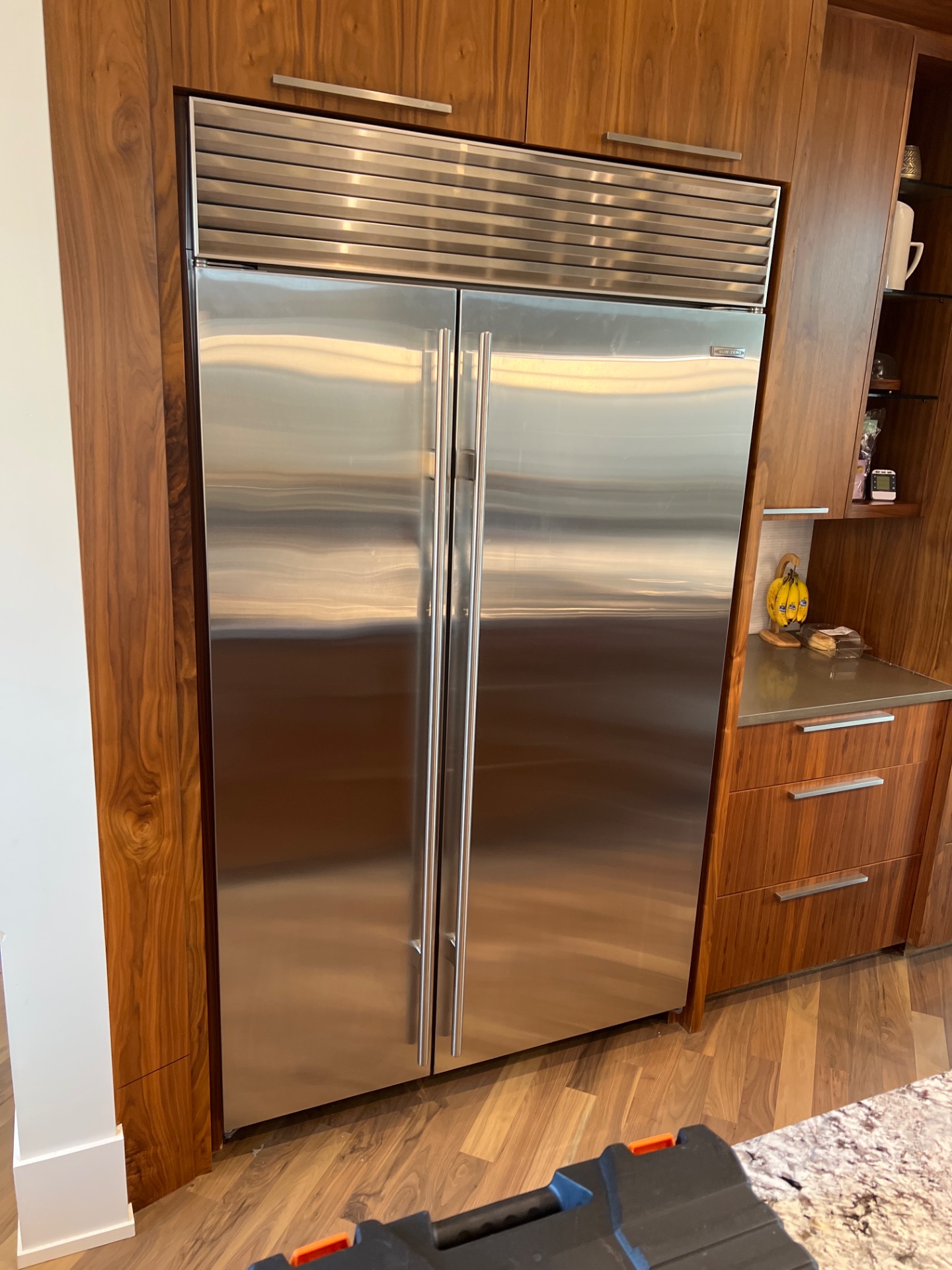
A homeowner in Upper Mount Royal called TechVill for fridge repair in Calgary about food freezing on the middle shelf of their Sub-Zero BI-48S built-in side-by-side – and mentioned, almost in passing, that the symptom looked similar to an earlier service call when a previous technician had replaced the evaporator fan. That detail reshaped the diagnosis from the first minute on site.
Phase 1 — Reading the History Before Touching the Unit
Sub-Zero BI-48S/S/TH is a 48-inch built-in side-by-side, dual-compressor, designed to drop into a custom cabinetry surround. On units of this generation, food freezing on the fresh-food side traces to a small number of possible faults — most of them in the airflow loop. A failed evaporator fan is a common first call, which is presumably what an earlier technician had concluded.
But the symptom had come back. Whatever was replaced last time had treated the surface, not the cause. Technician Leonid started with that read: if a fan replacement on this unit didn’t hold, the airflow side wasn’t the real problem — the sealed system was.
Phase 2 — Confirming the Sealed-System Failure

With the top grille removed and the compressor compartment opened, the pattern was consistent with multi-component degradation across the refrigerant circuit. The compressor was due, the evaporator showed signs of damage from contaminated refrigerant flow, the drier was loaded, and the thermistor reading was off-spec. On a sealed system, those components fail together — once contaminants circulate through the loop, anything they pass through is compromised.
This is also where the prior fan replacement made sense in retrospect: contaminated refrigerant flow had been hampering cooling for some time, the previous tech had treated a symptom on the airflow side, and the underlying loop kept right on degrading.
Phase 3 — Full Sealed-System Rebuild
Based on those findings, a complete rebuild was the right scope. Replacing only the compressor — the most expensive single part — would have left the contaminated drier and degraded evaporator in place, and the new compressor would have inherited the same problem within weeks.
Components replaced:
- Compressor service package (part #7009447) — the variable-capacity compressor that pressurises and circulates refrigerant through the fresh-food side, supplied as a Sub-Zero package with drier and electricals
- Refrigerator evaporator (part #7010514) — the cooling element behind the fresh-food cabinet wall, where refrigerant absorbs heat from the compartment
- Thermistor service assembly (part #4204740, ×2) — the temperature sensors that feed compartment readings back to the control board for compressor cycling
- Control board (part #7041549) — the controller that interprets thermistor input and drives the compressor and defrost cycles
Sealed-system procedure performed:

After component installation, the system was evacuated under deep vacuum to pull out residual moisture and non-condensable gases — both of which damage a new compressor on first run. A formal pressure test was then held against the evacuated system to verify it was leak-free before any refrigerant entered. Only after the pressure test passed was the system charged with R134a to Sub-Zero specifications. Pressure-testing before charging is the standard order on a Sub-Zero rebuild for a reason: introducing refrigerant into an unverified system risks losing the entire charge — and contaminating the new components — through a leak that should have been caught on the bench.

Phase 4 — A Second Finding the Customer Didn’t Call About
During the inspection — not while looking for it — the evaporator fan motor and blade were found in a state that doesn’t match normal wear. The blade was loose on the shaft and not seated correctly. The motor shaft had excessive play. The wear pattern and assembly state pointed to mishandling during installation rather than service life: the kind of finding that traces back to a prior service visit, not the unit’s age.
The customer was informed on the spot and the finding was documented. Two things follow from that:
- It helps explain why the original symptom kept coming back. Even with the sealed-system fault now corrected, an incorrectly seated fan would have continued to interfere with airflow over the evaporator and produce uneven cooling.
- It gives the customer a written record they can use to address the issue with whoever did the prior work. Without documentation, that’s their word against the previous shop’s.
The fan motor and blade replacement was written up as a separate ticket — appropriate, given the root cause traces to a different service visit and the parts and labour belong on a different invoice.
The Result
On startup after the rebuild, the unit began cooling as expected. With the sealed system pressure-tested and properly charged, and a fan-motor concern formally raised in writing, the homeowner has a unit running on factory-level refrigeration and full transparency about what’s left to address.

Total invoiced: $2,131.50 CAD for the sealed-system rebuild — parts (compressor service package, evaporator, thermistor assembly, control board), labour, deep vacuum, pressure test, and R134a charge.
The Economic Case
A comparable Sub-Zero BI-48S replacement is in the high five figures installed by the time the cabinetry surround, panels, and removal of the existing unit are factored in. The rebuild restored the existing installation at a fraction of that figure, and — because the underlying sealed-system fault is now corrected rather than masked — without the recurring service-call cycle the homeowner had been on.
Sealed-system work on a Sub-Zero requires the test equipment to verify the loop before recharging, the OEM service packages that come with matched drier and electricals, and the discipline to read the customer’s history rather than only the immediate symptom. The fan-blade finding is the kind of thing a faster job would have missed — and it’s the reason this unit kept needing visits.
Book online to schedule a Sub-Zero diagnostic with our team.