(855) 397-7233
There is a line inside appliance repair that most homeowners never see until they land on the wrong side of it. On one side is diagnosing a sealed-system fault — reading the pressures, recognizing a dead compressor or a failed evaporator coil, and correctly telling the customer what the fridge needs. On the other side is actually completing that work: recovering the refrigerant, opening a pressurized circuit, brazing in new components, pulling a deep vacuum, and recharging to specification. A shop can be perfectly capable of the first and still not equipped for the second. That gap is exactly where this Central Canmore repair began.
A homeowner in the Bow Valley had already been through one repair company before TechVill arrived. That company got the diagnosis right — the refrigerator needed a new coil — but told the customer the repair was beyond their scope and left. The homeowner was left with a dead built-in fridge and a correct diagnosis that nobody would act on. This is what a repair-of-last-resort call looks like, and with sealed-system work it is far more common than most people expect.
The Problem – A Correct Diagnosis Nobody Would Finish
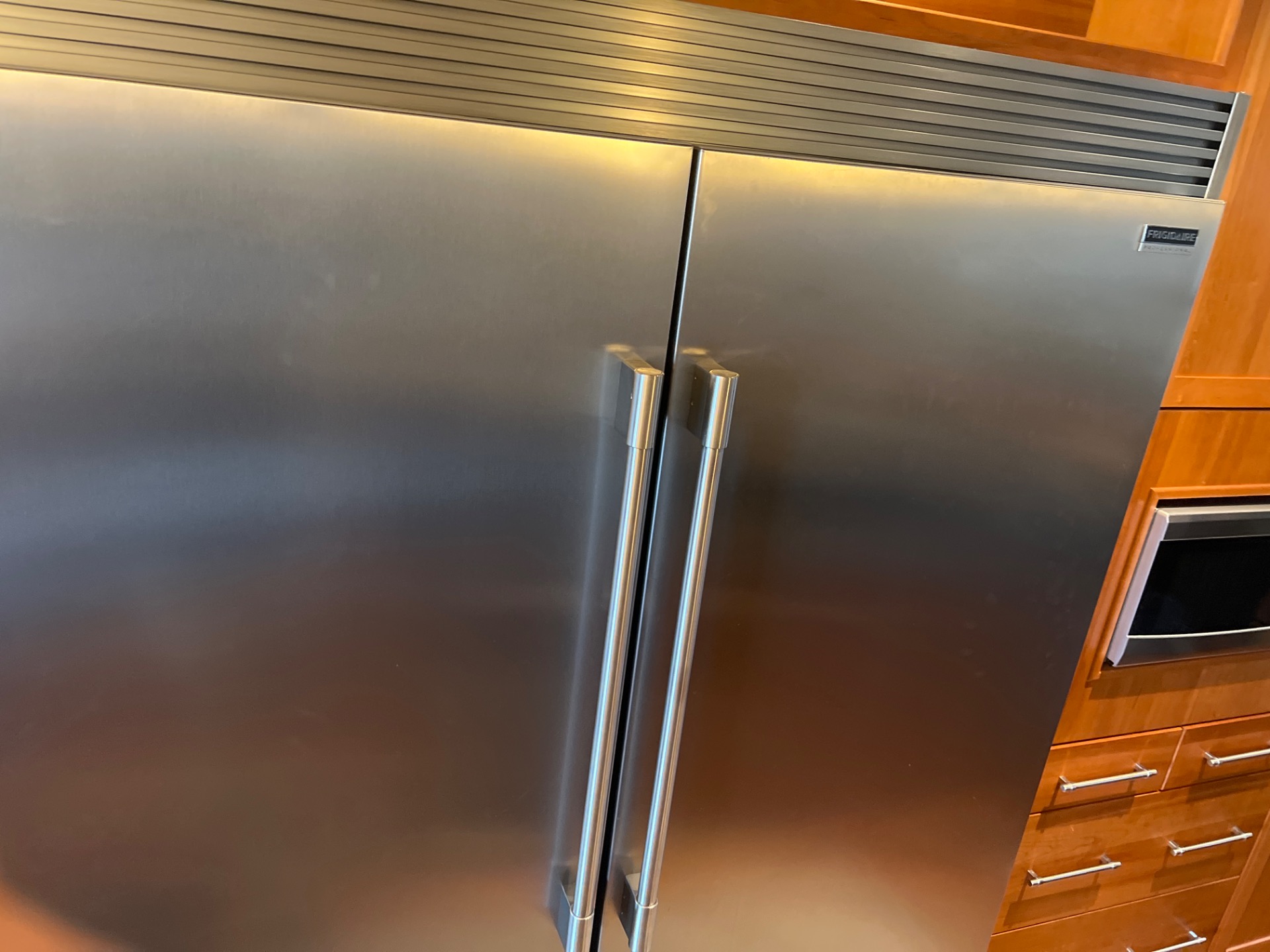
The unit was a Frigidaire Professional built-in refrigerator — the flush-fit, cabinetry-integrated tier, not a freestanding fridge you slide out and swap. It had stopped cooling. By the time TechVill was called, the homeowner already knew roughly what was wrong, because a previous technician had told them: the fridge needed a new coil. What that technician could not do was carry the repair through. The required work sat outside their capability, so the customer was handed a diagnosis and sent looking for someone who could complete it.
That is a frustrating position. The homeowner had already paid for diagnostic time, learned the fault, and still had a non-working built-in unit — one that cannot simply be wheeled out and swapped for whatever is in stock. Built-in refrigerators are sized and panelled to the surrounding cabinetry; replacing one often drags in millwork changes and a custom install. The repair path was clearly the sensible one. It just needed a company that could execute it.
Why a Sealed-System Rebuild Is a Different Tier of Work
Here is the technical reason a fridge like this ends up as a last-resort call. A refrigerator’s cooling comes from a closed loop — compressor, condenser, evaporator coil, filter drier and a measured charge of refrigerant — that runs under pressure and stays sealed for the life of the appliance. Diagnosing a failure in that loop only takes gauges and know-how. Repairing it means breaching the seal, and once the circuit is open the whole job changes character.
The refrigerant has to be recovered and handled correctly rather than vented. New components have to be brazed in cleanly. Every joint then has to be proven leak-free under pressure, because a rebuilt circuit that weeps refrigerant will lose its charge and quit within days. The circuit has to be evacuated with a deep vacuum to strip out air and moisture — trapped water can freeze at the metering point, choke off flow, and kill a brand-new compressor. Only then can it be recharged, by measured weight, to the manufacturer’s specification. None of that is a parts swap. It calls for refrigerant-handling training, evacuation and charging equipment, and the experience to work the steps in the right order. That is the capability tier the previous shop did not have — and the one this repair required.
Diagnosis – Confirming the Coil, Scoping the Whole Circuit
TechVill technician Leonid took the call. On site in Central Canmore, he confirmed the built-in Frigidaire was not cooling and worked the sealed system as a whole rather than acting on the earlier diagnosis alone. The previous technician’s read was sound — the evaporator coil did need replacing — but a fridge that has lost cooling across a degraded circuit is rarely a single-part story. Once a sealed system is opened, the surrounding components and the charge all have to be brought back to spec together, so the honest scope was a full rebuild, not just the one coil.
The Repair – A Full Sealed-System Rebuild in One Visit
Leonid completed the rebuild in a single visit that ran 220 minutes — about three and a half hours on site — reflecting the real scope of the work.
Components replaced:
- Compressor (part #5304494536) — the pump at the heart of the sealed system; it pressurizes and circulates the refrigerant that moves heat out of the cabinet
- Evaporator coil (part #297414901) — the coil the earlier technician had flagged; it absorbs heat from inside the fridge as refrigerant boils off across it
- Filter drier (part #5303305677) — captures moisture and contaminants in the refrigerant line, and is replaced as a matter of course whenever the sealed system is opened
- Thermistor (part #297110400) — the temperature sensor that reports compartment temperature back to the control board so the system knows when to run
Sealed-system procedure performed:
With the components installed, Leonid worked the circuit in the correct sequence. The rebuilt system was first pressure tested for leaks — it passed, with no leaks found — confirming every brazed joint was tight before any refrigerant went in. He then pulled a deep vacuum to evacuate air and moisture from the loop, and charged the system with R134a refrigerant to the manufacturer’s specification. Post-repair testing confirmed the refrigerator was cooling down properly, with all functions operating as expected and no further issues at the time of service. The completed repair carries TechVill’s 90-day labour warranty.
What This Case Shows About Choosing a Repair Company
The full rebuild came to $2,788 plus 5% GST, for a total of $2,927.40 CAD, covering the compressor, evaporator coil, filter drier and thermistor, the refrigerant charge, a handling and disposal fee for the old sealed-system components, and the labour for a three-and-a-half-hour visit. On a built-in unit, that figure has to be weighed against the alternative: replacing a cabinetry-integrated fridge is not just the price of a new appliance but potentially new panels, millwork adjustments and a custom install. A rebuild that restores the original unit to full cooling, done properly and verified leak-free, keeps all of that intact.
The larger lesson is about capability. Genuine Frigidaire OEM parts matter here: a sealed system runs on precise pressures and a precise charge, and components built to the wrong internal tolerances leave the circuit out of balance, shortening compressor life and undercutting the cooling the rebuild is meant to restore. But parts are only half of it. This homeowner did not need a diagnosis; they already had a correct one. They needed a company that could carry out refrigerant recovery, leak-testing, deep-vacuum evacuation and a measured recharge — the sealed-system tier of work that not every appliance shop is set up for. TechVill’s technicians arrive with the equipment and training to walk a refrigerant circuit end-to-end, which is what let Leonid finish, in one visit, the repair another company could only name.
Need Frigidaire Built-In Refrigerator Repair in Canmore?
TechVill services Frigidaire refrigerators across Canmore and the Bow Valley, including built-in and Frigidaire Professional units. Whether your fridge needs a straightforward diagnostic or a complete sealed-system rebuild with refrigerant recovery, leak testing, deep vacuum and recharge, our technicians arrive with the equipment to work the refrigerant circuit end-to-end and with access to genuine Frigidaire OEM parts.
Book online to schedule a Frigidaire refrigerator diagnostic with our team.