

When a refrigerator stops holding temperature, the call almost always comes in worded the same way: “the fridge isn’t cooling.” It is the right description of what the homeowner is seeing. It is rarely the right description of what is broken. On most service calls of this kind, the cooling system is fine. The failure lives one step upstream, in the defrost circuit.
This call out to Three Sisters Mountain Village in Canmore was a clean example of how that diagnostic chain runs in our refrigerator repair work.
The Premise
On any frost-free refrigerator, cold air is generated at a single component — the evaporator coil — and circulated through the cabinet by the evaporator fan. Frost builds up on the evaporator over normal operation, and that frost is removed by a defrost cycle: a heater warms the coil, the ice melts, the water drains away through a small line at the bottom of the evaporator compartment, and the cycle ends when a defrost thermostat detects that the coil is back above freezing.
Three components have to do their jobs correctly for that to work: the defrost timer initiates the cycle on schedule; the defrost heater melts the ice; the defrost thermostat terminates the cycle when the coil is clear. If the thermostat or the timer fails open, the cycle doesn’t end. Heat keeps running. Or worse — the cycle never initiates at all, frost accumulates indefinitely, the drain line freezes solid, and meltwater that should have drained away pools, refreezes, and locks up the entire evaporator compartment.
When that happens, the symptom the homeowner sees is “not cooling.” Because the evaporator fan blade is now encased in ice and can’t spin, and even if it could, the airflow path is blocked. The refrigerator can no longer move cold air into the food zone — even though the cooling system itself is still trying to do its job perfectly behind the wall of ice.
That is the diagnostic chain. The thesis: on a frost-free refrigerator, “not cooling” is usually a downstream symptom of an upstream defrost-circuit failure, not a failure of the cooling system itself. The technician’s job is to pull the evaporator cover and read what is actually there — not to chase the symptom as it was described on the work order.
How That Read in Canmore
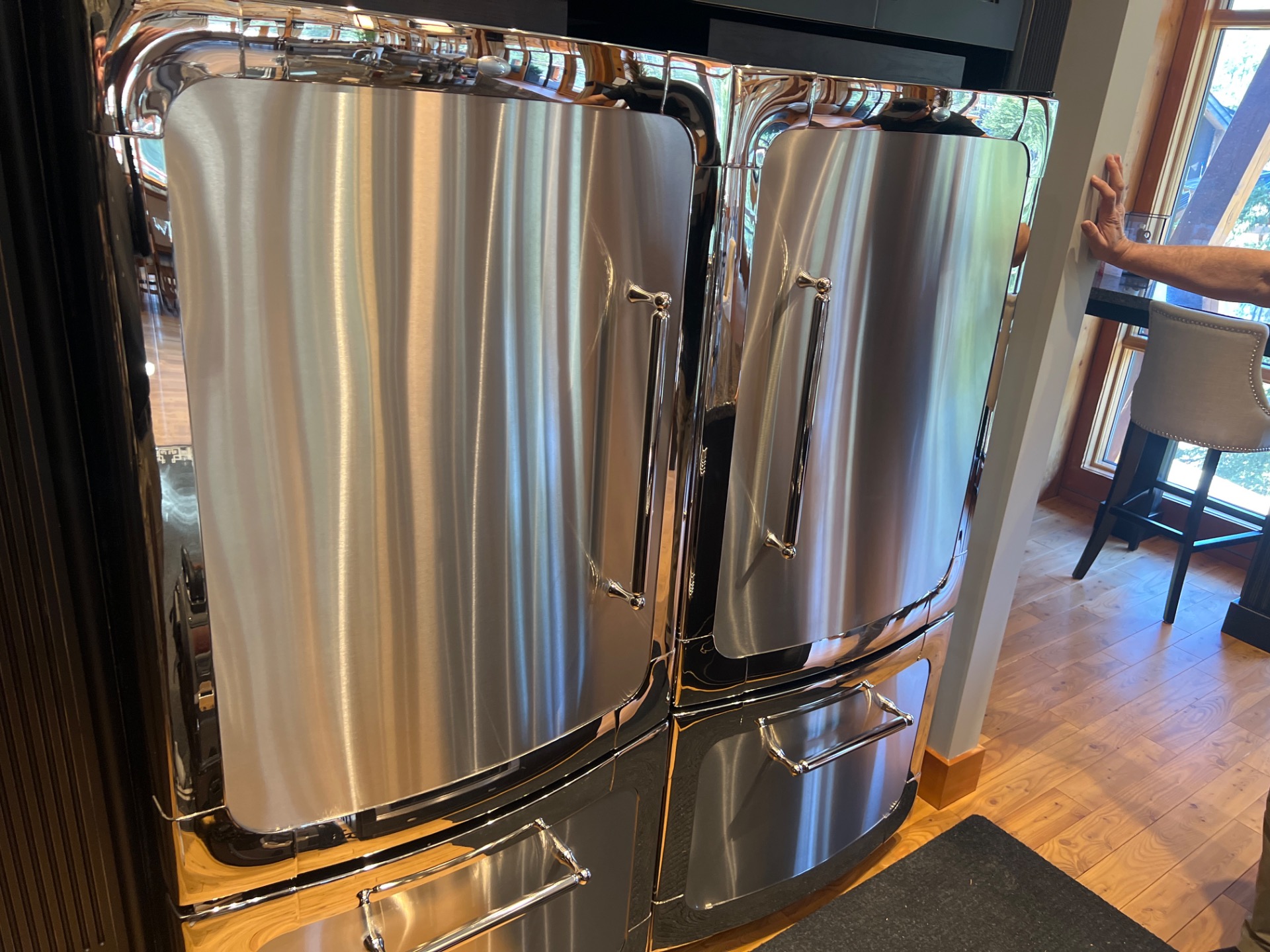
The customer in Three Sisters Mountain Village called in with the textbook complaint: refrigerator not cooling. The unit is a Heartland — premium Canadian retro-style, 1950s aesthetic, set up as paired fridge and freezer towers.
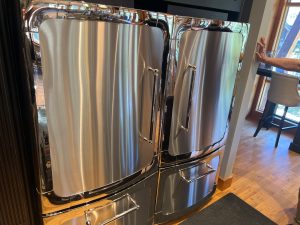
Technician Leonid pulled the evaporator cover. Two observations were immediate and they confirmed the diagnosis before any meter came out:
- The drain line at the bottom of the evaporator compartment was frozen solid — a column of ice where there should have been an open path.
- Heavy ice buildup had formed around the evaporator fan motor, with the fan blade partially locked.
Both observations point to the same upstream cause: the defrost cycle had been failing for some time. The defrost thermostat and defrost timer were not terminating the cycle correctly — meaning either the cycle never ran at all, or it didn’t run long enough, or it ran wrong. Condensate that should have drained away during each cycle had been accumulating and freezing in place over weeks. Eventually the drain plugged, the ice climbed up into the evaporator section, and the fan motor got encased.
The “not cooling” symptom was the last link in a four-step chain. Treating it as the first link — by replacing the fan motor and walking away — would have produced a 30-day-warranty repair at best. Within weeks the still-broken defrost circuit would have re-iced the compartment around the new fan, and the customer would be back where they started.
The Repair
Three things needed to happen in the right order:
Components replaced:
- Defrost thermostat — the temperature switch that terminates the defrost cycle when the coil clears; failure of this part allows ice to accumulate indefinitely
- Defrost timer — the controller that initiates the defrost cycle on schedule; failure here means the cycle never runs in the first place
- Evaporator fan motor — collateral damage from the ice that built up around it once the drain blocked; replaced rather than freed because the bearings had been compromised by being run partially locked
(Heartland-specific part numbers are sourced through the manufacturer’s service channel and were not captured on the work order. Heartland parts are not stocked off-the-shelf the way mass-market refrigerator parts are; the brand is niche and the service channel is direct.)
Thermal and drain work performed:
The evaporator compartment was manually defrosted to clear all accumulated ice — meltwater carefully captured rather than left to refreeze. The drain line was cleared end-to-end and confirmed flowing freely. This is the step most repair shops skip even when they identify the defrost circuit correctly: if the drain remains partially blocked with old ice and biofilm, the very next defrost cycle’s meltwater has nowhere to go, and the system re-ices within days. The drain clear is what converts a parts swap into a permanent repair.
The unit was reassembled, returned to power, and observed through its first cycle. Cooling came back as expected, the defrost cycle terminated correctly on the new thermostat, and the drain line ran clear. Additional labour was logged for servicing the paired fridge/freezer towers rather than a single compartment.
What This Reflects
Two things to draw out of this repair beyond the parts list.
The chain matters more than the part. A diagnostic discipline that goes to the evaporator cover and reads the actual condition — not the symptom on the work order — finds the right component on the first visit. Without that step, “not cooling” sends a less disciplined technician to the cooling system: compressor, refrigerant charge, condenser, sealed-system testing. None of those would have been wrong on this unit. They are simply not where the failure is.
Niche premium brands need shops that actually service them. Heartland is a Canadian retro-style line — high-end pricing, vintage form factor, parts that aren’t stocked at the regular distributor. Many appliance repair shops decline to service this brand at all, because identifying the right service part and ordering through Heartland’s channel isn’t a routine workflow. Doing it correctly on the first visit — including the manual defrost and the drain-line clear that a parts-catalogue alone won’t tell you to do — is itself the differentiator on this kind of call.
If your refrigerator reads “not cooling” and the cooling system inside is working perfectly, the answer is almost always upstream. Book online to schedule a Heartland refrigerator diagnostic, a defrost-circuit repair, or any frost-free refrigerator service with our team.