

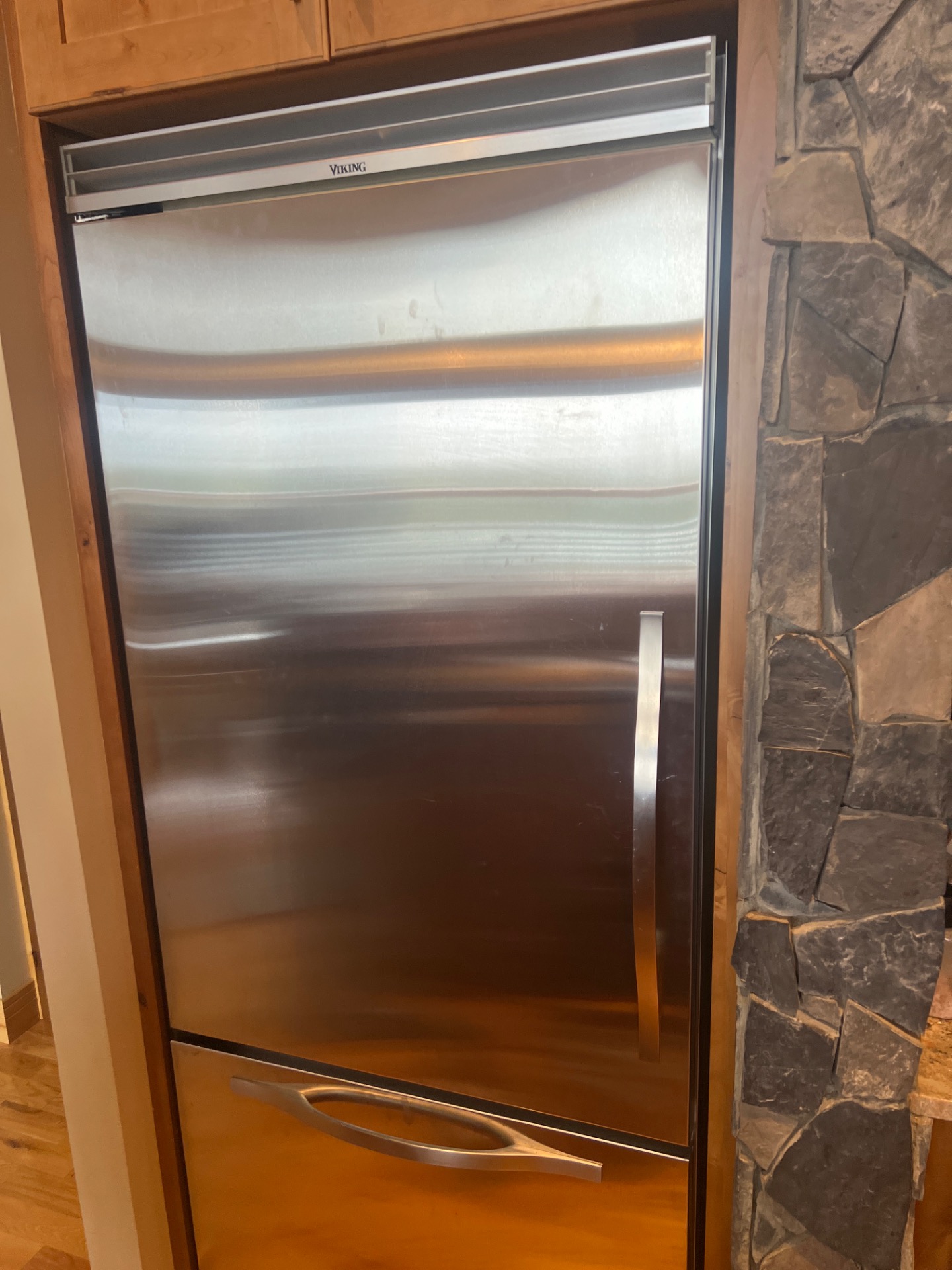
A homeowner in the Silvertip community of Canmore contacted TechVill for built-in fridge repair on a Viking bottom-freezer that had two problems at once – the user interface controls had stopped working correctly, and the unit had stopped cooling. TechVill technician Leonid drove out to the mountain estate property, walked the diagnosis through, and ended the visit with both subsystems repaired in one trip. Along the way he also documented two separate corrections to work a previous technician had left incorrectly closed.
This case ran 160 minutes on site and tells the story in roughly the order things were discovered.
Phase 1 — The UI controls and the green harness
The first complaint was the obvious one: the user-side controls were not responding correctly. On a Viking built-in of this generation, the user interface connects to the main control system through a dedicated wiring harness — green in the OEM colour code — that carries the signal between the UI panel and the control board. When the harness is intact, button presses and display feedback are reliable. When the harness has failed, the control board is not receiving correct signals from the UI, and the user-side complaints follow.
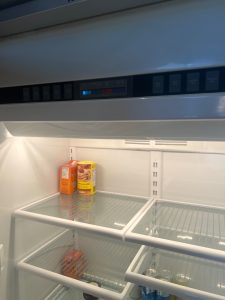
Diagnosis confirmed the green harness as the failed component. Replacing it with the OEM Viking service part (PE950174) restored full UI function. Buttons responded, the display showed correct status, and the user-side interaction was back to normal.
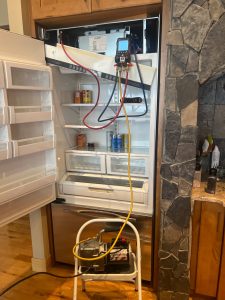
That should have been a one-fault, one-fix repair. But the unit still was not cooling — which meant a second, independent fault was waiting underneath the first one.
Phase 2 — The sealed system was empty
With the UI repair complete, Leonid moved to the cooling problem. A built-in refrigerator that has stopped cooling can mean a failed compressor, a failed evaporator fan, a refrigerant leak, or a control fault somewhere else in the system. Diagnostic readings on this unit pointed clearly at one thing: the sealed system was empty of refrigerant.
Leak testing isolated the source quickly, and the source was not where it normally is. The leak was at the Schrader valve — the access port used by service technicians to evacuate, charge, or check pressure on a sealed refrigeration system. The Schrader was loose. Refrigerant had been venting slowly through it ever since.
That finding tells a specific story about the unit’s recent service history. A Schrader valve does not loosen on its own — it is tightened during service and stays tightened until someone opens it. A loose Schrader after the fact means a previous technician opened the sealed system, did some work, and did not tighten the valve back to spec on the way out. The customer’s slowly-leaking refrigerant had been quietly costing them cooling performance for who knows how long.
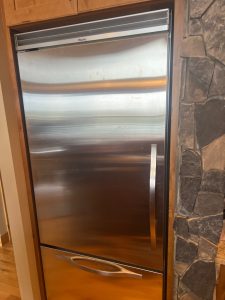
Leonid tightened the valve, evacuated the system to vacuum (which clears air and moisture before recharging), and recharged with the proper refrigerant to manufacturer specifications. Post-repair testing confirmed the sealed system was holding pressure, both compartments were cooling, and the unit was operating as designed.
Phase 3 — The oven that was “no longer repairable”
While Leonid was on site, the customer raised a separate concern about a different appliance — a built-in oven in the same kitchen that a previous technician had told him was no longer repairable. The story the customer had been given: the parts for the oven are no longer available. Effectively, the oven had been written off, and the customer was looking at replacement of a built-in unit.
Leonid took a look. The parts the previous technician had said were unavailable were, in fact, still available through the manufacturer’s service channel. The information the customer had received was wrong. Rather than dramatize that or leave the customer uncertain, Leonid prepared a written quotation on the spot for the oven repair scope — a real parts quote with line items, so the customer can compare it against the replacement cost and make an informed decision about whether to fix the oven or replace it.
That is a second prior-tech correction in one visit. The first was the loose Schrader valve under the refrigerator. The second was the “parts unavailable” claim on the oven. Neither correction was the reason for the original service call, and neither got billed as scope expansion — both were documented as what they were, given back to the customer with the right information, and left to the customer to act on.
What was actually billed and what was scoped separately
The Viking refrigerator dual-subsystem repair on this visit: $3,466.68 CAD total payment, covering the green harness replacement, the sealed-system service (Schrader valve correction, evacuation, and recharge), the diagnostic work, and the on-site labour for a substantial 160-minute scope. The work order documents the total as a consolidated charge rather than itemizing parts, labour, refrigerant, and service-call lines separately.
Components replaced:
- Viking UI control wiring harness (part #PE950174, green colour code) — carries signal between the user interface panel and the main control board; the failed unit had stopped delivering correct UI input to the control logic, producing the user-side control complaints
Sealed-system service performed:
- Schrader access valve tightened to manufacturer specification — restoring the sealed loop and stopping the refrigerant leak at the prior-service-defect point.
- System evacuated to vacuum — clearing air and moisture from the lines before recharging.
- System recharged with the correct refrigerant to manufacturer specifications.
- Post-repair pressure verification — confirming the system was holding and cooling cycles were normal on both compartments.
The built-in oven quotation prepared on the same visit was issued as a separate scope, with its own line items, for the customer to authorize independently if they choose to proceed.
What this case demonstrates
Two-subsystem diagnosis and repair in one visit is the right answer when the underlying faults are independent. A loose Schrader valve on a sealed system and a failed green harness on the UI control are two completely unrelated failures that happen to be on the same unit. A less comprehensive approach would have addressed the visible UI symptom, closed the file, and left the slow refrigerant loss for the next service call when the cooling failure finally showed up. Catching both in one visit means one trip, one labour line, and no separate callback when the second subsystem’s symptoms surface on their own.
Honest disclosure of prior-service issues — without dramatizing them — is the kind of work that builds long-term customer trust. The loose Schrader valve was documented in the work order as the leak source, fixed correctly, and reported back to the customer without theatrics. The “parts no longer available” misinformation about the adjacent oven was corrected with an actual parts quote rather than a dismissive comment. Both corrections gave the customer back accurate information to make their own decisions.
OEM-only parts are the only defensible choice on premium built-in refrigeration. The Viking green harness is a brand-specific connector design matched to the unit’s UI control architecture; the sealed-system refrigerant is the specific type and quantity Viking engineered the system around. Generic substitution at either point would have introduced tolerance mismatches that would have shortened the life of the repair.
Canmore service is its own operational capability. The Silvertip community is an estate-home development on Canmore’s south flank, adjacent to the Silvertip Golf Resort, with property values in the $2M to $10M+ range. The drive from Calgary runs over an hour each way, in the mountain corridor between the city and Banff. Most Calgary appliance shops do not make that trip. This is TechVill’s second documented Canmore case, after a Heartland refrigerator repair in Three Sisters Mountain Village — both serviced by the same technician, covering two of Canmore’s premier mountain residential communities.
Need Viking Refrigerator Repair in Canmore or the Bow Valley?
TechVill services Viking appliances across Calgary, Canmore, and the Bow Valley corridor. Our technicians arrive with brand-specific test equipment, access to the Viking service parts catalogue, sealed-system service capability, and the experience to diagnose dual-subsystem failures end-to-end on premium built-in refrigeration.
Book online to schedule a Viking refrigerator service appointment with our team.