

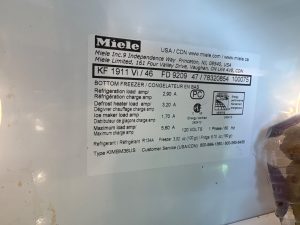
A homeowner on a rural acreage in Priddis, in Foothills County southwest of Calgary, contacted TechVill after their Miele KF1911Vi/46 built-in refrigerator stopped cooling on both sides at once. The freezer and ice maker had quit entirely, and the fresh-food compartment was no longer holding temperature. TechVill technician Boris arrived, measured the system, and traced the failure to several components at the same time — a clogged condenser, a non-running freezer compressor, and a failed inverter. This is a repair in progress: the condenser was cleaned, the inverter is on order, and an evaporator fan is still to come.
The Problem – Both Compartments Failing on a Premium Integrated Built-In
The KF1911Vi/46 is part of Miele’s premium built-in line. The “Vi” suffix marks it as a panel-ready integrated unit, designed to disappear flush into custom cabinetry with a matching door front. Replacing a refrigerator built to this standard is not a like-for-like swap — it usually means new custom panels, cabinetry adjustments, and integration labour on top of the appliance cost, which for this class of unit runs into many thousands of dollars before any of that fitting work.
When both compartments stop cooling at once, the symptom is diagnostically important. Two cooling problems appearing together usually trace back to one of two scenarios: a single shared upstream cause — a blocked condenser, a sealed-system fault, or a control-electronics failure that affects the whole appliance — or several components failing independently around the same time. Replacing whatever looks broken without separating these two cases is how a homeowner ends up paying twice. The first job on site was to tell them apart.
Diagnosis – Quantitative Measurement, Component by Component
Boris worked the unit methodically and documented the readings rather than estimating them. The temperatures alone showed how far the appliance had drifted: the fridge compartment sat at +16°C against a 0–4°C target, and the freezer measured +27°C against a -18°C target — essentially room temperature, with no meaningful cooling on the freezer side at all.
From there the diagnosis went component by component:
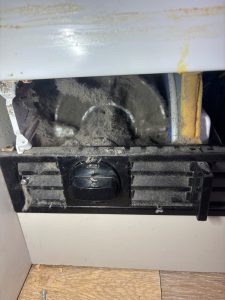
- Condenser completely clogged. The heat-rejection coil was packed with dust and lint, choking the system’s ability to shed heat. It was cleaned on site to clear that restriction immediately.
- Condenser fan spinning. With the blockage removed, the airflow side of the condenser circuit was confirmed functional.
- Fridge compressor drawing 0.34 A. A clamp measurement confirmed the fresh-food compressor was electrically active, but the relatively low current is consistent with a compressor running under reduced load — what you would expect when the sealed system isn’t moving refrigerant correctly against its design conditions because of the upstream restriction.
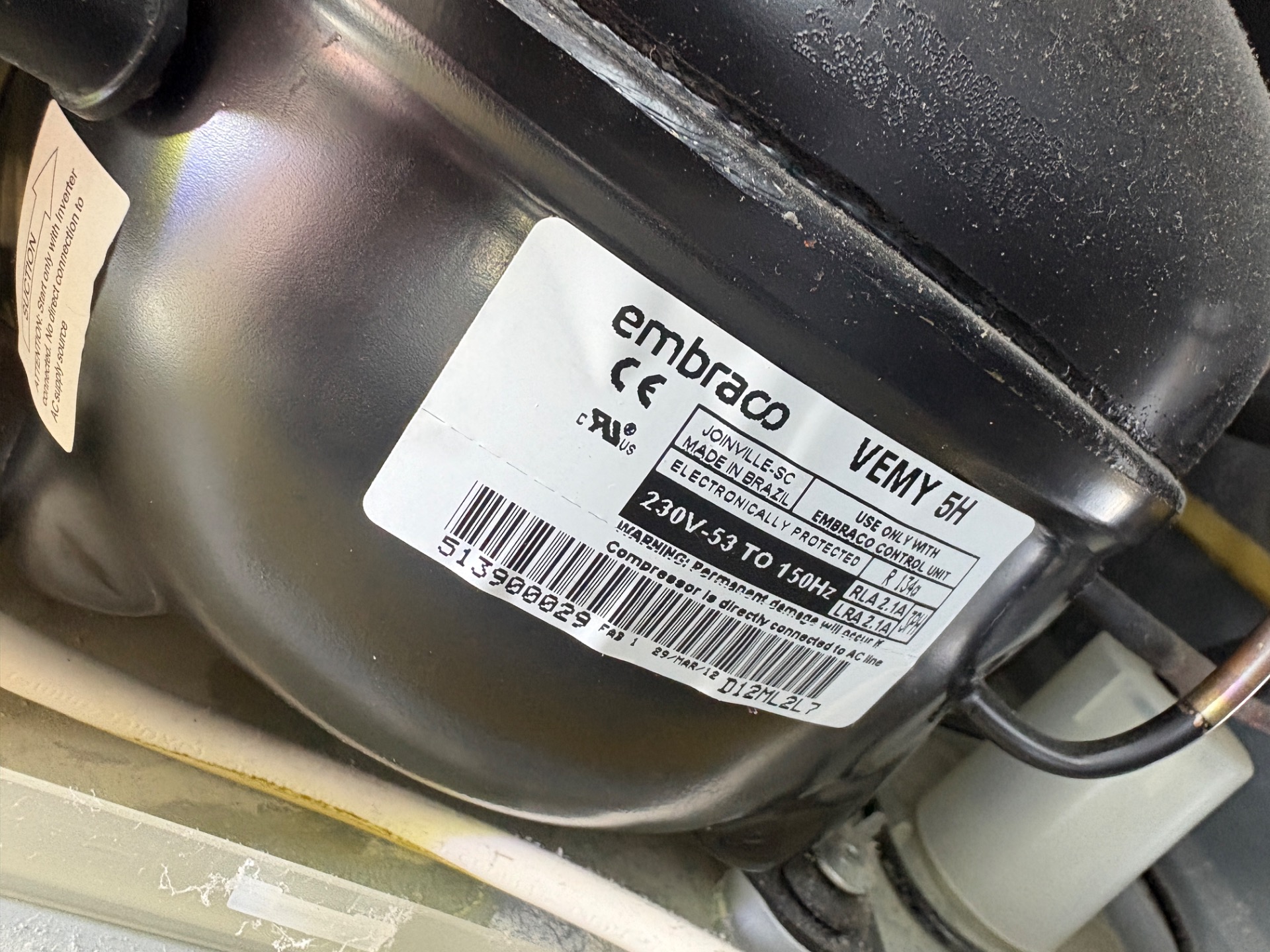
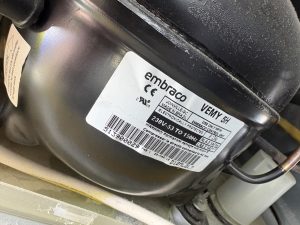
- Freezer compressor not running. This unit uses a dual-compressor architecture, with a separate compressor for the freezer circuit. That compressor was not operating, which directly explains the +27°C freezer reading.
- Inverter fault. The inverter — the variable-speed electronics that drives the modern Miele compressor — was identified as failed and flagged for replacement.
- Refrigerator evaporator fan not spinning. The fan that circulates cold air through the fridge compartment was confirmed dead and added to the parts list.
Boris also entered the appliance’s service test mode and pulled its stored error history: F110, F121 through F125, and F141 through F146. These were classified as minors — transient or historical events rather than active critical faults — and cleared, so the control could be re-evaluated from a clean baseline once the new parts are installed. Reading and interpreting Miele’s internal service codes is OEM-tooling-level work; logging the codes, classifying them, and clearing them is part of a disciplined sealed-system service record, not an optional extra.
The interpretation: this is a genuine multi-component failure with at least one shared upstream stressor. The condenser blockage had been loading the entire sealed system; on top of that, the freezer compressor was down, the inverter had failed, and the fridge evaporator fan had stopped. Sealed-system side, air-circulation side, and control side were all involved.
The Repair – In Progress, Cleaned and Re-Electronified, Fan Pending
Because this case is honestly mid-repair, here is exactly where it stands. Completed at this visit:
- a full multi-component diagnostic with measured temperatures and compressor current;
- the condenser deep-cleaned on site, restoring heat-rejection capacity immediately;
- the inverter electronics replacement initiated;
- the stored test-mode error codes documented and cleared for a clean re-evaluation;
- a full disclosure to the homeowner of the remaining scope and cost.
OEM Miele parts on this repair:
- Inverter electronics, VCC3 (part #9120760) — the variable-speed control unit that drives the compressor, modulating its output instead of switching it fully on and off. That modulation is the core of Miele’s energy-efficient cooling, and an inverter fault can show up as anything from a compressor that never starts, to one that cycles erratically, to one that runs but at the wrong speed.
- Refrigerator evaporator fan, 115V (part #7226824) — circulates chilled air through the fresh-food compartment. On order, with an ETA of up to four weeks and prepayment requested.
Still pending: when the evaporator fan arrives, the appliance will be reassembled and the whole system re-evaluated. A specific open question is the freezer compressor: with the condenser blockage cleared and the inverter replaced, the next visit will confirm whether that compressor resumes normal operation, or whether it has failed independently and needs to be replaced in its own right. We are documenting that openly rather than guessing at it now.
The Result – Restriction Cleared, Verification to Follow
Clearing the condenser blockage and replacing the inverter restores the two things the appliance most needs to function: its ability to reject heat and its compressor control electronics. With the evaporator fan still on order, full cooling performance can’t be confirmed until that part is installed and the system re-checked — so the homeowner has been set up to expect a return visit and a final function test rather than a finished result today. That transparency is the point: a premium sealed-system rebuild of this scope is verified, not assumed.
What This Case Demonstrates
The repair economics of an integrated built-in. A KF1911Vi/46 is engineered to vanish into the kitchen — panel-ready, flush, matched to surrounding cabinetry. Walking away from a unit like this doesn’t just mean buying a new refrigerator; it means new custom door panels, possible cabinetry rework, and integration labour to make a replacement sit correctly in the same opening. Against that, a staged repair — condenser cleaned, inverter replaced, evaporator fan to follow, freezer compressor verified — keeps the existing installation intact and addresses the actual failures. For this class of appliance, diagnosing and repairing is very often the economically rational path, not the sentimental one.
Comprehensive diagnosis instead of a single visible swap. A less thorough approach could have replaced only the inverter, since that was the obvious electronics failure, and left the condenser choking the system — or cleaned the condenser and missed the inverter and the dead evaporator fan entirely. Either path leads back to a second service call. Measuring the temperatures, clamping the fridge compressor at 0.34 A, confirming the freezer compressor wasn’t running, reading and clearing the stored error codes, and checking the evaporator fan turned a vague “it’s not cold” complaint into a defined, multi-component scope. Identifying every failure mode in one diagnostic is what keeps a repair like this from turning into three.
Why OEM parts matter on a Miele inverter specifically. The VCC3 inverter is not a generic motor relay — it is a calibrated, model-matched control unit that talks to the compressor and the appliance’s electronics within tight tolerances. An aftermarket or cross-referenced substitute may carry the right physical connectors and still drive the variable-speed compressor outside its intended operating envelope, because the firmware, speed mapping, and fault thresholds are specific to the unit. On a compressor whose entire efficiency depends on precise speed modulation, a control board that’s “close enough” can run the compressor at the wrong speed, mis-read fault conditions, or shorten its life. Sourcing the genuine Miele 9120760 keeps the inverter’s calibration matched to the compressor it was designed to command — which is exactly why TechVill’s OEM-only policy isn’t a preference here, it’s a requirement.
Need Miele Built-In Refrigerator Repair in Priddis or Foothills County?
TechVill repairs Miele built-in and integrated refrigerators across Calgary and the surrounding rural Foothills communities, including Priddis. Rural acreage service from the city is something many Calgary shops don’t take on regularly; our technicians make the trip with the test equipment to walk the sealed system and controls end to end, and with access to genuine Miele OEM parts. Mileage for rural calls is quoted transparently up front so there are no surprises on the invoice.
Book online to schedule a Miele built-in refrigerator diagnostic with our team.