


A specific class of service calls comes in with the customer’s diagnosis pre-written into the ticket. “Griddle igniter replacement.” “Compressor swap.” “Heating element replacement.” The homeowner has been close enough to the appliance long enough to form a hypothesis about what failed, and the booking text reflects that hypothesis as if it were the diagnosis.
The right protocol is to test the hypothesis as the first diagnostic step, not to execute it. If the hypothesis is correct, the test confirms it and the part swap proceeds. If it isn’t, the test rules it out within minutes and the diagnostic continues. Acting on the ticket as-written, on a unit that hadn’t actually been diagnosed, is one of the most common ways customers end up paying for parts that were never the failure.
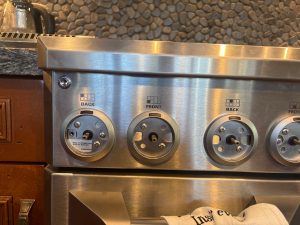
This is what testing the customer’s hypothesis looks like in practice — on a 48-inch GE Monogram pro range in Priddis, AB, where the ticket pointed at the igniter and the actual fault sat one component over.
Q: What did the ticket say?
“Griddle igniter replacement.” A specific operation, on a specific component, on a specific section of the range — the griddle, on a ZDP486NDP4SS pro-range that runs both burner and griddle sections off the same gas distribution. The customer expected an installer-style visit: arrive, swap part, leave.
Q: What did TechVill bring to the door?
TechVill is factory-authorized by GE for the Monogram platform, with access to the service procedures and part specifications specific to the ZDP486 series. TechVill technician Boris pulled the documentation in advance, brought a multimeter for igniter resistance and continuity, a clamp meter for current draw on the demand cycle, and a calibrated thermal probe for thermostat verification. Authorized service does not mean the customer’s ticket gets executed without question. It means the diagnostic protocol the manufacturer specifies for the platform gets followed.
Q: What did the first test show?
The igniter was healthy. Continuity confirmed, resistance within spec, current draw correct on the demand cycle, no visible surface degradation. The customer’s hypothesis ruled out within the first few minutes of the call. If the work order had been executed as written, the igniter would have been swapped, the griddle would still not have lit, and the customer would have paid for an unnecessary part on a unit that still wouldn’t work.
Q: So what was the actual fault?
The griddle thermostat. With the igniter cleared, the diagnostic continued through the griddle control circuit. The thermostat that regulates griddle cavity temperature was reading inaccurately against the calibrated probe and was failing to close the demand circuit on cold-start. That single fault explained the symptom completely: with the thermostat not closing on demand, the igniter never received the request to fire, and the griddle never lit. From the customer side, identical to igniter failure. Mechanistically, a different component.
The OEM part identified for the platform was thermostat WS01F02656, the GE-specified replacement for the ZDP486 griddle assembly.
Q: Was the replacement straightforward?
The part itself, yes. The wiring, no — and this is where authorized service ran into one of its limits.
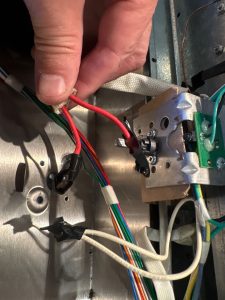
The replacement thermostat shipped with documentation that did not clearly specify the harness-side electrical wire connection configuration. On a unit at this calibre, with multiple control circuits routed through a shared harness, an incorrect connection could produce a non-functional griddle, incorrect feedback to the main control board, or — in the worst case — a wiring fault that affected adjacent circuits. None of those were acceptable outcomes.
Boris worked the wiring through harness analysis: tracing signal lines from the new thermostat against the schematic in the GE service documentation, confirming polarity on the load side, and verifying continuity through each connection before powering up. The configuration that worked against the harness and the schematic was confirmed and finalized.
Q: What got installed in the end?
- Thermostat (part #WS01F02656) — temperature sensor and control that maintains griddle cavity temperature against user setpoint by gating the gas valve and igniter cycle on the ZDP486NDP4SS platform
After installation and wiring verification, the unit was powered up and the griddle was put through a complete heat-up cycle. The thermostat closed correctly on demand, the igniter fired, the griddle burner lit, and cavity temperature reached setpoint within the expected window.
Q: What did this save the customer?
Two things. First, an unnecessary igniter swap that would have produced no improvement on a unit that wouldn’t have been any closer to working. Second, a callback against the actual fault, which would have meant a second truck roll, a second diagnostic charge, and a coordination cost on the customer’s calendar that didn’t need to exist.
The original ticket text — “griddle igniter replacement” — got rewritten to match what was actually wrong. The customer paid for the right repair. The healthy igniter is still on the range, with the rest of its service life intact.