

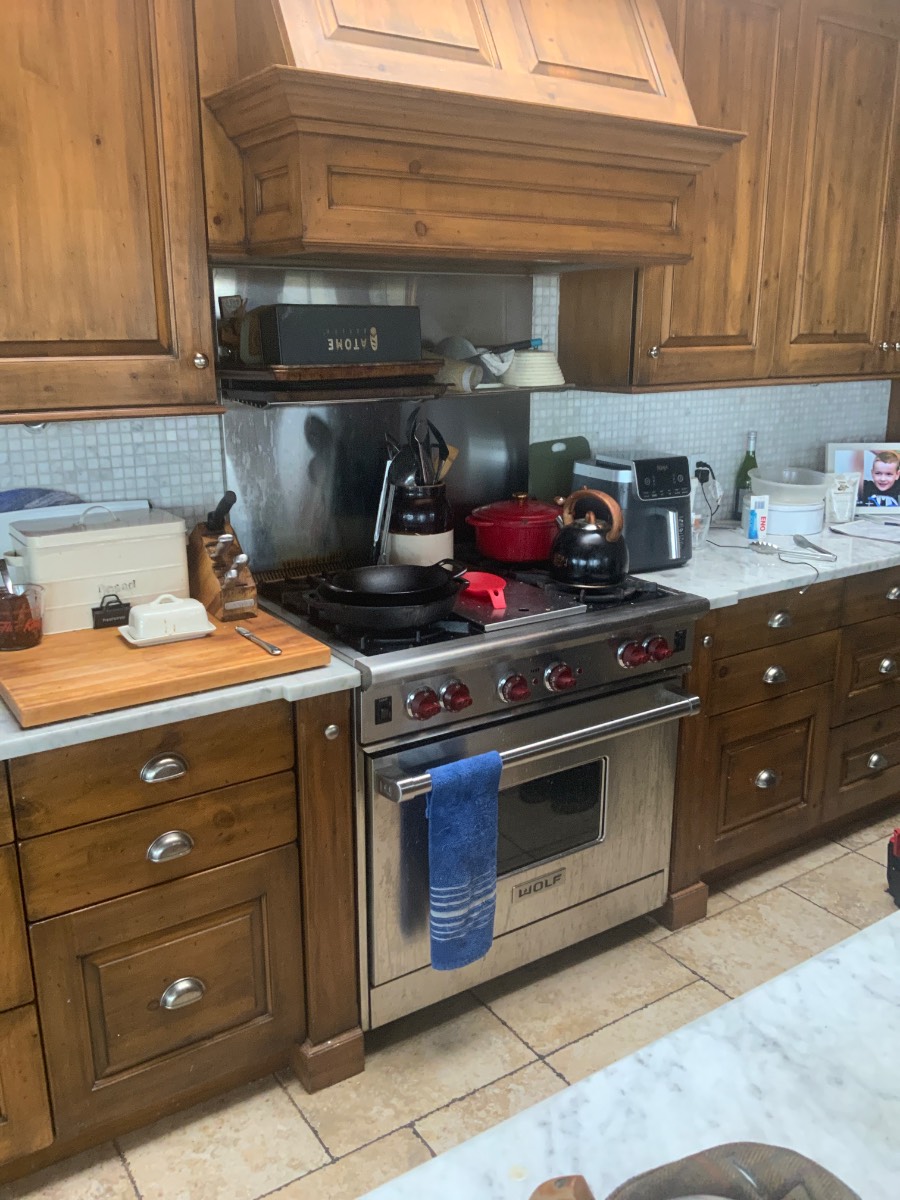
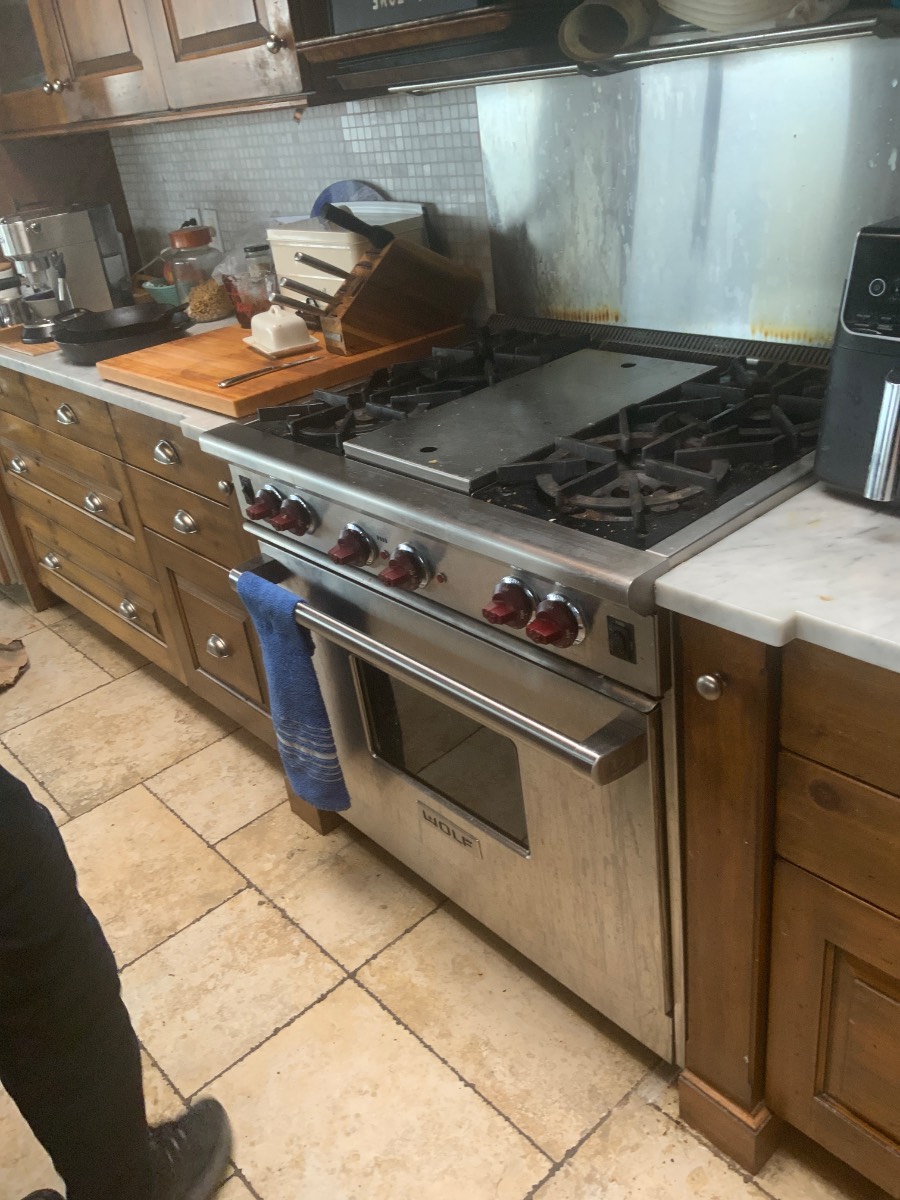
The call came in from a homeowner in White Rock with a specific concern: their Wolf R364G 36-inch gas range was randomly turning on, and at times would not turn off even with the knob in the off position. That description deserves a careful read before the appointment is even scheduled. This walks through how the call was scoped, why it took priority, and what was actually wrong.
What the customer reported, and why the framing matters
The oven would randomly turn on, or would not turn off even with the control switch in the off position.
A homeowner reading their own appliance’s behaviour as “random” can mean several things. On an electronic oven it usually means a control board glitch or a stuck button. On a mechanical gas range, “random ignition” carries weight that is qualitatively different from an oven that runs at the wrong temperature or one that will not light at all. Uncontrolled gas flow into a household appliance is a gas-safety category, not a regular appliance complaint. The risks scale: potential for gas accumulation if ignition is delayed, fire from unintended heat sources, and serious carbon-monoxide concerns if combustion runs incomplete.
The right scheduling response is same-day or next-day diagnostic priority. Not a standard service slot a week out.
What the diagnostic looked like on arrival
Intermittent gas faults are diagnostically infamous. They happen when no one is watching, and they stop the moment a technician walks in the door. Most diagnostic visits on this kind of complaint go one of two ways — either the symptom cooperates and a confident diagnosis follows, or the symptom hides and the visit closes with “could not reproduce.”
This one cooperated. TechVill technicians Alex and Albin arrived and duplicated the symptom immediately: the oven was firing on its own, with the knob set to off. That mattered, because the diagnosis could be anchored in observed behaviour rather than inferred from a description that no one could verify.
What was actually wrong
The cause was a single failed component: the oven thermostat switch, located behind the oven knob. Specifically, a contact inside the thermostat was making contact even when the switch was not engaged — the thermostat was electrically commanding the oven to fire even though the user had the knob in the off position. The control was lying about its own state, and the appliance was acting on the false signal.
That maps cleanly: safety-relevant symptom (random ignition, fails to shut off) traces to a single internal contact in a single component. No workaround, no software fix, no chasing wiring or gas-valve theories — the failing physical contact gets replaced and the system returns to honest behaviour.
Why this was a fast-turnaround repair
The Wolf service channel typically runs three-to-five days on special-order parts. On a safety call, that wait is itself a problem. The customer’s range is a gas-safety hazard until the thermostat is in.
The Wolf 827647 oven thermostat is one of the parts TechVill keeps on hand specifically because this failure mode comes up enough on the brand to justify the inventory position. A 50% deposit was collected on this visit to confirm the customer’s authorization to proceed, with the install visit scheduled essentially immediately rather than queued behind a manufacturer parts shipment.
When installed, the verification matters as much as the install itself. Post-install testing on a thermostat replacement does not just check that the oven fires when commanded — it confirms that the oven does not fire when the knob is set to off. The honest-behaviour test, with the knob in every off position, across enough cycles to confirm the random-ignition behaviour is gone.
Components replaced:
- Wolf oven thermostat (part #827647) — switches the oven heat circuit on and off in response to user control input; the failed unit had an internal contact closing even when the switch was set to off, commanding the oven to fire without user input
What the customer paid
The total quoted: $1,222.20 ($1,164 + 5% GST). 50% deposit $611.10 CAD was collected by credit card on the diagnostic visit — exactly half the quoted total, math reconciles cleanly. Balance due on completion: $611.10. Because the part is stocked on hand at TechVill, the install visit moves at the customer’s scheduling preference rather than waiting on Wolf service-channel shipping.
The install was assigned as a two-technician scope. Wolf R-series ranges are heavy, gas-connected, and integrated into custom kitchen installations. Two pairs of hands provides safer handling, proper gas-line management, and faster execution — same scoping discipline TechVill applies to every built-in premium installation. Alex’s documented work history covers eight cases now across the BC service area, on Viking, Fhiaba, Miele, and Wolf premium-brand installations from Burnaby through to White Rock. Albin’s case work is just starting; this is the first documented case in his portfolio.
What this case demonstrates
Safety-first symptom recognition is the first piece of the work. “Random ignition / won’t shut off” on a gas appliance is materially different from “oven not heating” or “oven not cycling correctly.” It deserves an immediate diagnostic priority — and the customer was right to flag it as a concern, not a routine service request.
Catching an intermittent fault during the diagnostic visit is the technical centerpiece. Many “random ignition” calls end at “could not reproduce” because the unit refuses to misbehave while the technician is there. The diagnosis on this case was anchored in observed behaviour, not in inferred behaviour from a complaint description — and that is the difference between a confident single-component replacement and a multi-visit fishing expedition.
Truck-stocked parts on safety-relevant failure modes are the operational piece. For Wolf customers in Metro Vancouver, the difference between a three-to-five-day Wolf service-channel wait and a few-day in-stock install is the difference between living with a gas-safety hazard for another week and getting it fixed promptly. That inventory positioning is the kind of brand-specific service capability that justifies itself on cases exactly like this one.
White Rock is the ninth documented BC community in TechVill’s portfolio and the southernmost — well south of central Vancouver, on the way to the U.S. border. The BC coverage now runs the geographic width of the Lower Mainland: West Vancouver and the North Shore in the north, through Vancouver proper, Burnaby and Richmond in the middle, down to White Rock in the south. This is also the first Wolf case TechVill has documented in BC; all four previous Wolf cases were Calgary-region.
Need Wolf Gas Range Repair in the Lower Mainland?
TechVill services Wolf and Sub-Zero appliances across Metro Vancouver and the Lower Mainland, from West Vancouver through to White Rock. Our technicians arrive with brand-specific test equipment, two-technician scoping where the install requires it, and the inventory awareness to handle gas-safety calls on a same-week timeline.