

When a gas oven stops heating, the obvious assumption is that no power is reaching the part that lights it. But on a gas range, “power is reaching the ignitor” and “the ignitor is working” are two different things — and the gap between them is exactly where this kind of fault hides. A bake ignitor can be energized, can even glow, and the oven will still stay cold, because in a gas oven the ignitor is not only the spark — it is also the safety switch that decides whether gas is allowed to flow at all.
That distinction is the whole story of a recent repair TechVill technician Hardeep Singh handled on a Frigidaire gas range in the Killarney / Glengarry community of inner SW Calgary. Below is how the safety chain works, why a part that still receives voltage can leave you with a dead oven, and how the repair confirmed it.
The Problem – Cooktop Working, Oven Cold
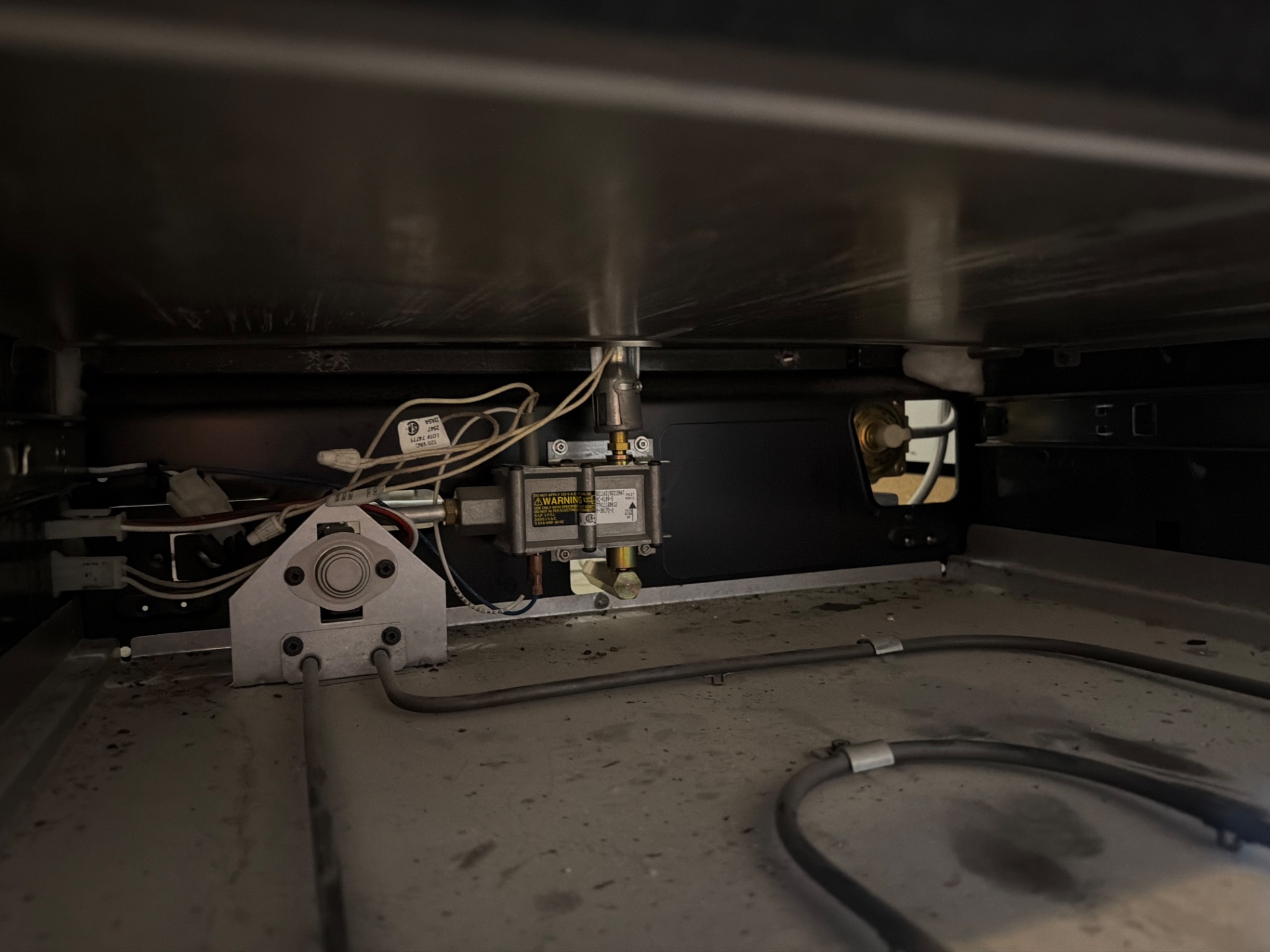
The homeowner reported a precise and diagnostically useful symptom: the cooktop burners lit and worked normally, but the oven produced no heat. On a gas range that split matters. A gas range is really two separate heating systems sharing one cabinet — the surface burners on top, and a separate gas burner sealed inside the oven cavity.
Because the cooktop was lighting, gas supply to the appliance was clearly intact and the basic gas-safety hardware was operational — otherwise the surface burners would not have worked either. That narrows the fault to the oven heating circuit specifically: the bake ignitor, the oven gas valve, the temperature control, or the safety chain that ties them together. On a Frigidaire PLGS389ADB — a freestanding, mid-tier residential gas range — an isolated oven-not-heating symptom most often traces to the bake ignitor.

How a Gas Oven Ignitor Actually Controls the Gas
Here is the mechanism that makes this fault counter-intuitive, and the reason a gas oven fails differently from an electric one.
On an electric oven, the bake element is the heat — current flows through it, it glows, and that resistance heating cooks the food. If voltage reaches an electric element and the element is intact, you get heat. (That is the failure mode we documented on a Frigidaire electric range in Scenic Acres, where the bake element itself had opened.) A gas oven works on a completely different principle. The hot-surface bake ignitor does not heat the food. It does two jobs at once: it gets hot enough to light gas, and — critically — it acts as the current-sensing safety switch that tells the oven’s gas valve it is safe to open.
The safety circuit on a gas oven watches current draw, not just voltage. A healthy hot-surface ignitor pulls a specific minimum current — typically in the 3.0 to 3.6 amp range — and the gas valve is wired in series with it. Only when the ignitor draws enough current to confirm it is glowing white-hot does the valve open and release gas to the burner. This is deliberate: it prevents the oven from dumping raw gas into the cavity before there is a flame source hot enough to ignite it.
The trap is what happens as an ignitor ages. Microcracks and material breakdown change its electrical resistance. It can still receive full voltage, and it may even produce a visible glow — but the current it draws falls below the safety threshold. The valve never “sees” enough current, so it refuses to open, gas never reaches the burner, and the oven stays cold. The unit is doing exactly what it was designed to do: hold the gas valve shut until ignitor confirmation arrives — confirmation that, with a degraded ignitor, never comes.
Diagnosis – Voltage Present, Current Absent
That theory is precisely what the diagnostic on the Frigidaire confirmed. Hardeep tested the bake circuit and found the bake ignitor was receiving proper voltage — the control board was correctly calling for heat, the relays were switching closed, and the wiring to the ignitor terminals was intact and energized. The control side of the oven was doing everything right.
The ignitor itself was the failure. It was energized but no longer drawing current within spec, so the safety-signal chain to the gas valve was effectively broken. That measurement does more than condemn the part — it rules out the alternatives. A failed control board, a wiring break, or a faulty gas valve would each produce a different test result; voltage-present-but-no-current-draw points specifically at a degraded ignitor and nothing else.

The Repair – Same-Family OEM Ignitor, One Visit
With the failure confirmed, the fix was a single part: replace the bake ignitor. Hardeep discussed the options with the homeowner and installed an Electrolux-specified ignitor — and on a Frigidaire, that is genuine same-corporate-family OEM sourcing, not an aftermarket substitute. Frigidaire has been an Electrolux brand since 1986, so the two share service-parts catalogues, electrical specifications, and mounting designs. An Electrolux-specified ignitor for a Frigidaire range is parts equivalence within one manufacturer family — a sound choice, not a compromise.
Component replaced:
- Bake ignitor, Electrolux/Frigidaire-family OEM service part — the hot-surface element that both lights the oven gas and provides the current-draw signal the safety valve needs before it will open. (The specific OEM part number was not recorded on the source work order.)
The part was already in TechVill’s stock inventory, so there was no order-and-return delay — the ignitor was installed on the same visit the moment the homeowner approved the repair.
Post-repair safety verification performed:
Because this is a gas appliance, the verification was deliberate rather than a quick on/off check. Hardeep ran the oven in bake mode and confirmed the full sequence end-to-end: the ignitor glowed, the gas valve opened, the burner flame established, and the oven came up to heat. He then confirmed flame stability, checked for any gas leak after the repair, and inspected the unit for damage. No leak and no damage were found. Start to finish, the visit ran 57 minutes on site.
The Result – Oven Heating, Verified End to End
The oven ignited properly and reached temperature, with a stable burner flame and no gas leak detected — the complete safety chain restored, not just the single part swapped. The homeowner left with a working oven the same day rather than waiting the five-to-seven business days a parts order would have required, because the correct ignitor was already on the truck.

What This Case Demonstrates
The takeaway for any homeowner with a gas oven that won’t heat: “the part is getting power” does not mean the part is good. A gas ignitor that still receives voltage can fail in a way that quietly keeps the safety valve shut, and only a current-draw measurement — not a voltage check — reveals it. That is the difference between a diagnosis and a guess, and it is why measuring the actual current, rather than condemning the first cold component, gets the right fault on the first visit.
It is also why the part choice matters more than it looks. The safety circuit depends on the ignitor drawing current within a defined window — too little and the valve never opens; the wrong characteristic and the timing of the gas-valve handshake drifts. A genuine same-family OEM ignitor is engineered to the resistance and current-draw tolerance that the Frigidaire safety circuit was calibrated around. A generic aftermarket ignitor that is merely “the right shape” can sit outside that calibrated window, which on a gas appliance is not a performance nuisance but a safety-chain risk. Because Frigidaire is an Electrolux brand, the Electrolux-specified part used here is same-family OEM equivalence — the safest compatible-part scenario there is, and a different thing entirely from a cross-brand aftermarket substitute.
The Frigidaire PLGS389ADB is a mid-tier residential range, common in established inner SW Calgary homes like those in Killarney / Glengarry, south of 17 Avenue SW. For a range in that segment, a correctly diagnosed single-part repair, completed in one visit with a same-family OEM part, restores the appliance for a fraction of replacement cost and keeps the gas-safety system performing as designed.
Need Gas Range Repair in Calgary?
TechVill repairs Frigidaire and other gas ranges across Calgary and surrounding areas. Whether your oven needs a straightforward ignitor diagnosis or a full gas-safety check, our technicians arrive with the test equipment to measure current draw, isolate the fault, and verify the repair end to end — backed by genuine OEM parts and our 90-day labour warranty.
Book online to schedule a Frigidaire gas range diagnostic with our team.