

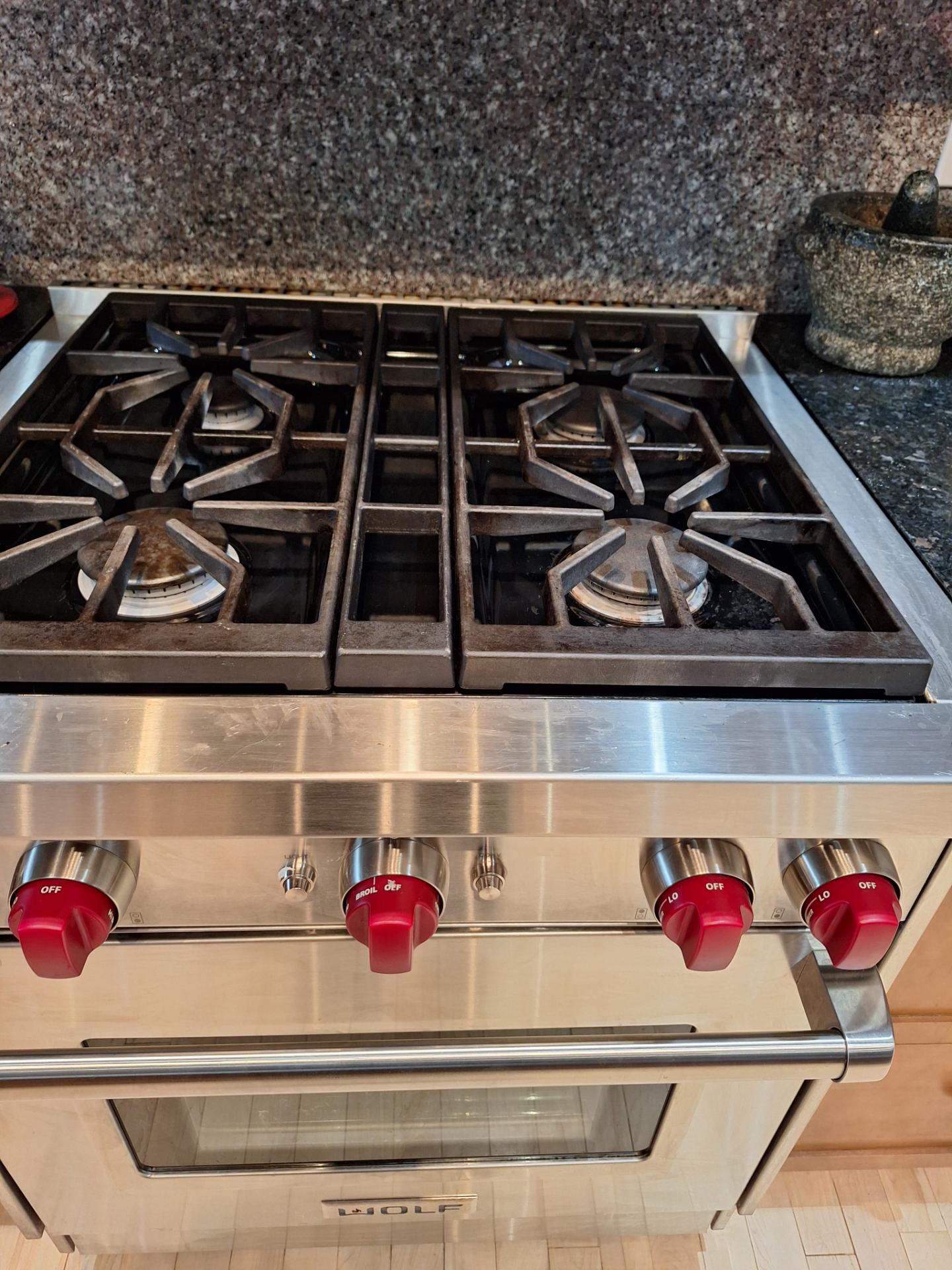
A homeowner in the Altadore / Marda Loop area of inner SW Calgary contacted TechVill about their Wolf GR304 30-inch gas range: two of the four burners would no longer light in simmer mode, producing only a repeated clicking sound. On a professional-style range like the GR304, that symptom is unusually informative — and it shaped a diagnosis built around a single, decisive isolation test rather than a guess.
Why this symptom narrows the fault
Before touching the range, the reported behaviour already ruled out several possibilities.
The clicking sound is the spark ignitor firing. If it clicks, the electronic ignition circuit for those positions is at least partly alive — so a dead ignition module was unlikely. The fault appeared specifically in simmer mode, which delivers the lowest gas flow of any burner setting; a burner that lights on high but fails at simmer points to a marginal gas-delivery problem, not a total no-gas condition. And only two of four burners were affected, which rules out a whole-range issue: the gas supply to the appliance and the overall ignition system were both fine.
That left a short list: grease or debris choking the low simmer flow, a spark electrode out of position, a failing burner assembly, or position-specific wiring and electronics. Each carries a very different repair scope and cost, so the goal of the visit was to isolate which one was actually in play.
How TechVill technician Alex isolated it
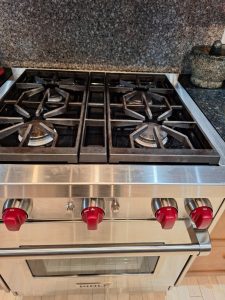
Step 1 — Clean first, to rule out the simple cause. Alex dismounted the affected burners and cleaned them, clearing any grease or debris that can block gas flow at the low simmer rate. The burners were reassembled and tested. There was no change — simmer ignition still failed. That eliminated the cheapest, most common cause outright.
Step 2 — Swap a burner to a known-good position. This is the test that settled the diagnosis. Alex took one of the suspect burners from a right-side position and ran it in a left-side position that was working normally. The burner lit and held its flame in the good position. The logic is straightforward: if the fault followed the burner, the burner is the problem; if the fault stayed with the position, the wiring, valve, or electronics for that location would be at fault. Here, the burner carried its fault with it — confirming the burner assemblies themselves were failing, not the positions they sat in.
Step 3 — Set the repair scope, with a contingency stated up front. The swap result confirmed that replacing the two failing burner assemblies was the correct scope — not the ignition module, and not position-specific electronics, either of which a less rigorous “replace and see” approach might have ordered. Alex walked the homeowner through the finding and was explicit that additional parts could be required if the install uncovered further issues, so the customer knew before approving that the scope might be refined. The customer approved the repair on that basis. Total diagnostic time on site: about 30 minutes.
The parts and the plan
With the fault isolated, the two Wolf burner assemblies were ordered through the manufacturer’s OEM service-parts channel. The GR304 uses different burner variants at different positions, which is why the two assemblies carry separate part numbers:
- Wolf burner assembly (part #809704) — burner module for one position/output variant; delivers and ignites gas across the full low-simmer-to-high flame range
- Wolf burner assembly (part #809706) — burner module for the differing position/output variant on the second affected burner
At the install visit, both assemblies are fitted, ignition is verified across every flame setting from simmer through high on both repaired positions, flame stability is confirmed under an extended run, and a post-installation gas-leak safety check is performed. If the contingency surfaces during the install, the customer is re-quoted before any further work proceeds. The completed repair carries TechVill’s 90-day labour warranty.
What the repair cost
The repair was quoted and approved at $825 CAD plus 5% GST ($866.25 total): $470 for the two burner assemblies, $30 parts handling, and $325 labour. The billing was split so the homeowner prepaid the parts to release the order and paid labour at completion — no advance labour charge.
The takeaway
The value here wasn’t the part swap — it was knowing exactly which part to swap. A burner that fails only in simmer can look identical to an ignition or electronics fault, and ordering the wrong assembly means a wasted visit and a second bill. Cleaning ruled out the easy cause; the burner-swap test proved where the fault lived; the contingency disclosure kept expectations honest. For a $5,000-plus professional range, that discipline is the difference between one correct repair and several attempts.
Genuine Wolf OEM burner assemblies matter on a range like this: simmer ignition depends on tightly toleranced gas-port and electrode geometry, and aftermarket substitutes that miss those tolerances can reintroduce the exact low-flow ignition fault the repair was meant to cure.
TechVill repairs Wolf gas ranges across Calgary and surrounding areas, arriving with the test approach to isolate a fault to the right component and access to genuine OEM parts. Book online to schedule a Wolf gas range diagnostic with our team.